Guitar Action Height Calculator: Free Tool
Free guitar action height calculator for acoustic, electric, and bass guitars. Get instant personalized string height recommendations based on your playing style. Calculate ideal action at 12th fret in mm or inches.
🎸 String Height Calculator
Get personalized action height recommendations for your guitar
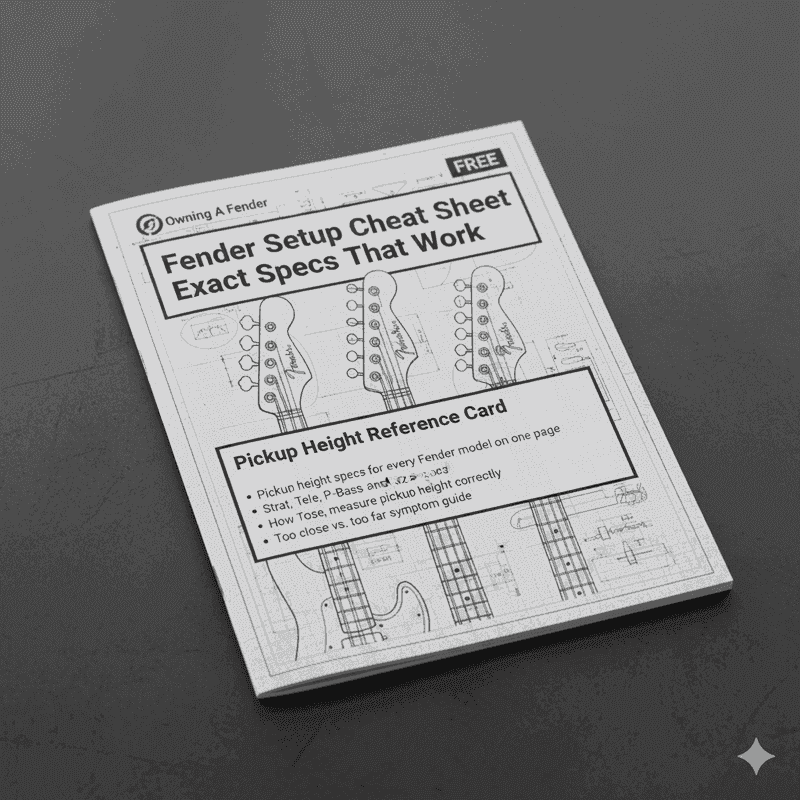
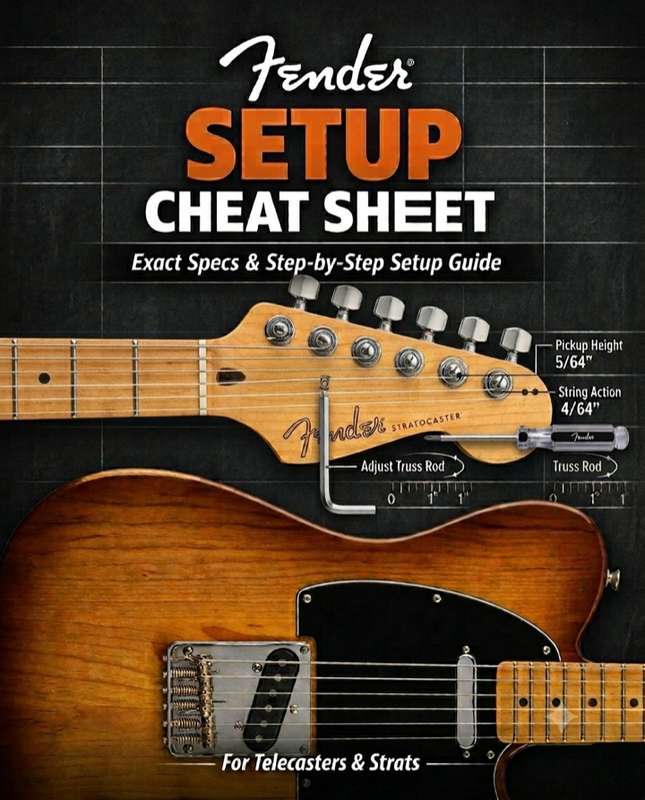
Skip the $150+ shop setup. Get exact Fender specs, step-by-step adjustment guides, and printable reference cards—do it yourself in 30 minutes:
Free Guitar Action Height Calculator: Get Perfect String Height for Your Playing Style
Finding the perfect action height for your guitar is crucial for playability, tone, and comfort. Our free guitar action height calculator provides instant, personalized recommendations based on your guitar type, playing style, and current measurements. Whether you're setting up an acoustic, electric, or bass guitar, this tool eliminates the guesswork from action adjustment.
Quick Answer: The ideal action height at the 12th fret varies by guitar type and playing style. For electric guitars, typical action ranges from 1.6mm-2.4mm (4/64"-6/64") on the treble side. Acoustic guitars generally need higher action: 2.0mm-2.8mm (5/64"-7/64"). Use our calculator below to get precise recommendations for your specific setup.
Why Accurate Action Height Matters
Guitar action height—the distance between your strings and frets at the 12th fret—directly affects:
- Playability: Lower action requires less finger pressure, enabling faster playing and easier bending
- Tone Quality: Proper action balances clean tone with resonance and sustain
- Fret Buzz Prevention: Action that's too low causes annoying buzzing and dead notes
- Playing Comfort: Correctly set action reduces hand fatigue during long practice sessions
Many guitarists struggle with action that's either too high (causing finger fatigue) or too low (causing fret buzz). This calculator provides science-based recommendations tailored to your specific guitar and playing style.
How to Use the Action Height Calculator
Step 1: Measure Your Current Action
Before using the calculator, you'll need to measure your current string height at the 12th fret:
- Tune and position the instrument: Tune to your usual pitch and hold it in playing position. Leave the strings open, without fretting them or fitting a capo.
- Measure the gap: Using a string height gauge or precision ruler, measure the distance between the bottom of the string and the top of the 12th fret
- Record measurements: Measure the highest-pitched and lowest-pitched strings. These are the two E strings on a standard six-string guitar, or G and E on a standard four-string bass.
- Keep the reference consistent: These calculator starting points use open strings measured at the 12th fret. Do not substitute measurements from another fret or a fretted neck-relief check.
 Buy on Amazon
Step 2: Select Your Guitar Type and Playing Style
The calculator needs to know:
- Guitar Type: Acoustic, electric, or bass
- Playing Style: How you primarily use your guitar (fingerstyle, rhythm, lead, blues, etc.)
- Measurement Units: Choose between metric (millimeters) or imperial (64ths of an inch)
Step 3: Get Your Personalized Recommendations
The calculator analyzes your inputs and provides:
- Color-coded status indicators (perfect, acceptable, too low, too high)
- Exact target measurements for your setup
- Specific adjustment amounts needed
- Direction of adjustment (raise or lower)
Essential Tools for Measuring and Adjusting Action
Measurement Tools
String Height Gauge (Most Accurate)
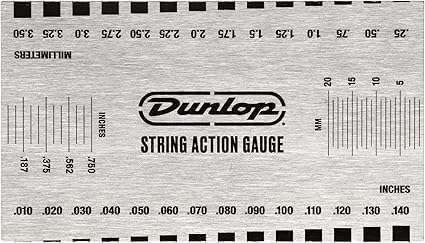
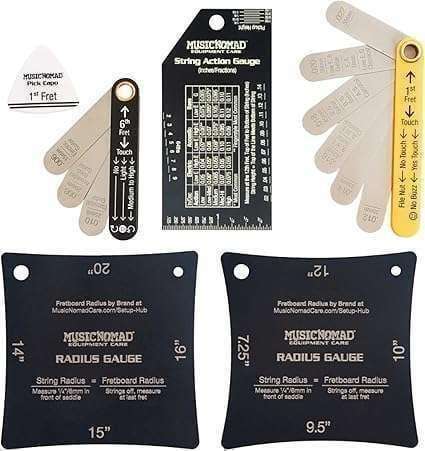
A dedicated string height gauge provides the most precise measurements. The Jim Dunlop String Height Gauge is the industry standard, offering clear readings in both imperial and metric units.
Alternative Measurement Methods:
- Precision ruler with 1/64" or 0.5mm increments
- Feeler gauges (less convenient but accurate)
- Digital calipers (overkill but extremely precise)
Adjustment Tools
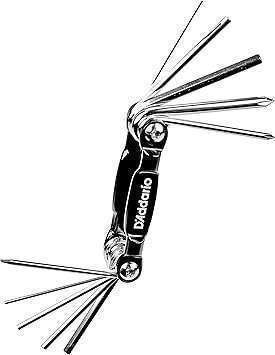
For Saddle Adjustment:
- Allen wrenches (hex keys) in various sizes
- Small screwdrivers (Phillips and flathead)
- D'Addario Multi-Tool combines everything you need
For Truss Rod Adjustment (if needed):
- Truss rod wrench specific to your guitar
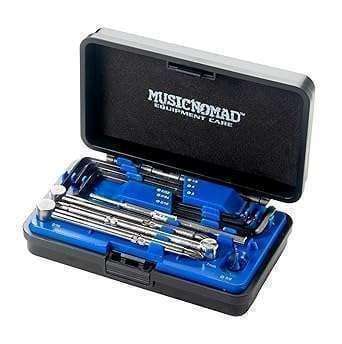
- MusicNomad Truss Rod Wrench Set covers most guitars
Understanding Action Height Recommendations
Acoustic Guitars
Acoustic guitars require higher action than electrics due to:
- Greater string vibration amplitude (louder, more dynamic playing)
- Heavier string gauges creating more tension
- Need to prevent buzzing on aggressive strumming
Typical Acoustic Action (at 12th fret):
- Fingerstyle: Treble 2.0mm (5/64"), Bass 2.4mm (6/64")
- Rhythm/Strumming: Treble 2.4mm (6/64"), Bass 2.8mm (7/64")
- Bluegrass/Heavy: Treble 2.8mm (7/64"), Bass 3.2mm (8/64")
Electric Guitars
Electric guitars can have lower action because:
- Lighter string gauges with less tension
- Magnetic pickups amplify string vibration
- Players often need fast, precise fretting
Typical Electric Action (at 12th fret):
- Lead/Shred: Treble 1.6mm (4/64"), Bass 2.0mm (5/64")
- Rhythm/General: Treble 2.0mm (5/64"), Bass 2.4mm (6/64")
- Blues/Bending: Treble 1.6mm (4/64"), Bass 2.0mm (5/64")
Bass Guitars
Bass guitars need moderate-to-high action due to:
- Heavy, thick strings with wide vibration
- Low frequencies requiring more clearance
- Playing techniques (slap, pop) creating aggressive string movement
Typical Bass Action (at 12th fret):
- Fingerstyle: Treble 2.4mm (6/64"), Bass 2.8mm (7/64")
- Slap/Pop: Treble 2.0mm (5/64"), Bass 2.4mm (6/64")
- Pick/Rock: Treble 2.8mm (7/64"), Bass 3.2mm (8/64")
Common Action Problems and Solutions
Problem: Fret Buzz on Multiple Strings
Diagnosis: Action is too low for your playing style or string gauge
Solution:
- Use the calculator to determine ideal height
- Raise bridge saddles incrementally (1/32" or 0.4mm at a time)
- Check relief and intonation after adjustment
Problem: Strings Feel Stiff and Hard to Press
Diagnosis: Action is too high
Solution:
- Calculate target action height
- Lower saddles gradually
- Ensure neck relief is properly set
- Consider lighter string gauge if problems persist
Problem: Buzz Only on Lower Frets
Diagnosis: Insufficient neck relief (too straight or back-bowed)
Solution:
- Check neck relief (should be 0.010" at 8th fret)
- Adjust truss rod before adjusting action
- See our complete truss rod adjustment guide
Problem: High Action After String Gauge Change
Diagnosis: Different string tension requires action adjustment
Solution:
- Heavier strings = more tension = may need higher action
- Lighter strings = less tension = can usually handle lower action
- Use calculator to find new ideal height for your gauge
Step-by-Step Action Adjustment Guide
For Most Electric Guitars (Tune-O-Matic, Hardtail, Strat-Style)
- Tune guitar to pitch - Action measurements are only accurate at proper tension
- Measure current action at 12th fret on both E strings
- Use calculator to determine target height
- Adjust bridge saddles with Allen wrench or screwdriver:
- Clockwise rotation = lowers action
- Counter-clockwise = raises action
- Make small adjustments (1/4 turn at a time)
- Re-measure and repeat until reaching target
- Check intonation and adjust if needed
For Acoustic Guitars
- Measure at nut (optional but recommended)
- Measure at 12th fret on both E strings
- Calculate target action
- Saddle adjustment:
- If too high: Sand bottom of saddle carefully
- If too low: Add shims under saddle or replace with taller saddle
- Professional help recommended for major saddle work
- Re-check measurements after any adjustment
For Bass Guitars
- Check string gauge - Heavier strings need more clearance
- Measure current action at 12th fret
- Use calculator for target height
- Adjust bridge saddles (similar to electric guitar process)
- Pay special attention to E and A strings - They vibrate widest
- Test with aggressive playing to ensure no buzz
- Fine-tune each string individually
After Adjusting Action: What Else to Check
1. Neck Relief
Action and relief work together. After action adjustment:
- Check relief at 8th fret (should be ~0.010" or 0.25mm)
- Adjust truss rod if needed
- Re-check action after relief changes
2. Intonation
Changing action affects intonation:
- Check 12th fret harmonic vs. fretted note
- Adjust saddle position forward or back
- Use electronic tuner for precision
3. Nut Height
Low nut slots can cause buzzing even with proper action:
- Check string height at 1st fret
- Should be just barely clearing the fret
- Nut work requires specialized tools
4. Fret Condition
Worn or uneven frets affect playability:
- Look for divots or wear under strings
- Check for high frets using fret rocker
- Consider professional fret leveling if needed
Action Height and String Gauge Relationship
The calculator's recommendations assume standard string gauges:
Electric Guitar:
- Extra Light: .009-.042
- Light: .010-.046
- Medium: .011-.049
Acoustic Guitar:
- Light: .012-.053
- Medium: .013-.056
- Heavy: .014-.059
If using non-standard gauges:
- Heavier strings: Add 0.2-0.4mm (1-2/64") to recommended action
- Lighter strings: Can reduce action by 0.2-0.4mm (1-2/64")
- Custom sets: Adjust based on thickest wound strings
Frequently Asked Questions
How low can I set my action before getting fret buzz?
It depends on your playing style, string gauge, and neck relief. The calculator provides the lowest safe action for your setup. Going lower than "minimum" recommendations will likely cause buzz.
Do I need to adjust my truss rod when changing action?
Not always. Adjust action first, then check if neck relief needs correction. The truss rod controls neck bow, not action height directly. See our truss rod adjustment guide for details.
Why do my high and low strings have different action heights?
Strings vibrate in wider arcs as they get thicker. Bass strings need more clearance to prevent buzz. This is why recommended action increases from treble to bass side.
Can action be too low even without fret buzz?
Yes. Extremely low action can cause weak sustain, thin tone, and poor intonation. There's a sweet spot between playability and tone quality.
Should action be the same across all 6 strings?
No. Action typically increases gradually from treble to bass side. Most guitars have individually adjustable saddles for this reason.
How often should I check my action?
Check action:
- After changing string gauges
- When changing tunings frequently
- If you notice playability changes
- During seasonal humidity changes (especially acoustics)
- At least once per year during routine setup
Related Guitar Setup Resources
Complete Setup Guides
- Guitar Action Height: Complete Setup Guide - In-depth action adjustment tutorial
- Guitar Truss Rod Adjustment Guide - Neck relief and bow adjustment
- Guitar String Gauges: Complete Guide - How string thickness affects setup
Model-Specific Setup Guides
- Stratocaster Setup Guide - Complete Strat setup including tremolo
- Telecaster Setup Guide - Tele-specific action and intonation
- Acoustic Guitar Setup Guide - Acoustic action, saddle, and nut work
Tools and Specifications
- Setup Specs Lookup Tool - Factory specifications for your guitar model
- String Gauge Recommendation Tool - Get a personalized string gauge and top string set picks (string choice affects action)
- Best Acoustic Guitar Strings - String selection affects required action
Conclusion: Dial In Your Perfect Action
The right action height transforms your guitar from fighting against you to working with you. Use our calculator to find your ideal setup, make small adjustments, and keep testing until it feels right. Remember:
- Start with calculator recommendations as your baseline
- Make incremental adjustments (small changes add up)
- Test thoroughly across all frets and playing styles
- Don't fear experimentation - you can always go back
- Consider professional setup if you're unsure
Perfect action is personal—what works for one player might not work for another. Use this calculator as your starting point, then fine-tune based on your feel and playing style.