Ultimate Fender Stratocaster Setup Guide: Exact Specs
Fender Stratocaster setup specs and steps: 4/64" (1.6mm) string height at the 17th fret, 0.25mm neck relief, pickup heights, tremolo balance, and intonation.
By Nick TheodoulouUpdated

Quick answer · Fender factory specs
Stratocaster, 9.5" to 12" radius
- String height at the 17th fret
- 4/64" (1.6 mm)
- Neck relief at the 8th fret
- .010" (0.25 mm)
From Fender's published chart. Other radii and pickup heights are on the full chart.See every Stratocaster factory spec →
Your Stratocaster setup0 of 5 done
Let the neck settle before you set the string height
A bigger truss rod change keeps moving for hours, so pros leave it overnight. Re-measure the relief tomorrow, then carry on.
Your ticks are saved on this device.
On this page
- The Ultimate Fender Stratocaster Setup Guide: String Height, Pickup Height & Tremolo Balance
- Part 1: Understanding Stratocaster String Height (Action)
- Part 2: Adjusting String Height on a Stratocaster
- Part 3: The Impact of Stratocaster Pickup Height
- Part 4: Comprehensive Stratocaster Setup: Truss Rod & Intonation
- Part 5: Tailoring Your Stratocaster's Setup
- Part 6: Advanced Setup Considerations
- Part 7: Stratocaster Maintenance and Care
- Perfect Stratocaster Setup
- Quick Reference: Stratocaster Setup Specifications
- Conclusion
- Frequently Asked Questions (FAQ)
- Related Posts
The Ultimate Fender Stratocaster Setup Guide: String Height, Pickup Height & Tremolo Balance
Last updated: October 19, 2026. String height and relief aligned with Fender's published Stratocaster chart (measured at the 17th fret).
Quick Answer: Fender's spec for a 9.5"–12" radius Stratocaster is 4/64" (1.6 mm) string height on both outer strings at the 17th fret (5/64" bass on a vintage 7.25" radius), a neck relief of about 0.25 mm at the 8th fret, pickups set to 2.4 mm (bass side) / 2.0 mm (treble side) on the neck and middle and 2.0 mm / 1.6 mm on the bridge, and a tremolo bridge balanced for stable return to pitch. Most Strat buzz is fixed by small relief and saddle tweaks rather than major hardware changes.
The Fender Stratocaster, renowned for its versatility and iconic tone, is a staple in the arsenal of guitarists across genres. Achieving the perfect setup is crucial for optimizing playability and unlocking the full sonic potential of this legendary instrument. This comprehensive guide will walk you through the process of setting up your Stratocaster, focusing on essential aspects like string height, pickup height, and overall guitar adjustments to ensure top-notch performance.
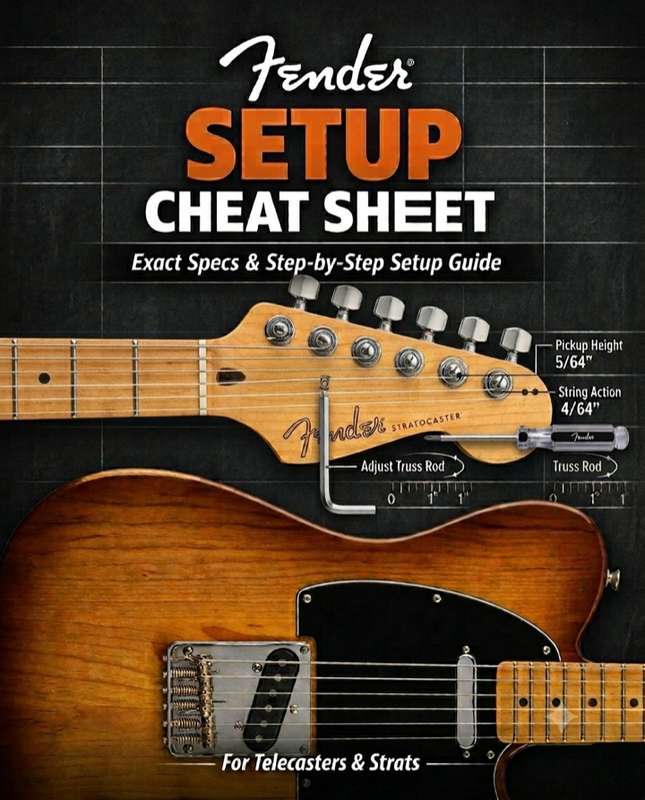
Part 1: Understanding Stratocaster String Height (Action)
Stratocaster string height (action) is the distance between the bottom of the string and the top of the fret. Fender measures it at the 17th fret: 4/64" (1.6 mm) on both outer strings for a 9.5"–12" radius, 5/64" (2 mm) bass / 4/64" (1.6 mm) treble for a vintage 7.25" radius, and 4/64" / 3/64" for a flat 15"–17" radius. These are minimum specs for factory strings; raise them a little for a heavy touch.
Full chart: our Fender Stratocaster factory setup specs page has Fender's action, relief and pickup-height tables by radius and pickup type, with how to measure each one.
🧮 Calculate Your Ideal Action: Not sure if your current setup is optimal? Use our free Action Height Calculator to get personalized recommendations based on your playing style.
🛠️ Building a DIY kit? Our DIY guitar kit setup guide covers kit-specific pitfalls — rough frets, high nuts, and bridge alignment — with exact specs for Strat and Tele-style kits.
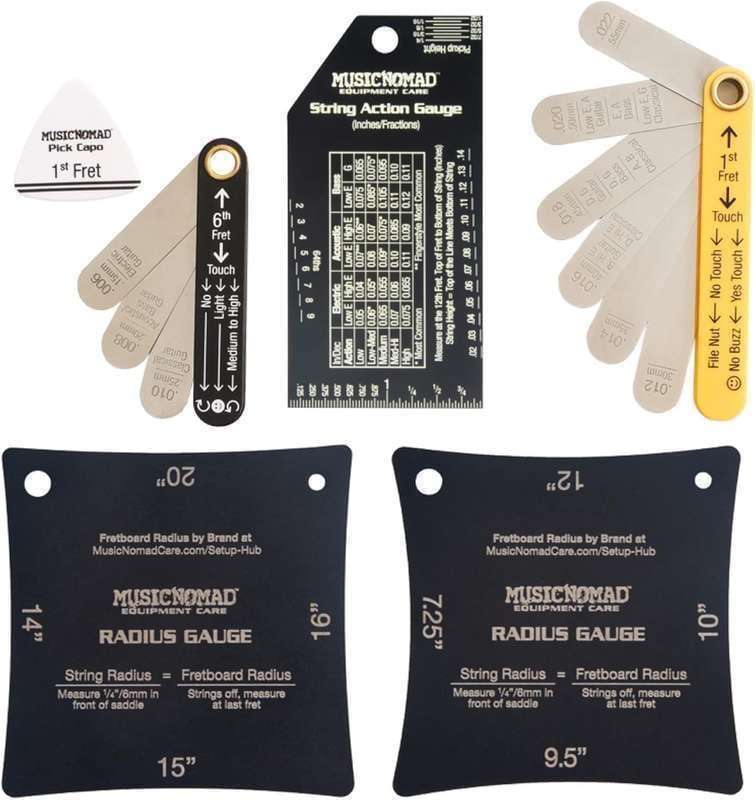
Essential Stratocaster Setup Tools
 Buy on Amazon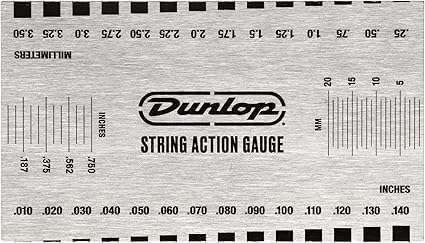
Which Tool Do You Need for Each Adjustment?
Every step in this guide pairs one measuring job with one turning job. This table maps each adjustment to the exact tool, so you can buy once and skip whatever you already own.
| Adjustment (guide part) | What you measure or turn | The tool for the job |
|---|---|---|
| Measure action at the 17th fret (Parts 1–2) | String-to-fret distance in mm | String action gauge (Dunlop System 65) |
| Check neck relief at the 8th fret (Part 4) | Gap under the string, about 0.25 mm | Truss rod gauge / feeler gauge |
| Measure pickup height (Part 3) | Pole piece to string, pressed at the last fret | Pickup height gauge |
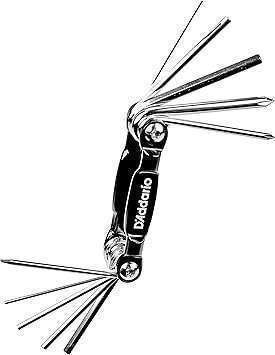
| Turn the saddle height screws (Part 2) | Two small hex screws per saddle | D'Addario Multi-Tool (hex keys and screwdrivers) |
| Adjust the truss rod (Part 4) | Hex nut at the headstock | Correctly sized truss rod wrench (MusicNomad MN235 set) |
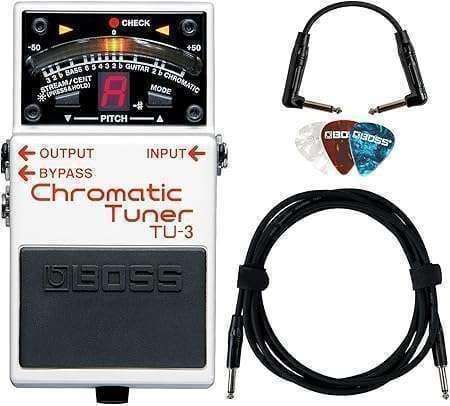
| Set intonation (Part 4) | Fretted 12th-fret note against the harmonic | Accurate chromatic tuner (Boss TU-3) |
The three measuring jobs are all covered by the MusicNomad MN604 setup gauge set, so one purchase handles every measurement in this guide — you add a multi-tool, a correctly sized truss-rod wrench, and a tuner for the turning jobs. If you only plan to set action, the standalone Dunlop System 65 gauge is the cheaper single-tool buy.
Part 2: Adjusting String Height on a Stratocaster
Measuring action height at the 17th fret - Fender's spec is 4/64" (1.6 mm) on a 9.5" radius.
Adjust Stratocaster string height by turning the bridge saddle screws with an Allen wrench. Clockwise raises, counterclockwise lowers. Always retune after adjustments.
The Stratocaster features a tremolo bridge with individual saddle adjustments, allowing precise control over each string's height. Follow these steps:
- Detune strings slightly — Reduces tension on saddles for easier adjustment
- Use an Allen wrench — A D'Addario Multi-Tool works well
- Turn saddle screws — Clockwise raises, counterclockwise lowers
- Retune and measure — Check action at the 17th fret after each adjustment
- Balance comfort and clarity — Prevent fret buzz while maintaining playability
▶ Watch: Fender Stratocaster Full Setup
This video walks through the same string-height, pickup-height, and tremolo-balance process covered below:
Click the thumbnail below to watch the full setup video on YouTube:
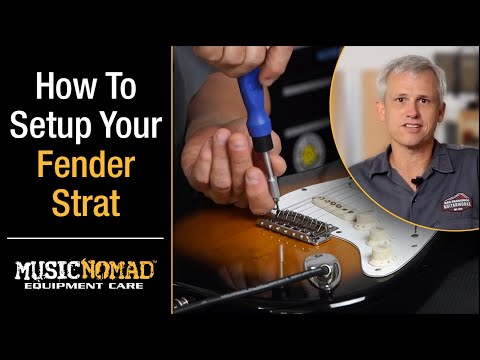
 Photo by Richard Khuptong on Unsplash
🎸 Looking for your first or next Strat? Check out our Best Stratocasters Under $500 guide with detailed comparisons. Own a Strat? Use Factory Specs Lookup to compare against factory specs, find your serial with the Fender serial number lookup, or add to My Garage to track maintenance.
Part 3: The Impact of Stratocaster Pickup Height
Stratocaster pickup height affects tone and volume. Standard measurements vary by pickup position. Neck and middle: 2.4mm (bass) and 2.0mm (treble). Bridge: 2.0mm (bass) and 1.6mm (treble).
Pickup height significantly influences your guitar's tone and output level. The proximity of pickups to strings affects sustain, clarity, and overall volume.
Stratocaster Pickup Height Specifications
| Pickup | Bass Side | Treble Side |
|---|---|---|
| Neck Pickup | 2.4mm (3/32") | 2.0mm (5/64") |
| Middle Pickup | 2.4mm (3/32") | 2.0mm (5/64") |
| Bridge Pickup | 2.0mm (5/64") | 1.6mm (1/16") |
Note: Measurements are taken from the bottom of the string to the top of the pickup pole piece, with the string pressed at the last fret.
These factory specifications are your starting point, but dialing in the perfect setup often requires reference materials you can keep handy while working on your guitar.
| Pickup type | Bass side | Treble side |
|---|---|---|
| Vintage style | 2.4mm (6/64") | 2.0mm (5/64") |
| Standard single-coils | 2.0mm (5/64") | 1.6mm (4/64") |
How to Adjust Pickup Height
- Locate adjustment screws — Found on either side of each pickup
- Adjust height — Turn clockwise to lower, counterclockwise to raise. Use a Jim Dunlop String Height Gauge for precision
- Test sound — Play through an amplifier to assess tonal changes
- Balance output — Ensure consistent volume and tone across all pickups
Warning: Raising pickups too close can cause magnetic pull on strings, affecting intonation and sustain. For a complete guide, see our Stratocaster Pickup Height Adjustment Guide.
 Photo by Cyprien Da Silva on Unsplash
Part 4: Comprehensive Stratocaster Setup: Truss Rod & Intonation
A complete Stratocaster setup includes truss rod adjustment, intonation, and nut height. These adjustments work together to optimize playability and tone.
A thorough Stratocaster setup goes beyond string and pickup height. The most critical step usually missed is the neck relief.
Step 1: Checking Neck Relief (Truss Rod)
Before you touch your action height, you must set your neck relief. If your neck is bowed, lowering your saddles won't fix the action—it will just cause buzzing.
Checking neck relief at the 8th fret while capping the 1st and last fret.
How to check:
- Capo the 1st fret.
- Press the low E string down at the last fret (where the neck meets the body).
- Use a .010" (0.25mm) feeler gauge to check the gap between the string and the top of the 8th fret.
- The gauge should slide in with a tiny bit of friction.
Step 2: Adjusting the Truss Rod
If the gap is too large (too much relief), or the string is touching the fret (backbow), you need to adjust the truss rod.
Adjusting the truss rod at the headstock. Remember: "Righty – Tighty" (Straightens neck/Reduces relief).
The adjustment rule:
- Gap too big? Turn clockwise (tighten) to straighten the neck.
- No gap/buzzing? Turn counter-clockwise (loosen) to add relief.
- Go slow: Only turn 1/8th of a turn at a time. Let the neck settle for a few minutes, then check again.
Step 3: Intonation and Nut Height
Use the free guitar intonation checker with your tuner to find saddle direction, record all six strings, and print your checklist. Retune after each adjustment and make a final pass with your tremolo settled.
Once relief and action are set:
- Intonation setting — Adjust saddle positions so each string plays in tune. Use a precise tuner like the Boss TU-3 Chromatic Tuner
- Nut height adjustment — Proper nut slot depth enhances playability, particularly for open chords
Part 5: Tailoring Your Stratocaster's Setup
Fine-tune your Stratocaster by adjusting tremolo bridge (floating vs decked), pickup pole pieces, and string gauge. Each affects tone, playability, and tuning stability.
Tremolo Bridge Setup: Floating vs Decked
| Setup Type | Bridge Position | Best For | Tuning Stability |
|---|---|---|---|
| Floating | Parallel to body | Pitch bending effects | Lower |
| Decked | Flush against body | Maximum tuning stability | Higher |
For a deep dive including spring balancing and precise bridge angle targets, see our guide: Stratocaster Tremolo Setup — Float vs Decked.
Additional Adjustments
- Pickup pole piece adjustment — Fine-tune individual string output (if pickups allow)
- String gauge selection — Heavier strings offer richer tone and sustain; lighter strings facilitate bending and fast playing
Part 6: Advanced Setup Considerations
Advanced players can customize tremolo spring tension, action for specific genres, and experiment with string types and gauges to refine their playing experience.
For experienced players, advanced customization options include:
- Tremolo spring adjustment — Balance tension between springs and strings for optimal tremolo action
- Action customization — Adjust action for specific techniques (slide guitar, aggressive strumming)
- Electronics upgrade — Consider high-quality pots, switches, and wiring for improved tone
- String experimentation — Try different types and gauges
Part 7: Stratocaster Maintenance and Care
 Photo by Simon Weisser on Unsplash
Regular maintenance includes cleaning, string changes, and periodic setup checks. Control humidity and temperature to preserve your Stratocaster's quality and longevity.
Maintaining your Stratocaster ensures longevity and consistent performance. Key practices include:
- Regular cleaning — Wipe down after playing to remove sweat and oils that can corrode hardware
- Periodic string changes — Fresh strings enhance tone and playability
- Climate control — Protect from extreme temperatures and humidity. Use a D'Addario Humidipak to control humidity levels
- Professional setup — Periodically have your guitar checked by a professional technician
- Safe shipping — If you need to ship your guitar, follow our Fender Shipping Setup Guide to prevent damage.
Stratocaster Care Gear
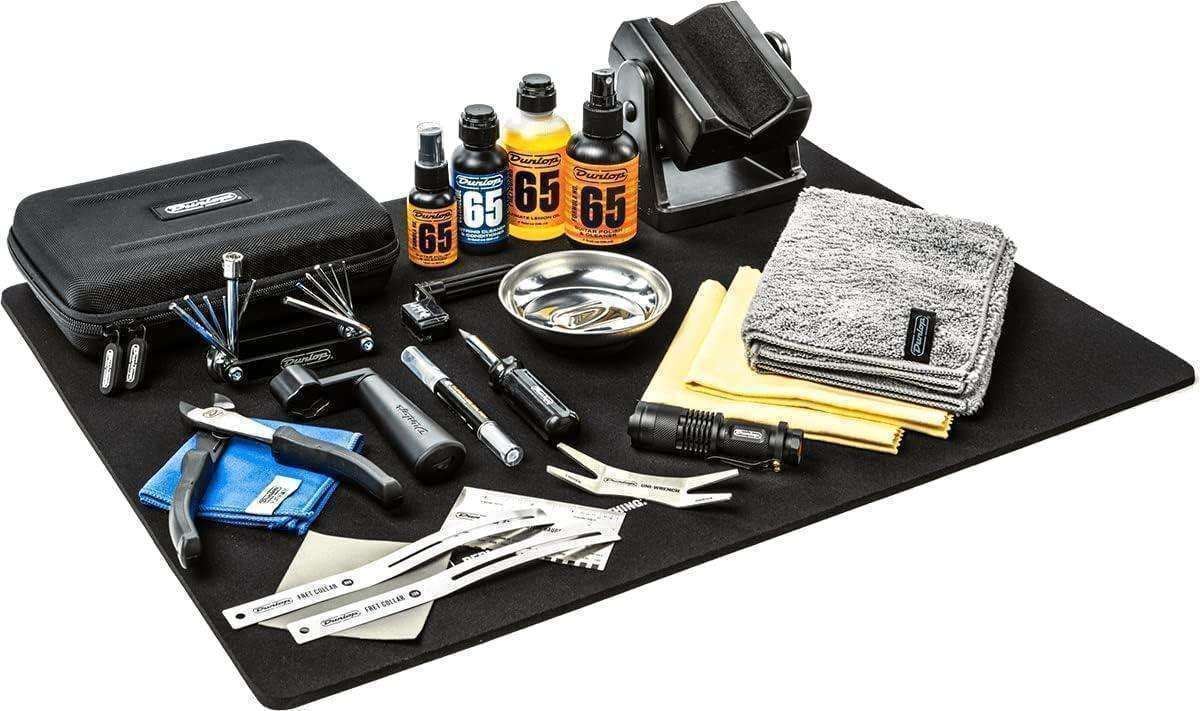

For eco-friendly maintenance tips, explore our Eco-Friendly Fender Guitar Care Article.
Perfect Stratocaster Setup
Ready to apply these techniques to your own Stratocaster?
 Photo by Federico Telesca on Unsplash
Ready to take your setup to the next level? Having all these specifications and troubleshooting steps in one printable reference makes the entire process smoother and faster.
Quick Reference: Stratocaster Setup Specifications
| Component | Standard Measurement |
|---|---|
| String Height (Action) | 4/64" (1.6mm) both sides at 17th fret (9.5"–12" radius); see the factory specs |
| Neck Pickup Height | Bass: 2.4mm, Treble: 2.0mm |
| Middle Pickup Height | Bass: 2.4mm, Treble: 2.0mm |
| Bridge Pickup Height | Bass: 2.0mm, Treble: 1.6mm |
| Setup Frequency | Every 6-12 months |
📊 Quick Tools: Factory Specs • Action Calculator • Fender Serial Number Lookup • My Garage
Own a Squier Stratocaster?
The core process is similar, but Sonic, Affinity and Classic Vibe models benefit from series-specific tremolo and hardware guidance. See the Squier Stratocaster setup guide.
🎸 Editor's Take: My Experience with Strat Setups
"I've set up dozens of Strats over the years, from beat-up Squiers to Custom Shop relics. One thing I've learned: don't be afraid of the truss rod.
When I first started modding guitars at 15, I was terrified I'd snap the neck. But the reality is, the Stratocaster is an incredibly resilient piece of engineering. The most common issue I see isn't broken parts—it's players tolerating high action because they're afraid to turn a wrench.
In this guide, I'll walk you through the exact process I use on my own Stratocasters. We'll use the photos I took while setting up my main Strat to show you exactly what to look for."
— Nick, Editor & Tech Lead
Conclusion
A well-executed setup transforms your Stratocaster into a finely tuned instrument that responds effortlessly to your playing. By mastering string height and pickup adjustments, you unlock the full expressive potential of your guitar.
Whether you're performing on stage or practicing at home, a properly set up Stratocaster sounds better and inspires greater confidence. Equip yourself with the right tools and accessories, like the D'Addario Multi-Tool or MusicNomad String Guitar String Cleaner to ensure your guitar stays in perfect playing condition.
Wondering what your Stratocaster is worth? Try our Guitar Price Estimate.
Frequently Asked Questions (FAQ)
1. How often should I set up my Stratocaster?
Every 6 to 12 months. Frequency depends on how often you play and environmental changes. Regular setups maintain optimal playability and prevent issues from temperature and humidity fluctuations.
2. What tools do I need for a Stratocaster setup?
Essential tools include Allen wrenches, screwdrivers, string action gauge, feeler gauges (like the MusicNomad Truss Rod Wrench Set (MN235)), a reliable tuner, wire cutters, and a string winder.
3. Can I set up my Stratocaster myself, or should I take it to a professional?
Yes, many guitarists do basic setups themselves. However, if you're inexperienced with truss rod or nut adjustments, consult a professional to avoid damaging your instrument.
4. How do I adjust the tremolo bridge on my Stratocaster?
Balance string tension with tremolo springs. Remove backplate, adjust claw screws (clockwise to deck, counterclockwise to float), test bridge angle, and fine-tune spring tension as needed.
5. What's the ideal pickup height for a Stratocaster?
Standard starting point: Neck/Middle 2.4mm (bass) and 2.0mm (treble). Bridge: 2.0mm (bass) and 1.6mm (treble). Ideal height depends on your playing style and pickups. Experiment with small adjustments.
6. Why is my Stratocaster buzzing after a setup?
Fret buzz usually comes from action too low, insufficient neck relief, uneven frets, or poorly cut nut slots. Raise string height slightly, adjust truss rod for forward bow, or consult a professional for fret leveling. For a location-by-location diagnostic, see our guitar fret buzz troubleshooting guide.
7. How does string gauge affect my Stratocaster's setup?
String gauge changes neck and tremolo tension. Heavier strings increase tension (may need truss rod and spring adjustments). Lighter strings decrease tension (may lower action). Always recheck setup when changing gauges.
8. Should I adjust the truss rod myself?
Yes, minor adjustments are safe. Measure neck relief at the 8th fret with a feeler gauge. Make small adjustments (no more than 1/8 turn at a time). Clockwise reduces relief, counterclockwise increases it. If unsure, seek professional help.
9. What is intonation, and why is it important?
Intonation ensures your guitar plays in tune across the entire fretboard. If off, notes sound sharp or flat higher up the neck. Adjust saddle positions to correct. Use a precise tuner like the Boss TU-3 Chromatic Tuner for accuracy.
10. How can I improve my Stratocaster's tuning stability?
Stretch new strings after installing, lubricate nut slots with graphite, consider locking tuners, and deck the tremolo by setting the bridge flush against the body.
11. What tuner should I use for setting up my Stratocaster?
Use a high-accuracy chromatic tuner. The Boss TU-3 Chromatic Tuner is excellent for intonation and regular tuning. It provides precise readings trusted by professionals.
12. What is the best string gauge for a Stratocaster?
A 9–42 or 10–46 set is the standard starting point. Lighter gauges feel easier to bend and put less tension on the tremolo; heavier gauges add fullness and stability but may require truss-rod and spring adjustments. Use the gauge that matches your tuning, playing style, and the tone you want.
13. How high should a Stratocaster bridge be?
For a decked tremolo, the bridge plate sits flush on the body. For a floating tremolo, the back of the bridge plate is typically raised 1/8 to 3/16 inch (3–5 mm) off the body. The height affects action, tremolo range, and tuning stability, so set it before you fine-tune individual saddle heights.
14. Should I float or deck my Stratocaster tremolo?
Deck the tremolo if you want maximum tuning stability and use the bar rarely. Float it if you want upward pitch movement and vibrato. Many players compromise with a slight float (one to two pull-ups) to keep reasonable stability while keeping some shimmer.
15. Where can I get a Fender Stratocaster setup PDF?
The Fender Setup Cheat Sheet is a printable PDF with every Stratocaster measurement on one card: string height, neck relief, pickup height, tremolo spring balance, and intonation. It covers the current American Professional II, Player, and Vintera models with per-model spec tables, so you can keep it on your workbench while you work.
 Photo by Willian West on Unsplash
Related Posts
Stratocaster-Specific Guides
- Stratocaster Tremolo Setup Guide — Detailed tremolo system configuration
- Best Strings for Stratocaster — Complete string recommendations
Universal Guitar Setup Guides
- Factory vs Custom Setup: What Matters? — Should you keep factory specs or customize?
- Guitar Action Height Guide — Perfect your string height for optimal playability
- Guitar Truss Rod Adjustment Guide — Neck relief adjustment for all guitars
Other Fender Guitar Setup Guides
- Telecaster Setup Guide — Complete Telecaster setup process
- Telecaster Truss Rod Adjustment — Neck relief adjustment techniques
- Jaguar Setup Guide — Offset guitar setup techniques
- Jazzmaster Setup Guide — Jazzmaster-specific setup procedures
- Mustang Setup Guide — Short-scale offset setup techniques
Finished your setup? Save it for next time. Open My Gear Garage, add your Strat, and record the string set and gauge. Put your measured action and relief in Notes, with units, measurement position and the date. Save the guitar, then open its card to check that the details are there.
On your next visit, open the same guitar and its Specs tab to recover those settings. Sign in to save to your account and retrieve it on another device; a guest save stays in this browser. Free accounts have room for two guitars. See the worked example if this is your first visit.
Keep reading
Next for your Stratocaster
- Same guitarFender Stratocaster Setup Specs 1962: Factory MeasurementsRead
- Same guitarFender Stratocaster Setup Specs 1965: Factory MeasurementsRead
- Same guitar1972 Fender Stratocaster Setup Specs: Factory MeasurementsRead
Everything for your Stratocaster
Open the hub