Guitar Setup Specs Lookup Tool - Specs & Starting Points
Free guitar setup specs lookup tool. Instantly find action height, pickup height, neck relief, and string gauge specs for Fender Stratocaster, Telecaster, Jazzmaster, Gibson Les Paul, Squier, and 30+ models — manufacturer-published figures where they exist, clearly-labelled starting points where they don't.
Supported brands: Fender, Gibson, Martin, Squier, Taylor, Yamaha. Selected models only; measurements may be general starting points.
Enter your guitar model above to see setup specs and starting points
Free Guitar Setup Specifications Lookup Tool
Quick Answer: Use the search tool above to find setup specifications for your guitar. Enter your guitar model (e.g., "Fender Stratocaster" or "Gibson Les Paul") to get measurements for action height, pickup height, neck relief, and recommended string gauge. Manufacturer-published figures are shown where they exist; where a maker publishes nothing, the tool says so or shows a general starting point.
Whether you're setting up a brand-new guitar, troubleshooting playability issues, or trying to return your instrument to a known baseline after experimentation, having access to reliable reference measurements is invaluable. This tool compiles setup specs from official manufacturer documentation (Fender, Gibson, and Taylor all publish figures) into one searchable database — and marks the rest honestly: Squier and Martin release no setup numbers, so their entries are labelled as starting points or "not published" rather than factory specs.
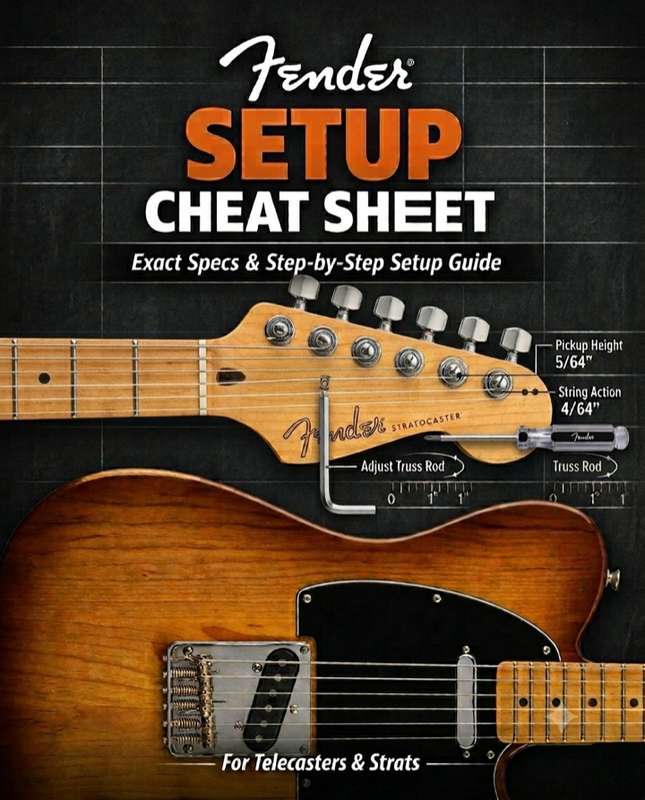
If you'd rather keep a printed reference at your workbench, the Complete Setup Collection bundles our Fender, Gibson, and Acoustic setup guides into one download at https://owningafender.com/products/complete-collection-bundle.
Why Factory Setup Specifications Matter
Every guitar leaves the factory with specific measurements that the manufacturer has determined provide optimal playability and tone for that model. These specifications are the result of decades of research, testing, and player feedback.
Benefits of Knowing Your Guitar's Factory Specs
| Benefit | Why It Matters |
|---|---|
| Proven baseline | Factory specs represent a setup that works well for most players |
| Troubleshooting reference | Compare current measurements to identify what's changed |
| Setup consistency | Maintain the same feel across multiple guitars |
| Resale value | Proper factory setup can increase used guitar value |
| Warranty compliance | Some warranties require factory-spec maintenance |
When to Use Factory Specifications
Factory specs are particularly useful when:
- Setting up a new guitar that arrived with poor playability
- After changing string gauges and needing to readjust everything
- Diagnosing fret buzz or intonation problems
- Preparing a guitar for sale (buyers expect factory specs)
- Seasonal adjustments after humidity or temperature changes
- Returning from experimentation when your DIY setup isn't working
Complete Guitar Setup Specifications Explained
Understanding what each specification means is crucial for proper guitar setup. Here's a comprehensive breakdown of every measurement in our database:
Action Height (String Height at 12th Fret)
What it is: The distance between the bottom of the string and the top of the 12th fret.
Why it matters: Action directly affects playability. Lower action means less finger pressure is needed, making fast playing easier. Higher action provides more volume, sustain, and headroom for aggressive picking.
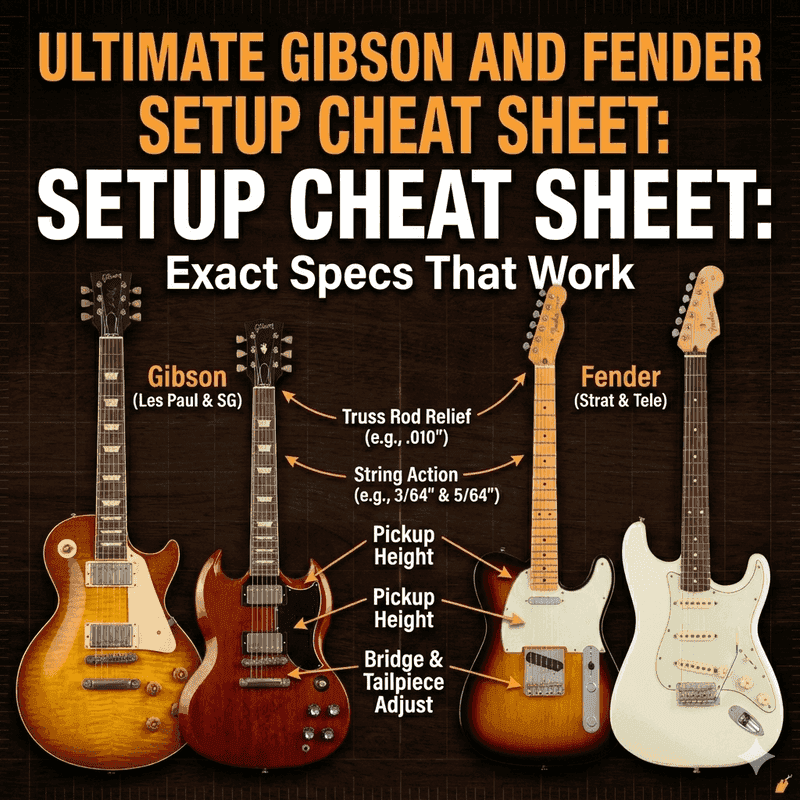
| Guitar Type | Low E String | High E String | Measurement Method |
|---|---|---|---|
| Fender Standard | 4/64" (1.6mm) | 4/64" (1.6mm) | At 12th fret |
| Gibson Standard | 5/64" (2.0mm) | 4/64" (1.5mm) | At 12th fret |
| Acoustic Standard | 7/64" (2.8mm) | 5/64" (2.0mm) | At 12th fret |
| Bass Standard | 6/64" (2.4mm) | 5/64" (2.0mm) | At 12th fret |
Pro tip: Measure action with a precision ruler or string action gauge. Many players prefer action 0.5mm lower than factory spec for easier playability, provided there's no fret buzz.
Neck Relief (Truss Rod Adjustment)
What it is: The slight forward bow in the neck, typically measured at the 8th fret while fretting the 1st and last frets simultaneously.
Why it matters: Proper neck relief allows strings to vibrate freely without buzzing against frets. Too little relief causes buzz on lower frets; too much creates high action in the middle of the neck.
| Guitar Type | Typical Relief | Measurement Location |
|---|---|---|
| Fender Electric | 0.010" (0.25mm) for 9.5"–12" radius; 0.012" (0.30mm) for 7.25" | 8th fret |
| Gibson Electric | 0.010" - 0.012" (0.25-0.30mm) | 8th fret |
| Fender Bass | 0.012" (0.30mm) for 9.5"–12" radius; 0.014" (0.35mm) for 7.25" | 8th fret |
| Acoustic | 0.010" - 0.012" (0.25-0.30mm) | 8th fret |
The Fender rows come from the radius-based relief charts in Fender's own Stratocaster, Telecaster and bass setup guides (checked September 2026). Note that Taylor acoustics use a different method entirely: .002"–.003" at the 7th fret with the string held at the 1st and 14th frets.
How to measure: Fret the 1st fret with a capo (or your finger) and the last fret with your fretting hand. Use a feeler gauge at the 8th fret to measure the gap between the string and fret crown.
Truss rod adjustment basics:
- Clockwise (tighten): Reduces relief, flattens the neck
- Counter-clockwise (loosen): Increases relief, adds bow
- Always turn in 1/8 increments and wait 24 hours for the neck to settle before measuring again
Pickup Height
What it is: The distance from the bottom of the string to the top of the pickup pole piece, measured while fretting the last fret.
Why it matters: Pickup height affects output volume, tone, and string behavior. Too close and the magnetic field pulls on strings, affecting sustain and intonation. Too far and you lose output and clarity.
| Pickup Position | Bass Side | Treble Side | Notes |
|---|---|---|---|
| Bridge (Strat/Tele) | 2.0mm (5/64") | 1.6mm (1/16") | Closer for more output |
| Middle (Strat) | 2.4mm (3/32") | 2.0mm (5/64") | Slightly further for balance |
| Neck (Strat/Tele) | 2.4mm (3/32") | 2.0mm (5/64") | Further for warmth |
| Humbucker Bridge | 2.4mm (3/32") | 1.6mm (1/16") | Adjust for balance with neck |
| Humbucker Neck | 2.8mm (7/64") | 2.0mm (5/64") | Further to avoid muddy tone |
Measuring technique: Press down the string at the highest fret. Measure from the top of the pickup pole piece to the bottom of the string using a precision ruler or pickup height gauge.
Nut Slot Depth
What it is: The depth of the grooves in the nut that hold the strings, measured as the clearance between the string and the first fret.
Why it matters: Proper nut slot depth affects open-string intonation, tuning stability, and first-position playability. Slots that are too shallow cause sharp intonation; slots too deep cause first-fret buzz.
| Guitar Type | Typical Specification |
|---|---|
| Fender Electric | 0.020" - 0.022" clearance above 1st fret |
| Gibson Electric | 0.018" - 0.020" clearance above 1st fret |
| Acoustic | 0.020" - 0.024" clearance above 1st fret |
How to check: Fret the 3rd fret and tap the string over the 1st fret. You should see/feel a small gap. If the string touches the 1st fret, the nut slot may be too deep.
Fretboard Radius
What it is: The curvature of the fretboard surface, measured as the radius of the circle that the curve would complete.
Why it matters: Fretboard radius affects chord comfort and bending range. Smaller radii (more curved) suit rhythm playing; larger radii (flatter) suit lead playing and string bending.
| Radius | Common On | Characteristics |
|---|---|---|
| 7.25" (184mm) | Vintage Fender | Very curved, comfortable chords, limited bending |
| 9.5" (241mm) | Modern Fender | Balanced for all styles |
| 10" (254mm) | Some Fender Custom Shop | Slightly flatter |
| 12" (305mm) | Gibson, many shredders | Flat, great for bending |
| 16" (406mm) | Martin acoustics | Very flat, fingerstyle friendly |
| Compound (9.5"-14") | Fender Am Pro | Best of both—curved at nut, flatter at body |
Fender Factory Specifications
Fender is one of the most documented guitar manufacturers. Here are the official specs for popular Fender models:
Fender Stratocaster Specifications
The Stratocaster has been refined over 70 years. Current factory specs reflect modern playing demands while honoring vintage roots.
American Professional II Stratocaster:
- Scale Length: 25.5" (648mm)
- Fretboard Radius: 9.5" (241mm)
- Frets: 22 narrow-tall
- Neck Relief: 0.010" (0.25mm) at the 8th fret, per Fender's radius chart
- Action: 4/64" (1.6mm) both strings at 12th fret
- Pickup Height: Bridge 2.0/1.6mm, Middle 2.4/2.0mm, Neck 2.4/2.0mm
- Tremolo Springs: 3 springs, angled
Player Series Stratocaster:
- Same 9.5" radius and 0.010" relief spec as the American Pro II
- Action may be slightly higher from factory
- Uses 3 springs, parallel configuration
→ Full Stratocaster Setup Guide
Fender Telecaster Specifications
The Telecaster's simpler design makes setup straightforward. Factory specs are nearly identical to the Stratocaster for the same series.
American Professional II Telecaster:
- Scale Length: 25.5" (648mm)
- Fretboard Radius: 9.5" (241mm)
- Neck Relief: 0.010" (0.25mm) at the 8th fret, per Fender's radius chart
- Action: 4/64" (1.6mm) at 12th fret
- Pickup Height: Bridge 2.0/1.6mm, Neck 2.4/2.0mm
Fender Jazzmaster & Jaguar Specifications
Offset guitars require special attention due to their floating tremolo and unique bridge design.
Key Differences from Standard Fenders:
- Jaguar uses 24" (610mm) scale length
- Jazzmaster uses standard 25.5" (648mm) scale
- Both benefit from slightly higher action (5/64" on low E)
- Heavier strings (.011-.049) recommended to reduce buzz on floating bridge
→ Full Jazzmaster Setup Guide → Full Jaguar Setup Guide
Gibson Factory Specifications
Gibson guitars use shorter scale length (24.75") and generally flatter fretboard radius, requiring different setup specs than Fender.
Gibson Les Paul Specifications
Les Paul Standard/Studio:
- Scale Length: 24.75" (629mm)
- Fretboard Radius: 12" (305mm)
- Neck Relief: 0.010" (0.25mm)
- Action: 5/64" (2.0mm) low E, 4/64" (1.5mm) high E
- Pickup Height: Gibson publishes no numeric factory pickup-height spec — its official pickup-height guidance is a video walkthrough with no measurements (checked September 2026). Common starting points are bridge 2.4/1.6mm and neck 2.8/2.0mm, measured with the last fret pressed
- Bridge: Tune-O-Matic with Stopbar tailpiece
Les Paul Setup Considerations:
- Shorter scale = lower string tension = slightly higher action preferred
- Stopbar tailpiece should be flush or slightly raised
- Top-wrap stringing affects sustain and tension
Gibson SG & ES-335 Specifications
These models share the same basic specifications as the Les Paul:
- 24.75" scale length
- 12" fretboard radius
- Same action and relief specs
Squier Specs & Starting Points
Squier publishes no factory setup numbers of its own. The figures below are starting points that follow Fender's published radius-based guidance, and Squier guitars may arrive with slightly wider tolerances from the factory.
Squier Classic Vibe Series
Classic Vibe Stratocaster/Telecaster:
- Scale Length: 25.5" (648mm)
- Fretboard Radius: 9.5" (241mm)
- Neck Relief: 0.010" (0.25mm)
- Action: 5/64" (2.0mm) low E, 4/64" (1.6mm) high E
- Generally arrives with slightly higher action than American Fenders
Setup tip: Classic Vibe guitars often benefit from a professional fret level and crown, after which action can be lowered to match American Fender specs.
→ Full Squier Telecaster Setup Guide
Acoustic Guitar Setup Specs — Published vs Not Published
Acoustic guitars require higher action than electrics due to the acoustic requirements of string vibration. Of the two big acoustic makers, only Taylor publishes setup measurements — Martin defers all setup specs to its authorized service centers.
Martin & Taylor Acoustic Specs
| Specification | Martin D-28 | Taylor 214ce |
|---|---|---|
| Scale Length | 25.4" (645mm) | 25.5" (648mm) |
| Fretboard Radius | 16" (406mm) | 15" (381mm) |
| Action (12th fret) | Not published by Martin — see an authorized service center | Not published by Taylor — action is set by NT neck angle and saddle height (factory saddle sits 1/8" above the bridge on the bass end, 1/16" on the treble end) |
| Neck Relief | Not published by Martin — see an authorized service center | 0.002" - 0.003" (0.05-0.08mm) at the 7th fret, string held at the 1st and 14th frets |
| Recommended Strings | .013-.056 Medium (factory-installed) | .012-.053 Light |
Sources: Taylor's setup assessment guide publishes the relief, nut and saddle figures above but no 12th-fret action number; Martin's FAQ defers action specifications and adjustments to authorized Martin service centers (both checked September 2026).
How to Use This Specifications Tool
Follow these steps for best results:
Step 1: Search for Your Guitar Model
Use the search box above to find your specific guitar model. Enter the brand and model name (e.g., "Fender Player Stratocaster" or "Gibson Les Paul Standard").
Step 2: Document Your Current Setup
Before making any changes, measure and record your guitar's current specifications:
- Action height at 12th fret (both strings)
- Neck relief at 8th fret
- Pickup heights for each pickup
- Current string gauge
Step 3: Compare to the Listed Specs
Note any differences between your current setup and the listed specs — remembering that some rows are manufacturer-published figures and others are starting points. This helps identify what needs adjustment.
Step 4: Adjust One Thing at a Time
Make adjustments incrementally:
- Start with neck relief (truss rod)
- Then adjust action (bridge saddles)
- Finally, set pickup height
- Check intonation last
Step 5: Test and Fine-Tune
Play your guitar for at least 30 minutes before making additional adjustments. Some changes feel different initially but become comfortable over time.
Pro Tip: While this online tool is perfect for quick lookups, many guitarists find it helpful to have a printed reference sheet at their workbench. Having specs, troubleshooting tips, and adjustment procedures all in one portable document means no more switching between your phone and your tools—just glance down and get back to work.
Essential Tools for Guitar Setup
To properly set up your guitar to factory specifications, you'll need:
| Tool | Purpose | Recommended |
|---|---|---|
| String Action Gauge | Measure action height precisely | StewMac or Dunlop |
| Feeler Gauges | Measure neck relief | Any metric set 0.1-1.0mm |
| Precision Ruler | General measurements | 6" stainless steel |
| Screwdrivers | Adjust pickups, bridge | Phillips and flathead |
| Allen Keys | Adjust saddles, truss rod | Metric and imperial set |
| Tuner | Ensure accurate pitch | Clip-on or pedal |
| Capo | Help with neck relief measurement | Any spring-loaded |
Frequently Asked Questions
What if my guitar model isn't in the database?
If your exact model isn't listed, search for a similar model from the same series. For example, if you have a Fender American Original Stratocaster, the American Professional II specs will be very close. Most guitars within a manufacturer's lineup share similar specifications.
Should I use exactly these measurements?
Factory specifications are starting points, not rules. Your ideal setup depends on:
- Playing style (light touch vs. heavy picking)
- String gauge (heavier strings need higher action)
- Musical genre (jazz players often prefer higher action)
- Climate (humidity affects neck relief)
- Personal preference (some players like lower/higher action)
Use factory specs as your baseline, then adjust 0.25-0.5mm at a time until it feels comfortable.
How often should I check my guitar's setup?
Regular maintenance schedule:
- Every 3-6 months: Check action and relief
- Every string change: Quick playability check
- Season changes: Humidity affects wood
- After travel: Climate changes affect neck
Check immediately when:
- Fret buzz appears suddenly
- Intonation seems off
- Playing feels more difficult
- You change string gauges
Can I damage my guitar adjusting these settings?
Safe adjustments (reversible):
- Pickup height (turn screws only)
- Bridge saddle height
- Intonation screws
Careful adjustments (follow proper technique):
- Truss rod (1/8 turn max, wait 24 hours)
- Nut slot filing (permanent—consider professional help)
- Fret leveling (requires experience)
Why do my specs differ from factory after a setup?
Factory specifications represent the manufacturer's baseline, but professional setups often deviate based on:
- Individual neck quirks
- Fret condition and levelness
- Client preferences
- String gauge changes
- Playing style optimization
A well-done professional setup may not match factory specs exactly—and that's often intentional.
How do I measure neck relief accurately?
- Attach a capo to the 1st fret
- Hold down the last fret with your fretting hand
- Look at the gap between the string and 8th fret
- Use a feeler gauge to measure (0.008"-0.012" typical)
- If no capo, press the 1st fret with thumb while reaching for the last fret
Serial Number Lookup Tools
Before setting up your guitar, decode its serial number to confirm the model year and factory specs:
- All Guitar Serial Number Lookups — Decode any brand instantly (Fender, Gibson, PRS, Martin, Ibanez + more)
- Fender Serial Number Lookup — Decode Fender USA, Mexico, and Japan serials
- Gibson Serial Number Lookup — Decode Gibson Nashville, Kalamazoo, and Custom Shop serials
- Squier Serial Number Lookup — Decode Squier Indonesia, China, Korea, and Japan serials
- Epiphone Serial Number Lookup — Decode Epiphone guitars from Qingdao China, Korea, Japan, and Indonesia
- Ibanez Serial Number Lookup — Decode Ibanez guitars from FujiGen Japan, Cort Korea, Indonesia, and more
More Setup Resources
Our comprehensive setup guides provide step-by-step instructions for each guitar type:
- Complete Stratocaster Setup Guide — Tremolo, action, pickup height
- Complete Telecaster Setup Guide — Bridge adjustment, electronics
- Complete Jazzmaster Setup Guide — Floating tremolo, rhythm circuit
- Complete Jaguar Setup Guide — Short scale, mute system
- Complete Les Paul Setup Guide — Tune-O-Matic, stopbar
- Complete Acoustic Setup Guide — Saddle, nut, action
- Complete P-Bass Setup Guide — Bass-specific adjustments
- Complete Mustang Setup Guide — Dynamic vibrato system