How to Set Up a DIY Guitar Kit: Step-by-Step Guide
Turn your DIY guitar kit into a playable instrument. Step-by-step setup guide covering assembly, truss rod, action, intonation, and common kit pitfalls. Includes exact specs and a printable checklist.
 Photo by Carter Yocham on Unsplash
A $60 DIY guitar kit can play like a $500 instrument — if you set it up right. The problem? Most kits arrive with rough frets, a high nut, loose bridge hardware, and a truss rod that has never seen string tension. Skip the setup, and you will have buzzing frets, sharp notes, and an instrument that fights back.
The good news: the setup process is identical to any Fender-style guitar. The only difference is that a kit starts rougher, so you need to check a few extra things before you dive in.
This guide walks you through the correct order of operations, the pitfalls that trip up first-time kit builders, and exactly which setup guide you need for your kit type.
📋 Quick Answer: To set up a DIY guitar kit, assemble it with bolt-on neck and bridge first, then string to pitch and wait 15 minutes for the neck to settle. Adjust truss rod relief to 0.010", set action height at the 12th fret (1.6 mm high E, 2.0 mm low E), set pickup height (2.4 mm bass, 2.0 mm treble), then intonate each string at the 12th fret. Re-check everything after 24–48 hours — the neck will move under tension.
What's in this guide:
- Tools and pre-assembly checks — four things to verify before stringing
- The correct order of operations — 7 numbered steps with exact specs
- Common DIY kit pitfalls — truss rod, bridge alignment, nut slots, saddle travel
- How to set up a DIY Stratocaster kit — Strat-specific tremolo and string tree fixes
- How to set up a DIY Telecaster kit — 3-saddle vs 6-saddle bridge and shimming
- Which setup guide do I need? — pairing your kit style with the right reference
- FAQ — kit-specific questions answered
🎸 Need exact specs? Our Fender Setup Cheat Sheet ($19) covers every measurement — action, relief, pickup height, and intonation — on one printable card. Works for any Strat or Tele-style kit.
Before You Start: Tools and Pre-Assembly Checks
Tools You Will Need
Most of these are already in your kit bag, but a few extras make the job easier:
- Allen wrench set (metric) — bridge saddle and truss rod adjustments
- Phillips screwdriver — pickup height and pickguard screws
- String action gauge or precision ruler — measuring action at the 12th fret
- Feeler gauges — checking neck relief
- Tuner with cents display — intonation work
- Radius gauge — matching saddle curve to fretboard (optional but recommended)
- Nut files — if your nut slots are too high or pinched (common on cheap kits)
- Big Bends Nut Sauce or pencil graphite — lubricating the nut and saddles
For a full breakdown of each tool, see our action height calculator and setup guides below.
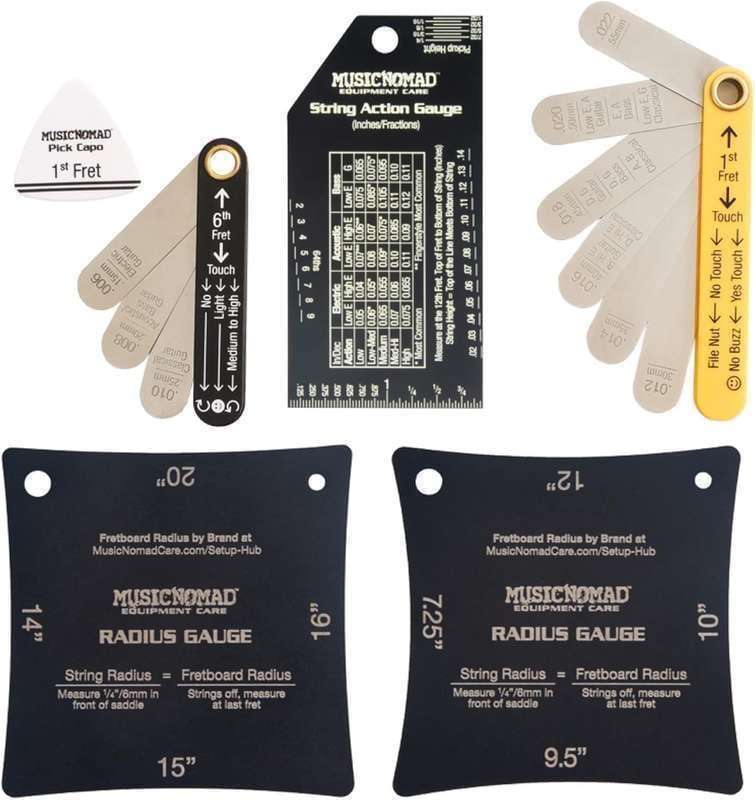
 Buy on Amazon
Pre-Assembly Checks (Do These First)
Before you string up, spend five minutes checking these four things. Fixing them now saves hours of frustration later.
1. Neck pocket fit. The neck should slide in snugly with no gaps at the heel. A loose pocket shifts under string tension, throwing off intonation. Shim with a thin strip of business card if needed.
2. Fret leveling. Run your finger along the fret tops. Feel any high spots? A single high fret causes buzzing that no amount of bridge adjustment will fix. Leveling is beyond this guide, but fret levelling tools on Amazon are a good starting point if you want to learn.
3. Nut slot depth. Press each string down between the 2nd and 3rd frets. There should be a hairline gap between the string and the 1st fret. If the string sits on the fret, the slots are too low. If the gap is more than a sheet of paper, the slots are too high — and your action will feel stiff up the neck.
4. Bridge alignment. The bridge plate should sit parallel to the neck centreline. On a Tele-style kit, the bridge is also the anchor — if it is crooked, your intonation saddle travel will run out on one side.
The Correct Order of Operations
Kits are not magic. They follow the same physics as a $2,000 Fender. The key is doing things in the right order — and waiting for the neck to settle.
Step 1: Assemble the Guitar
Bolt the neck to the body, install the tuners, attach the bridge, and wire the electronics. Do not glue the neck unless the instructions explicitly say so — a bolt-on joint lets you shim or adjust later.
Tighten the neck bolts in an X pattern (top left, bottom right, top right, bottom left) so the neck seats evenly. Do not over-tighten — snug is enough.
Step 2: String to Pitch and Wait
String the guitar with your chosen gauge and tune to standard pitch. Use the same gauge you plan to play — changing later means re-doing the whole setup.
Wait 10–15 minutes before touching the truss rod. The neck has never been under string tension. It needs time to bow slightly forward.
Step 3: Check and Adjust Neck Relief
This is where most kit builders go wrong. The truss rod is probably at neutral — straight, or even back-bowed — because the neck has been in a box for weeks.
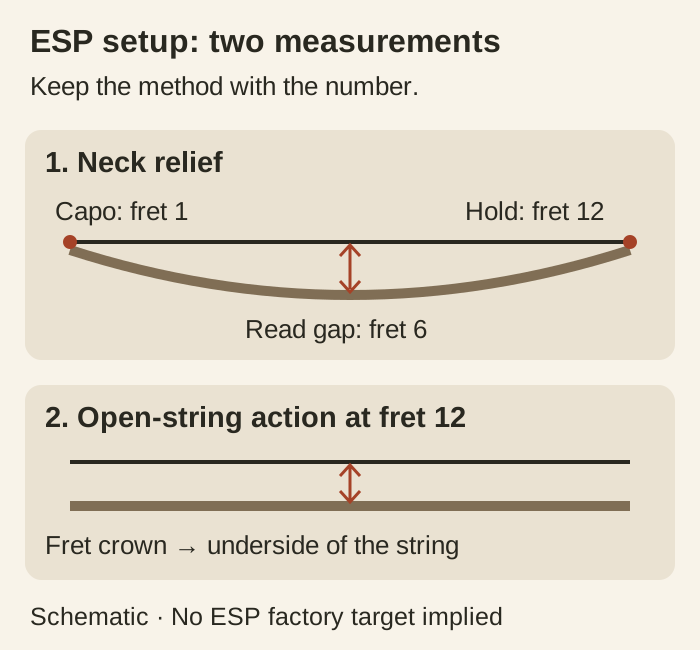
- Capo at the 1st fret.
- Press the low E at the last fret.
- Measure the gap at the 8th fret with a feeler gauge.
Target relief: 0.010" (0.25 mm) — roughly the thickness of a business card.
If the neck is perfectly straight or back-bowed, loosen the truss rod (turn counter-clockwise) 1/4 turn. Wait 10 minutes. Re-check. Repeat until you see a slight forward bow.
⚠️ Important: The truss rod is fighting nothing at first. Once string tension takes hold, the neck will bow forward more over the next 24–48 hours. Set relief slightly looser than your final target today — aim for 0.012"–0.015" — and re-check tomorrow.
For a deeper walkthrough, see our truss rod adjustment guide.
Step 4: Set Action Height at the Bridge
With relief in the ballpark, adjust string height:
- Measure action at the 12th fret with a precision gauge.
- Turn the bridge saddle screws with an Allen wrench. Clockwise raises, counter-clockwise lowers.
- Target heights for a Strat/Tele-style kit:
| String | Height at 12th Fret |
|---|---|
| High E | 1.6 mm (4/64") |
| B | 1.7 mm |
| G | 1.8 mm |
| D | 1.9 mm |
| A | 2.0 mm |
| Low E | 2.0–2.1 mm (5/64") |
Retune after every adjustment. The string tension changes as you move the saddles.
Step 5: Set Pickup Height
Pickup height affects both tone and volume. Too close, and the magnets pull the strings out of tune (especially on the G). Too far, and the tone thins out.
Standard measurements (string pressed at last fret, bottom of string to top of pole piece):
| Pickup | Bass Side | Treble Side |
|---|---|---|
| Neck | 2.4 mm (3/32") | 2.0 mm (5/64") |
| Bridge | 2.4 mm (3/32") | 2.0 mm (5/64") |
Adjust the screw on each side of the pickup. Retune and play-test. If the G string warbles when fretted above the 12th fret, the pickup is too close — back it off 0.5 mm.
Step 6: Intonate
Intonation ensures each note is in tune all the way up the neck.
- Tune the open string to pitch.
- Fret at the 12th fret and check the note. If it is sharp, the string is too short — move the saddle back (away from the neck). If flat, move it forward.
- Retune the open string after every saddle move. Repeat until the open note and the 12th fret note match within 2–3 cents.
⚠️ Kit-specific trap: Cheap bridges sometimes have limited saddle travel. The G string is the usual culprit — it needs the most compensation and the saddle runs out of room. If this happens, flip the saddle around or swap in a slightly longer screw from the hardware bag.
For more detail, see our Telecaster setup guide or Stratocaster setup guide.
Step 7: Re-Check Everything After 24–48 Hours
This is the step most people skip — and the one that separates a good setup from a great one.
The neck will settle under string tension. Relief that looked perfect yesterday may be slightly different today. Action may drop a fraction. Intonation may drift a few cents.
Do a full re-check: relief, action, pickup height, intonation. Make micro-adjustments. Then your kit is truly done.
Common DIY Kit Pitfalls
Truss Rod Starting from Neutral
Factory guitars arrive with the truss rod pre-tensioned for their string gauge. Your kit does not. The neck has been straight (or even back-bowed) in a box. When you add strings, it will bow forward — sometimes dramatically.
Fix: Set relief slightly looser than your final target on day one. Re-check after 24 hours.
Bridge Placement Slightly Off
On a Tele-style kit, the bridge plate is the string anchor. If it is even 1 mm crooked, your intonation saddles will max out on one side before the guitar is fully in tune up the neck.
Fix: Align the bridge plate parallel to the neck centreline before stringing. Use masking tape to mark the correct position.
Nut Slots Too High or Pinched
Cheap kit nuts are often cut conservatively — slots are too high, so the action feels stiff in the first position. Or they are pinched too narrow, causing the string to bind when you bend or use the tremolo.
Fix: High slots need deepening with nut files (or a careful hacksaw blade in a pinch). Pinched slots need widening. Lubricate with graphite or Nut Sauce regardless.

Saddle Reaching Its Limit During Intonation
As mentioned above, the G string needs the most compensation. On cheap 6-saddle bridges, the saddle sometimes runs out of travel before the 12th fret note is in tune.
Fix: Flip the saddle around. If that still does not work, check whether the bridge is positioned correctly (see above). In extreme cases, a replacement bridge with longer saddle travel is the only fix.
Bridge Plate Rocking
Some kit bridge plates sit loosely in their recess. Under string tension, the whole plate can rock forward and backward, causing rattles and tuning instability.
Fix: Shim the underside of the plate with thin cardboard or foil tape until it sits firmly. Do not over-tighten the mounting screws — you can crack a cheap body.
How to Set Up a DIY Stratocaster Kit
Strat-style kits — anything with a double-cutaway body, three single-coils, and a 6-saddle tremolo bridge — follow the standard order of operations above, but two kit-specific quirks come up often:
- Tremolo claw tension. New Strat kits ship with the back tremolo springs at random tension. With 10–46 strings, set the tremolo plate to float about 1.5–2 mm off the body at the back (use three springs, not five) so you have room to dive and pull. Tighten or loosen the two claw screws in the back cavity until the plate sits level.
- String tree pressure. The high E and B strings on a Strat headstock pass under a small string tree. If the tree is screwed down too tight, those strings bind in the nut slot and won't return to pitch after a bend. Back the screw off by 1/4 turn until you feel slack, then tune.
Match the rest of the setup to factory Player Series specs — 9.5" radius, 1.6 mm high E action, 0.010" relief. Our Stratocaster Setup Guide covers each step in detail.
How to Set Up a DIY Telecaster Kit
Tele-style kits use a 25.5" scale and the iconic ashtray bridge plate. Two kit-specific pitfalls dominate Telecaster setups:
- 3-saddle vs 6-saddle bridge. Cheap kits often ship with a vintage 3-saddle bridge. Each barrel handles two strings, which means perfect intonation across all six strings is impossible — it's a compromise. Compensated brass saddles fix this for ~$25 and slot straight into the existing bridge plate. If your kit came with a modern 6-saddle bridge, you can intonate each string independently.
- Bridge plate flat-mounting. The bridge plate must sit flush against the body. Any gap and the plate rocks under string tension — you'll hear it as a rattle through the pickup. Shim the underside with foil tape if needed before tightening the mounting screws.
Standard Tele action is slightly higher than a Strat (around 2.0 mm low E at the 12th fret) because Tele players tend to dig in. Our Telecaster Setup Guide walks through bridge swaps, compensated saddles, and Tele-specific intonation.
Which Setup Guide Do I Need?
DIY kits are copies of classic designs. The setup is the same — only the exact measurements differ.
| Kit Style | Setup Guide | Why |
|---|---|---|
| Strat-style | Fender Setup Guide | 25.5" scale, 6-saddle tremolo, single-coil pickups |
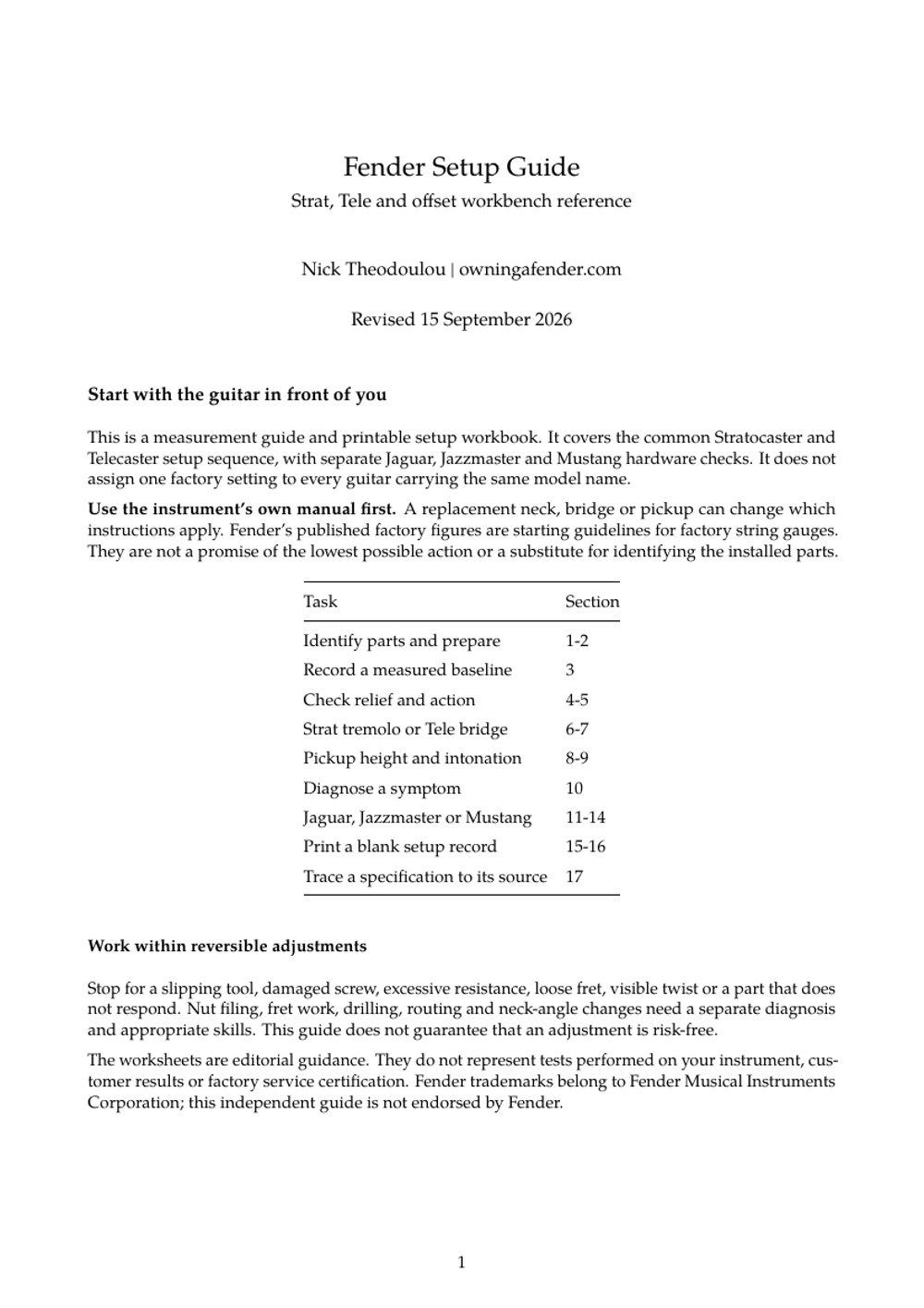
| Tele-style | Fender Setup Guide | 25.5" scale, fixed bridge (3 or 6 saddle), same specs as Player Tele |
| LP/SG-style | Gibson Setup Guide | 24.75" scale, tune-o-matic bridge, humbucker pickups |
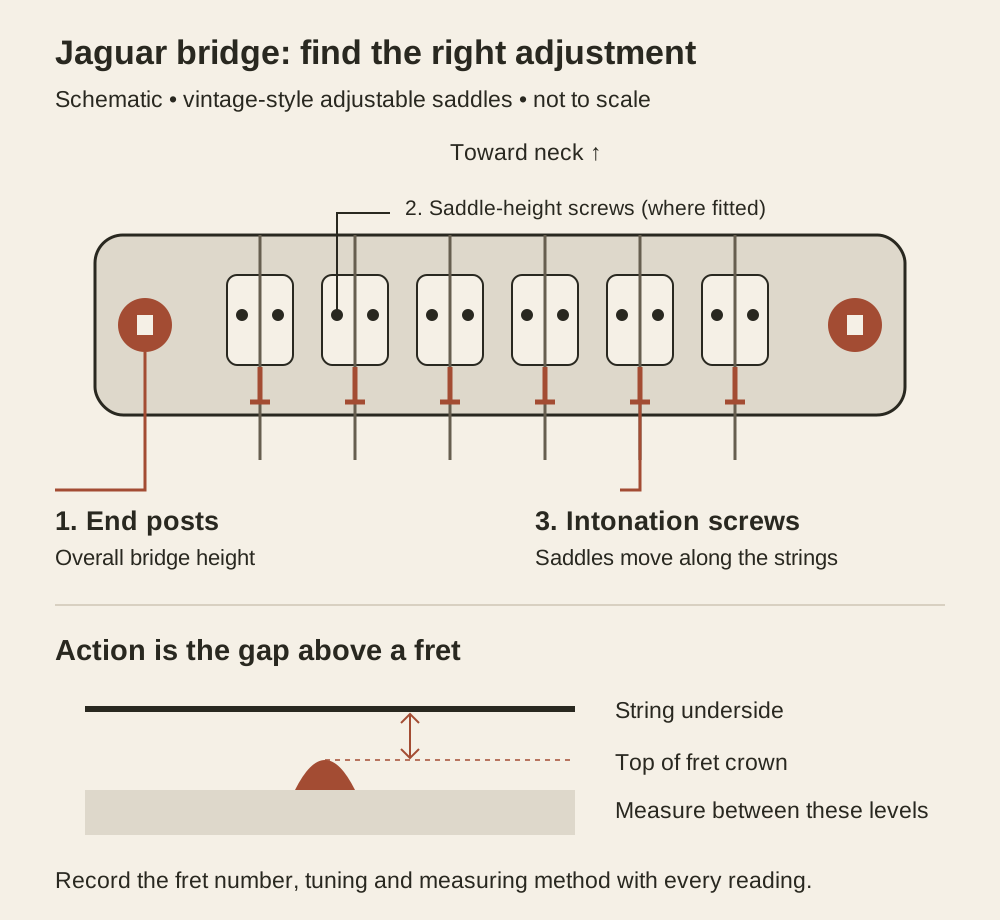
| Jaguar/Jazzmaster-style | Jazzmaster Setup Guide | Floating bridge, unique vibrato system |
💡 Tip: If your kit has a Floyd Rose or licensed tremolo, the setup principles are the same — but the measurements differ. Stick to the Fender guide for 25.5" scale starting points, then adjust by ear.
Use our action height calculator if you want style-specific targets without buying a guide.
FAQ
Can I use the Fender Setup Guide for a non-Fender kit?
Yes. The Fender Setup Guide covers the physics of setup — relief, action, pickup height, intonation — with exact measurements for Strat and Tele-style guitars. Most DIY kits copy those designs exactly (25.5" scale, same bridge types, similar neck profiles). The guide works perfectly.
My kit bridge does not intonate. What do I do?
First, check that the bridge is aligned parallel to the neck. If it is crooked, the saddles max out on one side. Second, flip the G-string saddle around — it may need more travel in the opposite direction. If both fail, a replacement bridge with longer saddle travel ($12–20) solves it permanently.
Do I need to level frets on a new kit?
Not always — but check. Run a credit card edge along the fret tops. If it rocks on any fret, that fret is high and will buzz. A single high fret ruins an otherwise perfect setup. Leveling is a separate skill, but it is worth learning if you plan to build more kits.
What string gauge should I use on a DIY Telecaster kit?
Start with 10–46 (regular slinky). Heavier strings increase tension, which helps anchor a loose bridge plate and improves tuning stability. Lighter strings (9–42) feel easier to play but can make cheap hardware rattle. Once the guitar is set up, experiment.
How long should I wait before re-checking the setup?
24–48 hours minimum. The neck has never been under tension. It will bow forward slightly as the wood compresses and the truss rod settles. Re-check relief first, then action, then intonation. A 5-minute re-check on day two turns a "good enough" setup into a professional one.
Final Word
A DIY guitar kit is not a shortcut to a cheap guitar. It is a blank canvas. The difference between a kit that buzzes and one that sings is almost always the setup — not the parts.
Follow the order of operations. Check the four pre-assembly points. Wait for the neck to settle. Re-check after 24 hours. Do that, and your $60 kit will play better than guitars costing ten times as much that never left the shop with a proper setup.
🎸 Want exact specs on one card? The Fender Setup Cheat Sheet ($19) lists factory measurements for Player, American Professional, and Squier models — plus pickup height formulas and troubleshooting notes. Print it, stick it on your workbench, and never guess again.