Jazzmaster Bridge Setup: Fix Buzz, Set Height & Intonation
Complete jazzmaster bridge setup guide: fix rattling, set proper height, align saddles, and intonate your floating bridge. Exact specs, stability fixes, and upgrade options.

If you own a Fender Jazzmaster, you have probably stared at that rocking bridge in frustration. Strings popping out of saddles, rattling metal on metal, mysterious buzz that disappears when you palm-mute — welcome to the world of jazzmaster bridge setup. The good news? With the right approach, you can tame that bridge completely without spending a fortune on aftermarket parts.
This guide covers everything from understanding why Jazzmaster bridges misbehave to exact step-by-step adjustments that work. Whether you have a stock bridge, a vintage reissue, or you are weighing up an upgrade, you will walk away knowing exactly what to do.
🎸 Want every Jazzmaster spec on one card? Our Fender Setup Cheat Sheet ($19) pre-fills all measurements for your exact model — action, relief, pickup height, bridge height, and intonation targets. Print it, stick it on your workbench, and never guess again.
Why Jazzmaster Bridges Buzz: The Physics Nobody Explains
The Jazzmaster bridge is not fundamentally flawed — it is misunderstood. To fix it, understand three forces: break angle, string tension, and bridge mass.
Break Angle: The Root of Most Evil
On a Strat or Tele, strings angle sharply down from the bridge to the tailpiece or through-body. That downward pressure pins the saddles firmly against the bridge plate.
On a Jazzmaster, the tremolo tailpiece sits much further back. This creates a shallow break angle — the strings do not press down hard on the saddles. With insufficient downward pressure:
- Saddles rock back and forth instead of sitting still
- Strings can slide sideways and pop out of shallow grooves
- The entire bridge rocks on its thimbles, producing sympathetic rattle
- Sustain suffers because energy leaks into bridge vibration instead of the body
Quick Answer: A shallow break angle is the #1 cause of Jazzmaster bridge buzz. Increasing that angle fixes most issues without replacing the bridge.
String Tension vs. Bridge Mass
The stock Jazzmaster bridge is light. That is authentic, but it also means it gets pushed around easily by string vibration. Heavier strings (10s or 11s) increase tension and help anchor the bridge naturally. If you are playing 9s on a stock bridge, you are asking for trouble.
For more on choosing the right gauge, see our best strings for Jazzmaster guide.
The Floating Factor
The bridge "floats" in two thimbles pressed into the body. It is not bolted down. This is part of the Jazzmaster design — it rocks slightly with the tremolo — but it also means any looseness anywhere in the system becomes audible rattle. Every screw, every saddle, every point of contact is a potential buzz source.
Factory Bridge Setup: What Fender Ships
Before you start changing anything, know what "correct" looks like from the factory.
Stock Bridge Height
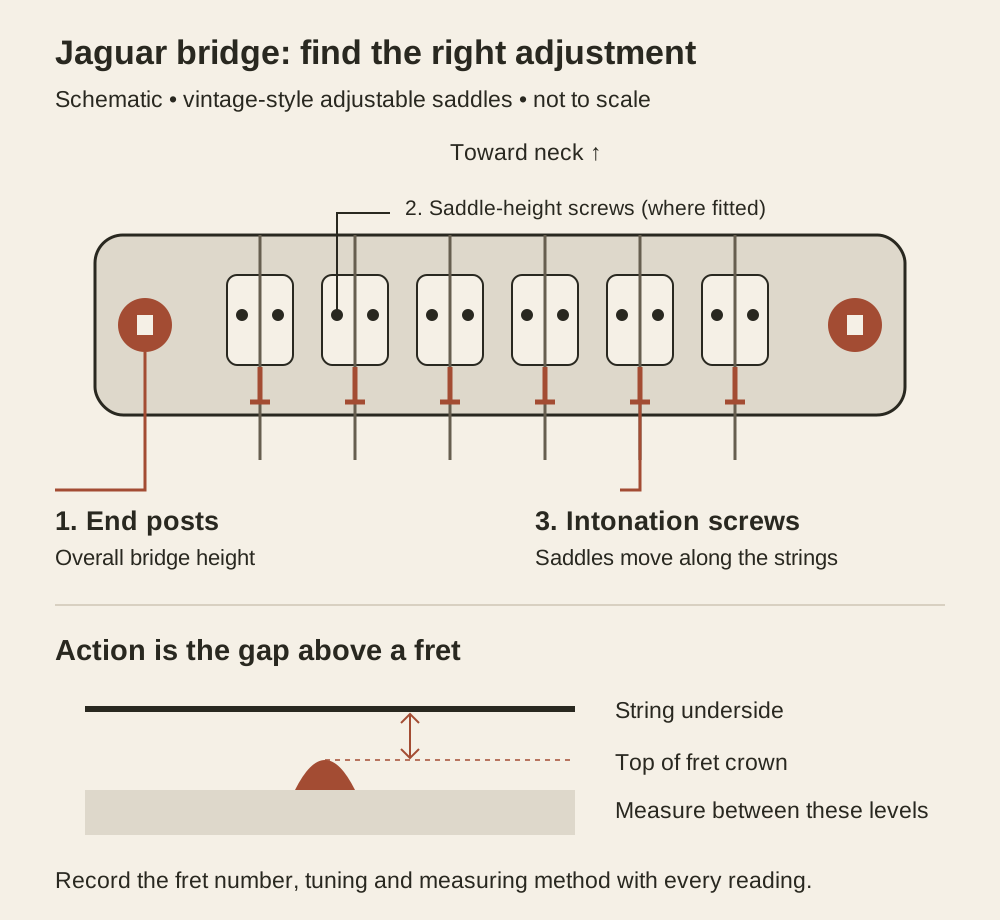
The bridge plate should sit approximately 6–7 mm above the body surface. Any lower and the break angle becomes too shallow. Any higher and the bridge becomes unstable, plus your action will be unplayably high.
Saddle Radius
Jazzmaster fretboards have either a 7.25" (vintage) or 9.5" (modern) radius. Your saddle heights should follow that curve. A radius gauge is the easiest way to check this — lay it across the saddles and verify the curve matches.
If your saddles form a flat line or a mismatched curve, your action will be uneven and some strings will buzz while others feel too high.
String Spacing
Stock Jazzmaster bridges have narrower string spacing than Strat or Tele bridges. Standard spacing is approximately 52–54 mm from E-to-E at the bridge. Make sure each saddle is positioned so the strings align with the pickup pole pieces.
Factory Action Specs
| String | Height at 12th Fret |
|---|---|
| High E | 1.6 mm (4/64") |
| B | 1.7 mm |
| G | 1.8 mm |
| D | 1.9 mm |
| A | 2.0 mm |
| Low E | 2.0–2.1 mm (5/64") |
For a complete action walkthrough, see our ultimate Jazzmaster setup guide which covers the full setup sequence from truss rod to tremolo.
Step-by-Step Jazzmaster Bridge Adjustment
Now let us walk through the actual adjustment process. Do this in order — skipping steps causes headaches later.
Tools You Will Need
- Small Allen wrench set (metric) — for saddle height screws
- Phillips screwdriver — for bridge height adjustment
- String height gauge or precision ruler
- Feeler gauges — for neck relief (already set, but you should verify)
- Tuner with cents display — for intonation
- Blue Loctite (medium strength, 242) — to keep screws from backing out
- Graphite or Big Bends Nut Sauce — for lubricating saddles
Step 1: Verify Neck Relief First
You cannot set a bridge properly on a neck with incorrect relief. Before touching the bridge:
- Capo at the 1st fret
- Press the low E at the last fret
- Measure relief at the 8th fret with a feeler gauge
- Target: 0.010" (0.25 mm) — roughly the thickness of a business card
If relief is off, adjust the truss rod first and wait a few hours for the neck to settle. See our truss rod adjustment guide if you need a refresher.
Step 2: Set Overall Bridge Height
- Loosen strings slightly — just enough to take tension off the bridge. Do not remove them.
- Adjust both bridge posts equally using a Phillips screwdriver. Turn clockwise to lower, counter-clockwise to raise.
- Target 6–7 mm from body to underside of bridge plate. Use a ruler or the depth scale on a string gauge.
- Retune to pitch and let the bridge settle for a minute.
- Check action at the 12th fret on the low E. You are aiming for roughly 5/64" (2.0 mm). Adjust the bridge posts slightly until you are in the ballpark.
Step 3: Adjust Individual Saddle Heights
Each saddle has a small grub screw underneath. Use a metric Allen key to raise or lower individual strings.
- Match the fretboard radius — high E lowest, low E highest. A radius gauge laid across the saddles should make contact evenly.
- Set the high E to 4/64" (1.6 mm) at the 12th fret.
- Gradually raise each saddle toward the bass side until the low E reads 5/64" (2.0 mm).
- Play every fret on every string and listen for buzz. If a string buzzes below the 12th fret, raise it slightly. If it buzzes above the 12th fret, check relief first.
Pro tip: Make 1/4-turn adjustments, retune, and test. Big jumps throw everything off.
Step 4: Align Saddles for String Spacing
Each saddle slides laterally on the bridge. Loosen the string slightly, nudge the saddle until the string sits directly over its pickup pole piece, then retighten the string. The string should track straight from the bridge to the tailpiece without angling sideways.
Step 5: Set Intonation
Intonation on a Jazzmaster is finicky because the bridge moves. Here is the method that actually works:
- Get a precise tuner with cent display.
- Tune the open string to perfect pitch.
- Fret at the 12th fret and compare to the 12th-fret harmonic.
- If fretted is sharp — saddle is too close to the neck. Loosen the string, move saddle backward, retighten, retune, recheck.
- If fretted is flat — saddle is too far from the neck. Move saddle forward.
- Recheck after every move because changing saddle position changes string tension, which slightly affects tuning.
- Work from low E to high E — bass strings shift the bridge more.
Warning: Do not expect perfect intonation on all strings simultaneously. The stock bridge has limited travel, and compromises are normal. If one string refuses to intonate correctly, it is often a sign the bridge needs an upgrade.
Step 6: Lock Everything Down
Once action, spacing, and intonation are correct, it is time to stop the bridge from drifting:
- Remove one saddle screw at a time, apply a tiny dab of Blue Loctite to the threads, and reinstall.
- Do the same for bridge height screws — the two big Phillips screws that hold the bridge posts.
- Let Loctite cure for 24 hours before heavy tremolo use.
This single step eliminates 80% of "my bridge keeps going out of adjustment" complaints.
Stability Fixes: Making the Stock Bridge Behave
If you have followed the steps above and still have issues, here are the targeted fixes.
Fix 1: Increase Break Angle with a Neck Shim
This is the most effective non-upgrade fix. A 0.5-degree shim in the neck pocket tilts the neck backward, increasing the string break angle over the bridge.
What you need: A proper tapered shim (StewMac, AllParts, or maple veneer). Do NOT use a credit card — uneven shims cause neck joint gaps and tuning instability.
How it helps:
- Downward pressure on saddles increases dramatically
- Strings stop popping out
- Bridge stops rattling because it is pinned by string tension
- Sustain improves because energy transfers to the body
Installation:
- Remove neck bolts
- Slide shim into neck pocket with the thick end toward the bridge side
- Reinstall neck, retune, and check action — you may need to lower the bridge slightly because the shim tilts the fretboard away from the strings
Fix 2: Lubricate the Saddles
Friction at the saddle is the enemy of tuning stability on a floating bridge. When you use the tremolo, strings must slide smoothly over the saddle tops. Any sticking causes the string to "hang" and return to pitch slowly or not at all.
Apply graphite powder or Big Bends Nut Sauce to each saddle groove. Work it in with the string, then wipe excess. This is a 2-minute job that makes the tremolo feel dramatically smoother.
Fix 3: Check the Thimbles
The bridge posts sit in thimbles pressed into the body. If these are loose or unevenly seated, the bridge rocks side-to-side.
- Wiggle test: Grab the bridge and try to move it laterally. There should be minimal play.
- Fix: If thimbles are loose, remove them, wrap the outside with a single layer of aluminium foil tape, and reinsert. This creates a snug press-fit without permanent modification.
Fix 4: String Gauge Upgrade
As mentioned earlier, heavier strings anchor the bridge better. If you are on 9s and experiencing chronic issues, moving to 10s or 11s will solve many problems by increasing string tension and downward pressure.
See our best strings for Jazzmaster guide for detailed recommendations by genre.
Upgrade Options: When to Replace the Bridge
Sometimes the stock bridge is simply worn out, poorly machined, or incompatible with your playing style. Here are the three best upgrades.
Mustang Bridge — The Budget Fix (~£30–50)
Fender Mustang bridges fit Jazzmaster thimbles directly. Mustang saddles have deeper grooves and better string retention than vintage Jazzmaster saddles.
Pros: Drop-in replacement, no modification needed, better retention than stock, cheap. Cons: Does not fix break angle by itself, limited intonation range on vintage-style units, different aesthetic. Best for: Players on a budget who want better string retention without surgery.
Mastery Bridge — The Professional Standard (~$175)
Widely considered the best Jazzmaster bridge. Replaces the rocking mechanism with a fixed, fully intonatable design that eliminates rattle while keeping the vintage look.
Pros: Eliminates buzz and pop-out, independent intonation, superb sustain, rock-solid tuning stability. Cons: Expensive, may shift tone slightly (more focused), still needs proper break angle to perform optimally. Best for: Recording musicians, touring players, or anyone who has exhausted setup fixes.
Staytrem Bridge — The Vintage Purist's Choice (~$120)
UK-made drop-in replacement that keeps the rocking bridge concept but with far tighter tolerances.
Pros: Authentic vintage appearance, excellent string retention, correctly radiused saddles (7.25" or 9.5" options). Cons: Long waiting list, limited availability outside the UK, less capable than a Mastery. Best for: Vintage restoration projects or players who want original looks with modern reliability.
My advice: Try the shim + Loctite + string gauge approach first. If that does not solve your issues, then invest in a Mastery. Do not throw $175 at a bridge before you have tried a $10 shim.
Troubleshooting Flowchart: If X, Do Y
Use these rapid-diagnosis steps when something goes wrong.
Strings Popping Out of Saddles
Answer: Use heavier strings (.010+ minimum). Add a 0.5-degree neck shim to increase break angle. Check saddle grooves for wear — worn saddles cannot hold strings. As a last resort, swap to a Mustang or Mastery bridge.
Bridge Rattles When I Play
Answer: Tighten all bridge screws and apply Blue Loctite. Check that the bridge sits firmly in its thimbles. Verify break angle is sufficient — shallow angle lets the bridge rock. If rattle persists after a shim and Loctite, consider an upgrade.
Buzz on Open Strings Only
Answer: Usually a nut issue. Check nut slot depth — slots should hold the string roughly 50% embedded. Lubricate the nut with graphite. Replace if worn.
Buzz Below the 12th Fret
Answer: Action too low or relief insufficient. Measure neck relief first — if under 0.008", loosen the truss rod. If relief is correct, raise the affected saddle by 1/64".
Buzz Above the 12th Fret
Answer: Saddle too low or insufficient relief. Check relief. If correct, raise saddle. If multiple strings buzz above the 12th fret, raise both bridge posts evenly.
Intonation Drifts After Tremolo Use
Answer: Strings are sticking at the saddles or nut. Lubricate both with graphite. Check bridge screws are tight (Loctite). If the bridge shifts in the thimbles, check for side-to-side play.
One String Will Not Intonate
Answer: Saddle has run out of travel. If a string is sharp at the 12th fret and the saddle is at its rear limit, try a lighter string gauge (not ideal, but sometimes necessary). Alternatively, upgrade to a Mastery bridge with greater saddle travel.
Tremolo Knocks Out of Tune
Answer: Check the bridge first — loose saddles or slipping posts are common culprits. Then check the nut (sticking strings). Finally, check tremolo spring tension — the claw screws on the backplate should balance string tension so the bridge plate sits level with the body at rest.
Frequently Asked Questions
Why does my Jazzmaster bridge rattle?
Answer: Bridge rattle is almost always caused by insufficient break angle, loose bridge screws, or worn saddles. The floating bridge relies on downward string pressure to stay still — when pressure is too low, every screw and saddle rattles. Fix it with a 0.5-degree neck shim, Blue Loctite on screws, and .010+ gauge strings.
How high should a Jazzmaster bridge be?
Answer: The bridge plate should sit approximately 6–7 mm above the body. This creates enough clearance for tremolo movement while maintaining a functional break angle. After setting the baseline, fine-tune saddle heights to 4/64" (1.6 mm) on the high E and 5/64" (2.0 mm) on the low E at the 12th fret.
Can I fix a Jazzmaster bridge without upgrading it?
Answer: Yes — most stock bridge problems are solvable without aftermarket parts. The three most effective fixes are: (1) adding a 0.5-degree neck shim, (2) applying Blue Loctite to screws, and (3) lubricating saddles with graphite. Only upgrade if these fail or if saddles are physically worn.
What is the best bridge upgrade for a Jazzmaster?
Answer: The Mastery Bridge is the best overall upgrade for players who want maximum stability, sustain, and independent intonation on every saddle. It is expensive at $175 but eliminates virtually all stock bridge issues. For a budget alternative, a Mustang bridge (£30–50) improves string retention and fits without modification. The Staytrem is ideal for vintage purists who want authentic looks with modern tolerances.
Why do strings pop out of my Jazzmaster bridge?
Answer: Strings pop out because the break angle is too shallow and stock saddle grooves are not deep enough. Solutions in order: (1) add a neck shim, (2) switch to heavier strings (.010+), (3) replace worn saddles, or (4) install a bridge with deeper grooves (Mustang, Mastery, or Staytrem).
Do I need a neck shim for my Jazzmaster?
Answer: Most Jazzmasters benefit from a 0.5-degree neck shim, even without obvious bridge problems. The shim increases break angle, which improves sustain, reduces rattle, and helps strings stay seated. It is a cheap, reversible mod that fixes the fundamental geometry issue underlying most offset bridge complaints.
How do I stop my Jazzmaster bridge from moving?
Answer: Apply Blue Loctite (medium strength, 242) to every threaded screw on the bridge: saddle height screws and bridge post screws. Remove each screw one at a time, apply a tiny dab to the threads, and reinstall. Let it cure 24 hours. This stops screws from backing out due to vibration. Also check that the bridge posts fit snugly in their thimbles — wrap loose thimbles with a single layer of foil tape for a tighter fit.
What string gauge is best for a Jazzmaster bridge?
Answer: .010–.046 is the best all-around gauge for a stock Jazzmaster bridge. The increased tension compared to 9s anchors the saddles better and reduces pop-out. Heavier gauges like .011–.049 improve stability further but need a truss rod tweak and slightly higher action. See our best strings for Jazzmaster guide for style-specific picks.
How is a Jaguar bridge different from a Jazzmaster bridge?
Answer: Functionally they are nearly identical — both use floating rocking bridges in thimbles with the same tremolo system. The Jaguar's shorter 24" scale creates slightly lower string tension, which can make bridge issues marginally worse. The same fixes apply: shims, heavier strings, Loctite, and saddle lubrication. See our Jaguar setup guide for full Jaguar-specific instructions.
Should I set up the bridge before or after the truss rod?
Answer: Always set neck relief first, then bridge action, then intonation, then pickup height. Bridge adjustments depend on the neck being straight and stable. Our setup specs lookup tool shows the exact sequence for every Fender model.
Conclusion
The Jazzmaster bridge is not broken — it is just sensitive. The shallow break angle, floating design, and light bridge mass make it uniquely responsive to setup choices. Get the geometry right (shim, height, break angle), lock the mechanical parts down (Loctite, lubrication), match your string gauge to the bridge, and the stock unit will serve you well.
Only upgrade when the bridge is physically worn or when you have exhausted the setup fixes. A Mastery Bridge is a wonderful piece of engineering, but a properly set up stock bridge with a shim and .010 strings will get 90% of players where they need to be.
🎸 Ready to nail the full setup? Grab the Fender Setup Cheat Sheet — it prints every Jazzmaster measurement (and Jaguar, Strat, and Tele too) on one workbench card. No more guessing, no more tabs open. Just tune, measure, adjust, and play.
For the complete Jazzmaster walkthrough — neck relief, tremolo balance, pickup height, and more — head to our ultimate Jazzmaster setup guide. And if you want to dial in your pickups after fixing the bridge, our Jazzmaster pickup height guide has exact measurements for every style from shoegaze to jazz.