Takamine Serial Number Lookup: Free Instant Decoder
Enter your Takamine serial number to get the year and factory. Covers Japanese Pro Series and G-Series acoustics from 1962 to now.
What's Next?
Now that you've decoded your Takamine guitar, here are the best places to continue:
- Acoustic Guitar Setup Guide — Step-by-step acoustic setup
- Acoustic Best Strings — Top string recommendations for acoustic
- Setup Specs Lookup — Find factory specs by year and model
- My Gear Garage — Track your collection and maintenance schedule
- Garage Pro — Maintenance log with unlimited guitars, full history & smart reminders
Takamine Serial Number Lookup: Decode Your Guitar Instantly
Takamine has been building world-class acoustic guitars in Sakashita, Japan since 1959. Whether you own a flagship Pro Series from Japan or a budget-friendly G-Series, the Takamine serial number lookup tool above decodes your instrument in seconds. Enter your serial number and get production year, factory location, and country — all free, with no sign-up required.
Our decoder covers all Takamine guitars from 1962 to present, including Japanese-made Pro Series and China-made G-Series models. If you're buying used, authenticating a vintage find, or simply curious about your guitar's history, read on for the complete guide.
Own another guitar? We also have free serial number decoders for Fender, Gibson, Squier, ESP, LTD, Schecter, Charvel, Epiphone, Gretsch, Ibanez, Jackson, Martin, PRS, Taylor, Yamaha, Chapman, Eastman, Guild, Harley Benton, Rickenbacker, Cort, and Seagull.
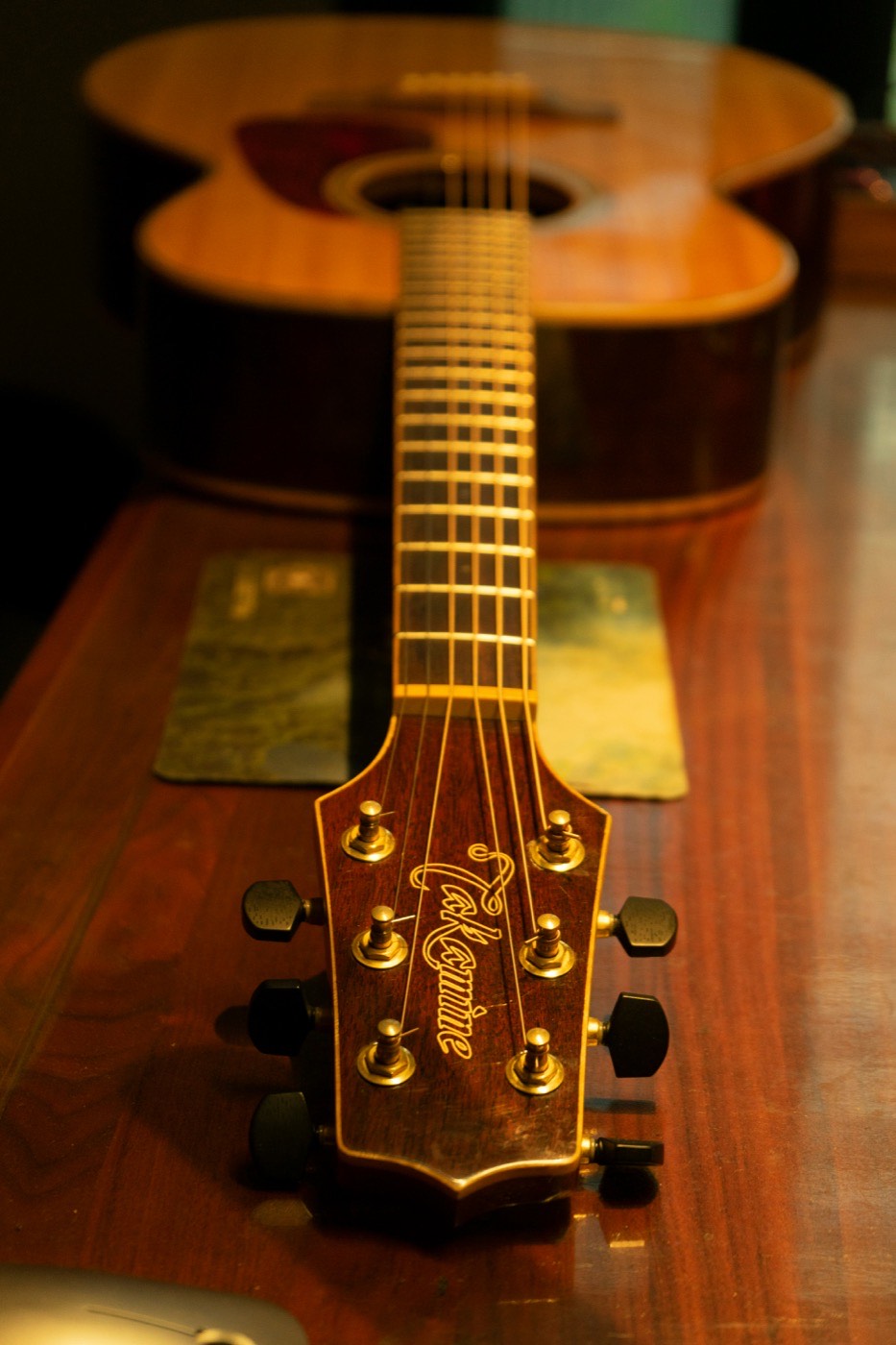
Photo by Luca Liew on Unsplash
Part 1: Where Is My Takamine Serial Number?
Before you can lookup your Takamine, you need to find the number. Location varies by series and era.
- Japanese Pro Series (1999-present): On the label inside the soundhole, visible through the sound opening.
- Japanese Pro Series (1998 and older): On the heel block, visible by looking deep into the soundhole.
- G-Series (China): Base of neck inside soundhole (sticker or stamped).
- Vintage (pre-1993): Varies — may be stamped on neck block or printed on label inside body.
Pro tip: Use a flashlight and angle it inside the soundhole. The label is typically on the back brace or the inside of the back panel. On older guitars, the serial may be stamped (not printed) on the neck block.
Part 2: 8-Digit Format (1962–Present) — YYMMXXXX
The most common Takamine format is 8 digits. But there's a critical distinction: the first two digits can mean actual year (export market) or years since 1962 (Japanese domestic / post-2012 universal).
How to Tell Them Apart
| First 2 Digits | Interpretation | Example |
|---|---|---|
| 62–99 | Actual year 1962–1999 (Export) | 75 = 1975 |
| 00–12 | Actual year 2000–2012 (Export) | 08 = 2008 |
| 13–37 | Years since 1962 = 1975–1999 (Japanese domestic) | 45 = 1962+45 = 2007 |
| 38–50 | Years since 1962 = 2000–2012 (Japanese domestic) | 45 = 2007 |
| 51+ | Years since 1962 = 2013+ (All markets post-2012) | 60 = 2022 |
The Format Explained
| Position | Digits | Meaning |
|---|---|---|
| 1–2 | YY | Year (see table above) |
| 3–4 | MM | Month (01–12) |
| 5–8 | XXXX | Sequential production number for that month |
Worked Examples
- 08040781: Year = 2008 (export), Month = 04 (April), Unit = 781 → April 2008, Sakashita, Japan
- 45061234: Year = 1962+45 = 2007 (Japanese domestic), Month = 06 (June), Unit = 1234 → June 2007, Sakashita, Japan
- 51010999: Year = 1962+51 = 2013 (post-2012 universal), Month = 01 (January), Unit = 999 → January 2013, Sakashita, Japan
- 75061234: Year = 1975 (export vintage), Month = 06 (June), Unit = 1234 → June 1975, Sakashita, Japan
Part 3: G-Series China Format — CC Prefix (2015–Present)
Takamine's G-Series (budget line) is made in China and uses a CC prefix.
The Format
| Pattern | Meaning |
|---|---|
| CC | Country code for China |
| YY | 2-digit year (actual) |
| MM | Month (01–12) |
| XXXXX | 5-digit production sequence |
Example
- CC150904411: CC = China, Year = 2015, Month = 09 (September), Unit = 04411 → September 2015, China G-Series
Part 4: G-Series TC Prefix (2020–Present) — Undocumented
Some newer G-Series guitars use a TC prefix. The format is not officially documented, but observed serials suggest:
- TC + YY + MM + DD + XX or similar pattern
- Example: TC20124581 may indicate 2020, December, with production ranking
Note: This format is speculative. The decoder provides approximate year only.
Part 5: Vintage Letter Prefix (1968–1981)
Early Takamine guitars used a single letter prefix followed by 3–5 digits.
| Letter | Era |
|---|---|
| A | 1968–1970 |
| B | 1970–1972 |
| C | 1972–1974 |
| D | 1974–1976 |
| E | 1976–1978 |
| F | 1978–1980 |
| G | 1980–1981 |
Example
- A123: Letter prefix "A" → 1968–1970, Sakashita, Japan
- C4567: Letter prefix "C" → 1972–1974, Sakashita, Japan
Part 6: Vintage Sequential Numbers (1966–1993)
Before the 8-digit system, Takamine used simple sequential numbering. Match your serial to the range table below.
Standard Sequential Ranges
| Serial Range | Year |
|---|---|
| 006–319 | 1966 |
| 320–999 | 1967 |
| 1000–9999 | 1968 |
| 10000–99999 | 1971 |
| 100000–106999 | 1972 |
| 107000–120000 | 1973 |
| 120001–139000 | 1974 |
| 139001–167000 | 1975 |
| 167001–186000 | 1976 |
| 186001–203000 | 1980 |
| 214001–263000 | 1983 |
| 263001–291000 | 1984 |
| 291001–302000 | 1985 |
| 302001–303000 | 1986 |
| 303001–331000 | 1987 |
| 331001–356000 | 1988 |
| 356001–367000 | 1989 |
| 367001–382000 | 1990 |
| 382001–392000 | 1991 |
| 392001–420000 | 1992 |
| 420001–430000 | 1993 |
Adamas Sequential Ranges (Separate Numbering)
Takamine's premium Adamas models used a completely separate serial numbering system starting in 1977.
| Serial Range | Year |
|---|---|
| 0077–0099 | 1977 |
| 0100–0608 | 1978 |
| 0609–1058 | 1979 |
| 1059–1670 | 1980 |
| 1671–2668 | 1981 |
| 2669–3242 | 1982 |
| 3243–3859 | 1983 |
| 3860–4109 | 1984 |
| 4110–4251 | 1985 |
| 4252–4283 | 1986 |
| 4284–4427 | 1987 |
| 4428–4696 | 1988 |
| 4697–4974 | 1989 |
| 4975–5541 | 1990 |
| 5542–6278 | 1991 |
| 6279–7088 | 1992 |
| 7089–8159 | 1993 |
| 8160–9778 | 1994 |
| 9779–11213 | 1995 |
| 11214–12448 | 1996 |
| 12449–13020 | 1997 |
| 13021–14623 | 1998 |
| 14624–16136 | 1999 |
| 16137–17393 | 2000 |
| 17394–18961 | 2001 |
| 18962–20040 | 2002 |
| 20041–20802 | 2003 |
| 20803–21085 | 2004 |
| 21086–21514 | 2005 |
| 21515–22211 | 2006 |
| 22212–22522 | 2007 |
| 22523–22878 | 2008 |
| 22879–23155 | 2009 |
| 23156–23402 | 2010 |
| 23403–23591 | 2011 |
| 23592–23763 | 2012 |
| 23764–23845 | 2013 |
Part 7: Takamine Factory Locations
Sakashita, Nakatsugawa, Japan — The Original Factory
Takamine's primary factory since 1959. Located in the Gifu Prefecture, this is where all Japanese Pro Series guitars are built. The factory is known for its skilled luthiers and traditional craftsmanship methods combined with modern CNC technology.
China — G-Series Factory
Takamine opened G-Series production in China in the mid-2010s to offer more affordable options. G-Series guitars use the CC and TC prefix serial formats and are built to Takamine's specifications but with more cost-effective materials and construction.
Part 8: Era-by-Era Changes
1960s–1970s: The Founding Era
- Serials: Sequential 3–6 digit, letter prefixes (A–G)
- Key Models: Early classical and steel-string acoustics
- Production: ~37 guitars (1966) to ~1,200+ (1970s)
- Notable: Founded by Mass Hirade and friends in Sakashita, Japan
1980s: Growth and Export
- Serials: Sequential 6-digit (continued)
- Key Models: Lawsuit-era models, early dreadnoughts
- Production: ~1,000–3,000 per year
- Notable: Began significant export to USA and Europe
1990s: The 8-Digit Era Begins
- Serials: 8-digit YYMMXXXX format introduced
- Key Models: EF series, early cutaway models
- Production: ~10,000–30,000 per year
- Notable: Pro Series brand established
2000s–2010s: Pro Series Dominance
- Serials: 8-digit continues; G-Series introduced
- Key Models: P1DC, EF341SC, EN10C-12
- Production: ~50,000–80,000 per year
- Notable: Became one of the top acoustic brands globally
2020s–Present
- Serials: 8-digit (years-since-1962 for all markets); CC/TC prefixes for G-Series
- Key Models: Modern Pro Series, Thinline models
- Production: ~80,000–120,000 per year (combined)
- Notable: Continued innovation in acoustic-electric technology
Summary: Quick Reference Table
| Format | Pattern | Era | Example |
|---|---|---|---|
| 8-digit (export) | YYMMXXXX | 1962–2012 | 08040781 = April 2008 |
| 8-digit (domestic/universal) | YYMMXXXX | 1962–present | 51010999 = Jan 2013 |
| CC prefix | CCYYMMXXXXX | 2015+ | CC150904411 = Sept 2015 |
| TC prefix | TC + digits | 2020+ | TC20124581 = ~2020 |
| Letter prefix | A–G + 3–5 digits | 1968–1981 | A123 = 1968–1970 |
| Sequential | 3–6 digits | 1966–1993 | 500 = 1967 |
| Adamas sequential | 2–4 digits | 1977–2013 | 0100 = 1978 |
What's Your Takamine Worth?
Your Takamine's era and factory drive most of its used-market value. Serial-number dating is the first step — the earlier your guitar, the more likely it carries the hand-built Japanese character collectors value.
| Era / Line | Factory | Typical Used Range | Notes |
|---|---|---|---|
| Vintage Japan (1962–1980s) | Sakashita, Japan | $600–$3,000 | Early steel-strings and lawsuit-era models are the most collectible |
| Pro Series Japan (1990s–2010s) | Japan | $300–$1,200 | EF/EN/P-series solid-top models hold value best |
| Modern Pro Series (2010s–present) | Japan | $300–$1,000 | Entry-to-mid Pro Series; 8-digit serials |
| G-Series (2015–present) | China | $200–$600 | Affordable imports; condition matters more than age |
Value factors: Model line (Pro Series > G-Series), solid versus laminated top, condition, and originality (case, paperwork, pickups). Vintage Japanese Takamines from the 1960s–1980s are the collectible tier; G-Series guitars are budget instruments that depreciate with use.
If you're buying or selling, a proper setup is the highest-ROI improvement — and our Guitar Price Estimator gives a current market range based on year, model, and condition.
Frequently Asked Questions
How do I read my Takamine serial number?
Most Takamine guitars use an 8-digit YYMMXXXX format. The first two digits encode the year (the actual year for export models, or years since 1962 for Japanese domestic and all post-2012 guitars), digits 3-4 are the production month, and the last four digits are the sequential production number for that month. Or enter it in the free tool at the top of this page for an instant answer.
Can I look up my Takamine guitar by serial number?
Yes. The free tool at the top of this page instantly returns production year, factory location, and country of origin. No sign-up required.
Where is the Takamine serial number?
On Japanese Pro Series guitars from 1999 onward, the serial is on the label inside the soundhole. On Pro Series guitars from 1998 and older, it is on the heel block, visible by looking deep into the soundhole. G-Series (China) guitars have it at the base of the neck inside the soundhole. Vintage pre-1993 guitars may have it stamped on the neck block or printed on the label inside the body.
How do I date a Takamine G-Series guitar?
G-Series guitars are made in China and use a CC prefix: CC, then a 2-digit year, then the month, then a 5-digit production sequence. For example, CC150904411 decodes to September 2015. Some newer G-Series guitars use a TC prefix (2020-present); that format is not officially documented, so the decoder returns an approximate year.
What does the letter prefix on an old Takamine mean?
From 1968 to 1981, Takamine used a single letter prefix followed by 3-5 digits. The letter indicates the era: A = 1968-1970, B = 1970-1972, C = 1972-1974, D = 1974-1976, E = 1976-1978, F = 1978-1980, and G = 1980-1981.
How do I date a vintage Takamine with only a short number?
Before the 8-digit system, Takamine used simple sequential numbering from 1966 to 1993. Match your serial to the range table in Part 6 above: for example, 006-319 is 1966 and 420001-430000 is 1993. Adamas models used a separate numbering system from 1977 to 2013 with their own range table.
Why do the first two digits of my Takamine serial not match the year?
Because two systems share the 8-digit format. Export serials through 2012 used the actual year (08 = 2008). Japanese domestic serials, and all serials from 2013 onward, count years since 1962 (51 = 2013, 60 = 2022). The comparison table in Part 2 shows how to tell them apart.
Where are Takamine guitars made?
All Japanese Pro Series guitars are built at Takamine's original factory in Sakashita, Nakatsugawa, in the Gifu Prefecture of Japan, where the company was founded in 1959. The budget G-Series is made in China and uses the CC and TC prefix serial formats.
Is there a free Takamine serial number checker?
Yes. The tool at the top of this page is a free Takamine serial number checker. Enter your serial for instant results covering production year, factory, and country. No sign-up or payment required.
How much is my Takamine worth?
Value depends on era, model line, and condition. Vintage Japanese Takamines (1962–1980s) typically range from $600-$3,000, Pro Series models from $300-$1,200, and G-Series imports from China from $200-$600. Solid-top Pro Series models hold value best; condition and originality matter more than age.
Does Takamine have an official serial number lookup?
Takamine does not offer a comprehensive public serial lookup tool. Our decoder covers Japanese Pro Series and G-Series models from 1962 to present, including the vintage letter-prefix and sequential formats, all for free.
How do I know if my Takamine is fake?
Check that the serial format matches the claimed era and that the headstock logo, label, and build quality look right for a Japanese or Chinese-made Takamine. For a quick second opinion, run the free fake guitar quick-check — a two-minute red-flag checklist (price, seller behaviour, serial, decals, workmanship) that returns an instant risk band. It can't see the guitar, but it tells you how hard to look before you pay.

 Buy on Amazon