Telecaster Intonation: Three- and Six-Saddle Setup
Set Telecaster intonation on three-saddle and six-saddle bridges. Learn which way to move saddles, balance paired strings, and diagnose tuning problems.
By Nick TheodoulouUpdated

Quick answer · Fender factory specs
Telecaster, 9.5" to 12" radius
- String height at the 17th fret
- 4/64" (1.6 mm)
- Neck relief at the 8th fret
- .010" (0.25 mm)
From Fender's published chart. Other radii and pickup heights are on the full chart.See every Telecaster factory spec →
On this page
- Telecaster bridge types: what you can adjust
- Prepare for a reliable intonation measurement
- How to set six-saddle Telecaster intonation
- How to intonate a three-saddle Telecaster
- When compensated Telecaster saddles help
- Telecaster intonation still sharp or inconsistent?
- Telecaster intonation FAQ
- Record the final Telecaster setup
Telecaster intonation is the adjustment that helps fretted notes stay in tune as you move up the neck. The procedure depends on the bridge: six saddles give each string its own length adjustment, while three barrels make you work with pairs. Identify that difference first and the rest of the job becomes much easier to understand.
Quick answer: Tune the string, then compare its 12th-fret harmonic with the normally fretted 12th-fret note. If the fretted note is sharp, move its saddle away from the neck; if flat, move it toward the neck. Retune after every change. On a three-saddle Telecaster, check both strings sharing each barrel and seek the best practical compromise.
Last updated: September 9, 2026. Direction of adjustment and bridge differences checked against Fender's setup guidance.
- Identify your bridge
- Prepare the guitar and tuner
- Set six-saddle intonation
- Set three-saddle intonation
- Understand compensated saddles
- Troubleshoot persistent tuning problems
- Frequently asked questions
- Record the final setup
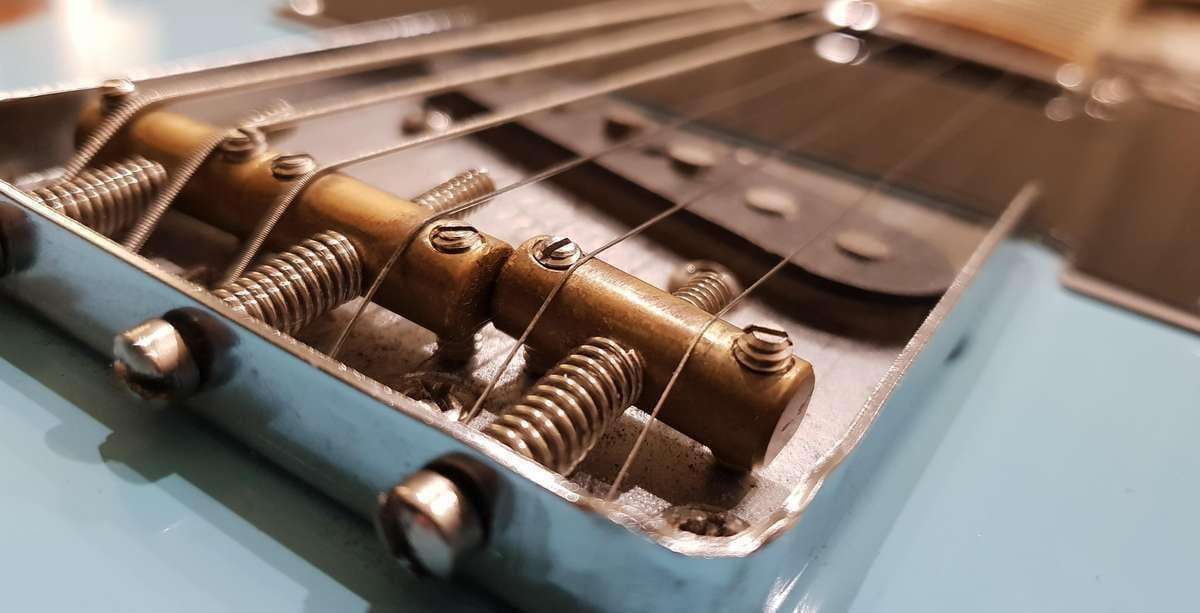
Telecaster bridge types: what you can adjust
Six individual saddles
A six-saddle bridge has a separate string-length adjustment for each string. Moving the low-E saddle does not directly move the A saddle. That makes the measuring process straightforward, even if it still takes several rounds of tuning and adjustment.
Look for the screw that moves the saddle along the string's length. Do not confuse it with the small vertical screws that set action. If you change height while trying to change length, you alter the setup you are attempting to measure.
Three shared barrels
On the familiar three-barrel arrangement, the low E and A share one saddle, D and G share another, and B and high E share the last. Moving a barrel changes the speaking length of both strings in its pair. They may not want exactly the same amount of compensation.
That is why a three-saddle Telecaster can show one string slightly sharp and its partner slightly flat. The result is not necessarily poor technique or a broken tuner. You are adjusting one shared part to satisfy two strings with different properties.
Compensated three-saddle designs
Some barrels have angled or offset string contact points to provide different effective lengths within a pair. Other designs include a movable section. Identify the exact design before changing its orientation: a compensated saddle fitted in the wrong position can make the problem worse.
| Bridge | Adjustable length positions | Main setup task |
|---|---|---|
| Six individual saddles | One per string | Match each fretted octave |
| Three straight barrels | One per pair | Balance the two errors |
| Three compensated saddles | Pair position plus designed offsets | Fit correctly, then test both strings |
| Adjustable compensated design | Depends on the hardware | Follow its specific instructions |
Fender describes the shared-saddle compromise in its Telecaster setup reference. Use the bridge that is actually on the guitar as your guide; a previous owner may have replaced the original hardware.
The Telecaster hub links to the model's other maintenance resources. If relief or string height still needs work, start with the complete Telecaster setup guide and return here for the final intonation stage.
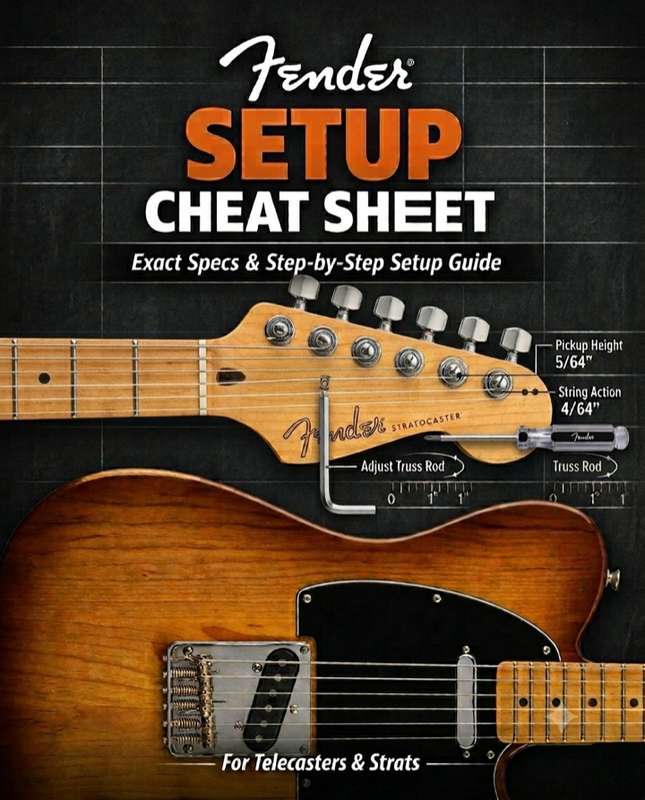
Prepare for a reliable intonation measurement
Use the strings and tuning you intend to keep
Intonate in your normal tuning, with the string gauge you plan to use. Worn or damaged strings can give inconsistent results, while a new set needs to settle before you make final adjustments. Do not compensate for a defective string by moving a saddle to an extreme position.
If you are changing gauge, do that before the rest of the setup. Keep the packaging or write down the individual gauges so the result is reproducible. “Light strings” is less useful than the actual set and tuning.
Finish relief, action, and pickup height first
Fretting stretches a string. Changing its height changes how far you push it down, which can change the compensation it needs. Finish the mechanical setup before expecting a final saddle-length measurement to stay valid.
Check Telecaster pickup height too if sustained notes behave strangely. Do not alter several settings during the intonation test. Each measurement should compare the same instrument state with only one intentional change.
Hold the guitar as you play it
Use your usual playing position, with the neck supported naturally. Avoid pressing the neck into a bench support or pulling it backward with your fretting hand. Small changes in pressure can make a tuner reading move even though the bridge has not changed.
Pick lightly enough to produce a clear note without a large initial pitch excursion. Allow the attack to settle briefly and use the same part of the note for every reading. Mute the other strings so the tuner has one clear signal to follow.
Set up the tuner and screwdriver
A stable tuner display and a correctly fitting screwdriver matter more than a large tool kit. Use the tuner's normal chromatic mode and keep its reference pitch consistent, ordinarily A = 440 Hz unless your music requires another reference. Check that your signal is clean and free of delay or pitch effects.
The choices below cover tuning, saddle adjustment, and checking that action has stayed consistent. A clip-on tuner can work in a quiet room; a direct signal can be easier when surrounding noise or vibration is confusing the reading.
Tools for a Telecaster Intonation Check

 Buy on Amazon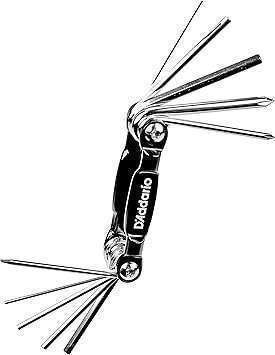
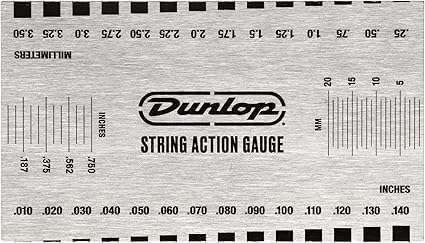
For a guided comparison, use the free intonation checker. Read its instructions and give it a clean, isolated note. It helps interpret the measurement; it cannot tell whether your string is worn or your fretting hand is squeezing too hard.
How to set six-saddle Telecaster intonation
Step 1: establish the reference note
Tune the open string accurately. Then sound the harmonic above the 12th fret and confirm that the tuner follows it consistently. If the reading jumps among unrelated notes, improve the signal or muting before touching the saddle.
Next fret the same string at the 12th fret with your ordinary playing pressure, just behind the fret wire. Do not press harder to make the note “clearer” unless it is actually buzzing. Excess force can sharpen the note and lead you to compensate for your test technique.
Step 2: read sharp or flat
Compare the fretted note with the harmonic, watching the direction as well as the amount of error. Repeat the comparison two or three times. A consistent small error is more useful than one dramatic reading produced by an unusually hard pick stroke.
| Fretted octave relative to harmonic | Needed length change | Saddle movement |
|---|---|---|
| Sharp | Increase speaking length | Away from neck |
| Flat | Reduce speaking length | Toward neck |
| Close and repeatable | None for now | Check other strings |
Think in terms of saddle movement rather than a universal screw-turn direction. Hardware orientation can differ. Watch the saddle move and confirm that it went where you intended.
Step 3: move a little, retune, repeat
Make a small adjustment, then retune the open string before measuring again. Moving the saddle changes both the string's length and its tension. Skipping the retuning step mixes those effects and makes the results misleading.
If the saddle resists or the string is heavily loaded against it, reduce string tension before moving it. Retune fully for the next measurement. Never force a stiff screw or use an oversized driver against the bridge pickup or finish.
Work through all six strings, then make a second pass. Finish by playing a few familiar chords and single-note lines in different positions. A guitar that looks good on the tuner should also feel predictable under your normal hand pressure.
Keep a small measurement record
Write the initial error and the final result for each string. Recording cents is useful if your tuner shows them, but do not claim more precision than its display supports. The point is to see whether an adjustment reliably reduced the problem.
There is no universal number of turns for a particular string gauge. The guitar's action, string construction, bridge geometry, and setup all matter. Photographs of another Telecaster's saddle pattern are clues, not a template to copy.
How to intonate a three-saddle Telecaster
Measure both strings before moving the barrel
Begin with one pair and write down both errors. Tune and test each string separately, using the same reference and fretting technique as for a six-saddle bridge. Now you can tell whether the pair needs to move together or already straddles the target.
If both fretted notes are sharp, moving the barrel away from the neck is the useful direction to test. If both are flat, try moving it toward the neck. Retune and remeasure both strings after every movement.
Balance errors that point in opposite directions
Suppose, as an illustrative example, the B string reads 6 cents sharp while the high E reads 2 cents flat. A small movement away from the neck might reduce the B error while making the high E flatter. Measure the result rather than assuming the two readings change equally.
Look for a compromise that reduces the most audible problem without making its partner unacceptable. Equal and opposite readings are one comparison point, not a rule that guarantees the best musical result. Check the intervals and chord shapes you use most.
Do not keep moving a shared saddle until one string reads perfectly while ignoring the other. That can make the pair sound worse overall. If the remaining error is distracting, the next step is to understand the hardware's limits, not to keep turning the same screw.
Work through E/A, D/G, and B/high E
Check every pair, even if only the G string originally bothered you. Changing one barrel's tilt or accidentally disturbing a neighbouring string can alter the setup. Keep saddle height stable while making the length changes.
| Pair | First string | Partner | Adjustment note |
|---|---|---|---|
| Low E / A | Record sharp or flat | Record sharp or flat | Move and retest both |
| D / G | Record sharp or flat | Record sharp or flat | Check plain or wound G |
| B / high E | Record sharp or flat | Record sharp or flat | Check upper-position chords |
Test music rather than one fret alone
After the octave comparison, play open-position chords, mid-neck chords, and notes higher up. Use normal pressure. A bridge adjustment can improve the octave test without curing a high nut slot, fret wear, or the compromises of an ordinarily fretted instrument.
If one favourite chord still sounds imperfect, resist tuning the whole setup around that chord alone. Check whether the same string is consistently wrong elsewhere. A useful setup serves the range of music you actually play.
When compensated Telecaster saddles help
Offset contact points address the shared-saddle problem
Compensated saddles aim to give paired strings different effective speaking lengths while retaining a three-saddle bridge. The amount and direction of that offset depend on the design. They still need fitting, action adjustment, and intonation checks after installation.
Fender's movable intonating bridge instructions illustrate one design with independently movable saddle sections. That is different hardware from a simple angled barrel; use the instructions supplied with the part you own.
Check fit and orientation before buying or swapping
Confirm bridge compatibility, string spacing, screw dimensions, and the intended string pairing. Do not assume every part advertised for a Telecaster fits every bridge. Retain the original saddles and label their positions if you replace them.
This guide does not require a hardware upgrade. First check that the current strings and mechanical setup are healthy. A new saddle cannot correct every source of a sharp fretted note.
Keep the intended string set consistent
A change from a plain G to a wound G can change the compensation required at the middle pair. If you regularly switch gauges or tuning, expect to revisit intonation. Choose strings for your playing needs, then set the bridge for those strings.
The sets below are familiar electric-string options in different gauges and constructions. Use the detailed Telecaster string guide if you are still choosing a set. There is no need to replace healthy strings merely to perform a check.
String Sets to Establish Your Setup Baseline


Telecaster intonation still sharp or inconsistent?
The saddle has reached the end of its travel
Stop and check the basics: tuning, the direction of the measurement error, string condition, and normal fretting pressure. Check that the saddle is correctly assembled and moving freely. Do not remove springs or reverse parts simply because an online photograph shows another arrangement.
Persistent travel problems may require a technician to assess the nut, neck, frets, or bridge positioning. If the instrument previously intonated with the same setup, identify what changed before making irreversible modifications.
The first few frets are sharp but the octave is close
That pattern deserves a nut-height and technique check. Moving the saddle farther back affects the whole string and may spoil an already reasonable octave measurement. Confirm the symptom with light, normal fretting pressure across several lower frets.
Nut filing is a separate operation with little room for undoing a mistake. Keep it outside this saddle-adjustment procedure. A qualified repairer can distinguish excessive slot height from fret wear or a playing-pressure issue.
The tuner reading changes after every pick stroke
Try a lighter, more consistent attack, mute unused strings, and check the signal path. An overdriven or heavily processed sound is a poor measurement source. If one string alone behaves erratically, inspect or replace it before moving the saddle again.
A good octave still leaves some chords imperfect
Intonation improves the compromise across the fingerboard; it does not make every interval mathematically pure. Check whether the remaining difference is small and consistent or a distinct fault isolated to a string or fret. That distinction prevents unnecessary bridge changes.
Telecaster intonation FAQ
Which way should I move a saddle for a sharp note?
When the fretted 12th-fret note is sharp relative to its harmonic, move the saddle away from the neck to lengthen the string. Retune the open string before checking again.
Which way should I move a saddle for a flat note?
Move it toward the neck to shorten the string when the fretted octave is flat. Use small changes and repeat the tune-and-measure cycle instead of estimating one large movement.
Can a three-saddle Telecaster intonate perfectly?
Straight shared barrels usually require a compromise between paired strings. Compensated designs can improve that compromise, but the final result still depends on strings, setup, and playing technique. Judge the whole instrument as well as the octave reading.
Should I use the harmonic or the open string?
Tune the open string first, then compare the 12th-fret harmonic with the fretted 12th-fret note. That puts the two comparison notes in the same octave and makes the direction of error easier to follow.
Do I need a strobe tuner?
A stable, sufficiently precise tuner is useful; a strobe display is one option. Consistent fretting pressure, a clean signal, and settled strings matter just as much. An unstable test technique cannot be fixed by a more expensive display.
Do compensated saddles fit every Telecaster?
No. Check your bridge type, string spacing, screw dimensions, and the part manufacturer's compatibility information. A replacement intended for a vintage three-saddle bridge is not automatically suitable for a six-saddle assembly.
Should I loosen the string before moving a saddle?
Reduce tension if the saddle resists, the string binds, or the hardware instructions require it. Always retune fully before measuring. Avoid forcing an adjustment against heavy resistance.
Why did intonation change after changing strings?
The new set may have different gauges, construction, or condition from the previous set. Finish tuning stability and the mechanical setup first, then repeat the intonation check with the strings you intend to keep.
Does saddle height affect intonation?
Yes. Changing action changes the distance a string travels when fretted. Set relief and action before final intonation, and recheck compensation after a meaningful saddle-height adjustment.
Record the final Telecaster setup
Write down the string set, tuning, and any remaining paired-string compromise. Keep a clear bridge photograph as a record of your own setup. The next string change will be easier when you can compare against a known working arrangement.
Finish by playing normally for a few minutes and checking tuning once more. If the guitar stays comfortable and predictable across the neck, leave the screws alone and enjoy the result.
Keep reading
Next for your Telecaster
- Same guitarSquier Telecaster Setup: Bridge, Action & IntonationRead
- Same guitarFender Telecaster Specs: Scale Length, Nut Width & Neck by ModelRead
- Same guitarFender Telecaster Factory Setup Specs: String Height, Relief & PickupsRead
Everything for your Telecaster
Open the hub