Jaguar Truss Rod Relief - Specs & Safe Adjustment Guide
Master Jaguar neck relief the safe way. This guide covers exact Jaguar truss rod relief specs, how to measure with feeler gauges, which direction to turn and by how much, plus pro tips to avoid damage. Fix fret buzz and dial in smooth playability on your Jag.
Getting Jaguar neck relief right is crucial for its unique feel and scale length. Too little relief causes buzzing, especially with the stock bridge, while too much makes the neck feel stiff. This guide provides specs, a safe method, and tips for confident adjustment.
For a full setup, see our main Jaguar Setup Guide.
 Buy on Amazon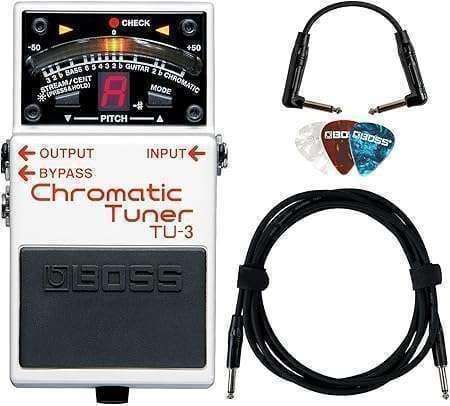
Target Relief Specs (Jaguar)
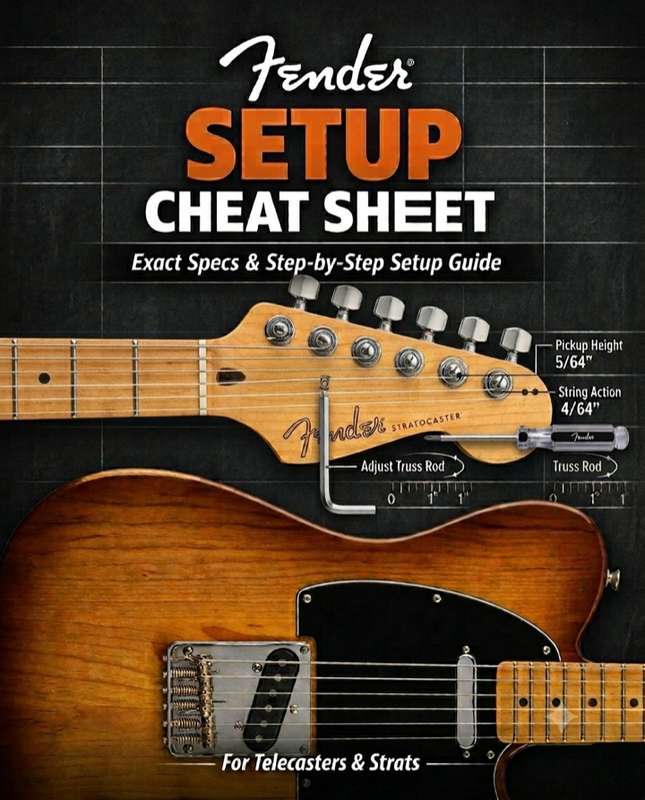
Quick Answer: Jaguar target relief is 0.25 mm (0.010 inches) for most players — the 9.5–12-inch-radius row of Fender's relief chart. Jaguars often need slightly more relief than Stratocasters or Telecasters due to their shorter scale length.
| Playing Style | Target Relief |
|---|---|
| Typical | 0.25 mm (0.010") — Fender's 9.5"–12" radius row |
| Lighter strings or touch | 0.20–0.30 mm (0.008–0.012") |
| Heavier strings (11s or up) | 0.30–0.40 mm (0.012–0.016") |
Relief is measured at the 7th–8th fret while fretting the last fret and with a capo at the 1st fret. Jaguars often benefit from slightly more relief than a Strat or Tele.
Why Scale Length Matters: The Physics of Relief
The Jaguar uses a 24-inch scale, which is significantly shorter than the standard 25.5-inch Fender scale (Strat/Tele) or the 24.75-inch Gibson scale. This means:
- Lower Tension: For a given pitch and string gauge, the Jaguar strings are much looser.
- Elliptical Vibration: Loose strings vibrate in a wider arc. If the neck is too straight (flat), the strings will hit the frets (buzz) more easily than on a Strat.
- Conclusion: Jaguars often need slightly more relief to accommodate this wider vibration path, especially if you play aggressively.
Tools You’ll Need
- Capo (e.g., Kyser Quick-Change Capo)
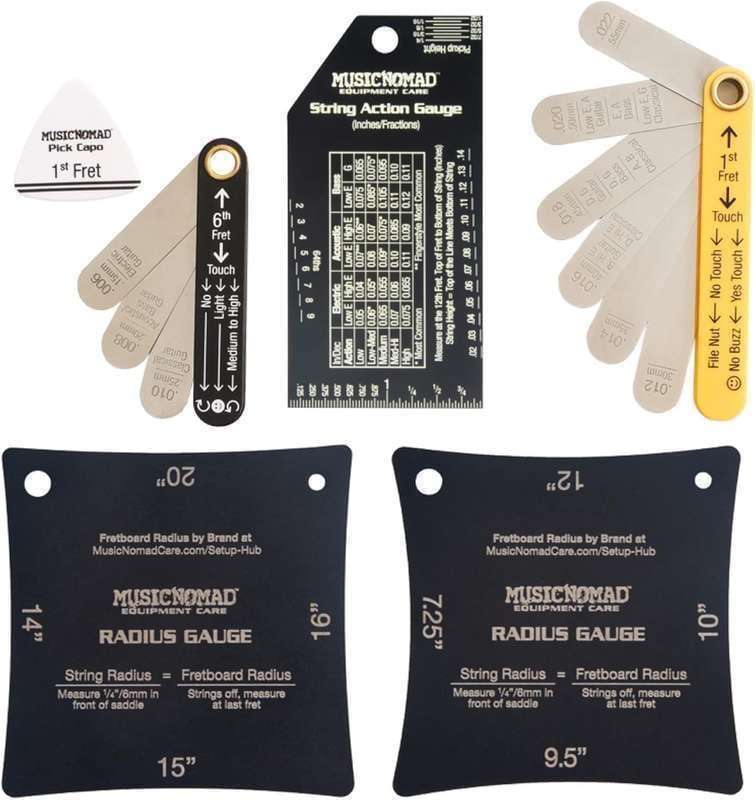
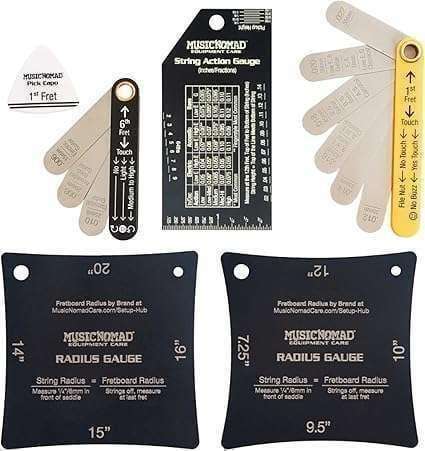
- Feeler gauges (e.g., MusicNomad Precision Truss Rod Gauge)
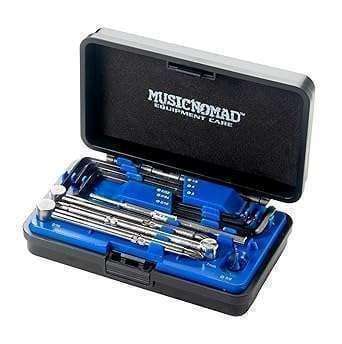
- Appropriate truss rod wrench (often 3/16" for US models; consider the MusicNomad Truss Rod Wrench Set)
- Tuner (e.g., Boss TU-3 Chromatic Tuner)
How to Measure Neck Relief
- Tune to Pitch: ALWAYS measure with the guitar tuned to playing pitch. Tension pulls the neck forward.
- Capo the 1st Fret: This eliminates the nut height variable.
- Fret the Last Fret: Use your right hand to hold down the low E string at the very last fret. The string now acts as a perfect straightedge.
- Measure the Gap: Use feeler gauges to check the gap between the bottom of the string and the top of the 8th fret wire.
- Evaluate: The string should just barely clear the feeler gauge without moving. If the string moves when you slide the gauge in, the gap is smaller than the gauge.
Adjustment Basics (Clockwise vs Counterclockwise)
- Clockwise (Tighten): Corrects "Up-Bow" (too much gap). Straightens the neck.
- Counterclockwise (Loosen): Corrects "Back-Bow" (no gap/buzzing). Adds relief.
The Golden Rule: Adjust in 1/8 turn increments. Retune and re-measure after each turn. Wood takes time to settle.
Heel-Adjust vs. Headstock-Adjust: Identifying Your Truss Rod
1. The Headstock Adjust (Modern)
Found on: Player Series, American Professional, Squier Classic Vibe (some), Performer.
- Convenience: High. You can adjust it with strings on.
- Tool: Usually a 3/16" Allen key (US/MEX) or 4mm/5mm metric key (Asian imports).
- Note: Keep the key fully seated to avoid stripping the nut.
2. The Heel Adjust (Vintage/Reissue)
Found on: American Vintage II, Vintera, Original 60s.
- Convenience: Low. The adjustment screw is at the base of the neck, hidden by the pickguard/body.
- The Procedure:
- Loosen strings completely.
- Place a capo to hold strings in place.
- Unscrew the 4 neck plate screws.
- Gently tilt the neck out of the pocket to expose the "X" screw or nut.
- Make your adjustment (guess wisely!).
- Re-attach measurements.
- Pro Tip: This is tedious. Measure twice, turn once.
Step-by-Step: Dialing in Jaguar Relief
- Evaluate: Measure current relief.
- Plan: Choose a target based on your string gauge and playing style.
- Adjust: Make a 1/8 turn in the needed direction.
- Settle & Retune: Let the neck settle, then retune.
- Play-test: Check for buzz and comfortable feel.
- Iterate: Repeat small adjustments until you reach your target.
Troubleshooting: Diagnosis and Solutions
Identifying the root cause of playability issues requires systematic diagnosis. Use this comprehensive table to match symptoms with their most likely causes and solutions.
Symptom-to-Cause Diagnostic Table
| Symptom | Likely Cause | Solution | Difficulty |
|---|---|---|---|
| Buzz on frets 1-5 only | Insufficient relief (neck too straight) | Loosen truss rod 1/8 turn, retune, retest | Easy |
| Buzz on frets 12-22 only | Too much relief OR action too low at bridge | Check action height first, then adjust relief | Medium |
| Buzz across ALL frets | Truss rod unrelated; check action, nut, fret wear | Full setup evaluation needed | Medium |
| Open strings buzz | Nut slots cut too low | File or replace nut | Medium-Hard |
| Buzz on specific strings only | Uneven frets, worn frets, or saddle height | Fret level/dress or saddle adjustment | Variable |
| Action feels too high despite low measurements | Too much neck relief | Tighten truss rod 1/8 turn increments | Easy |
| Truss rod very tight/won't turn | Maxed out adjustment or seized rod | STOP. Consult professional luthier. | N/A |
| Neck visibly twisted | Severe structural issue | Professional repair required | N/A |
| Bridge rattles during play | Loose bridge components, insufficient break angle | Tighten screws, add neck shim | Medium |
| Notes choke out when bending | Neck too flat, especially on treble side | Add slight relief, check fret level | Medium |
The "Sitar Sound" on Jaguars
A common complaint among Jaguar players is a metallic, sitar-like overtone on certain notes. This is almost never a truss rod issue. Instead, check:
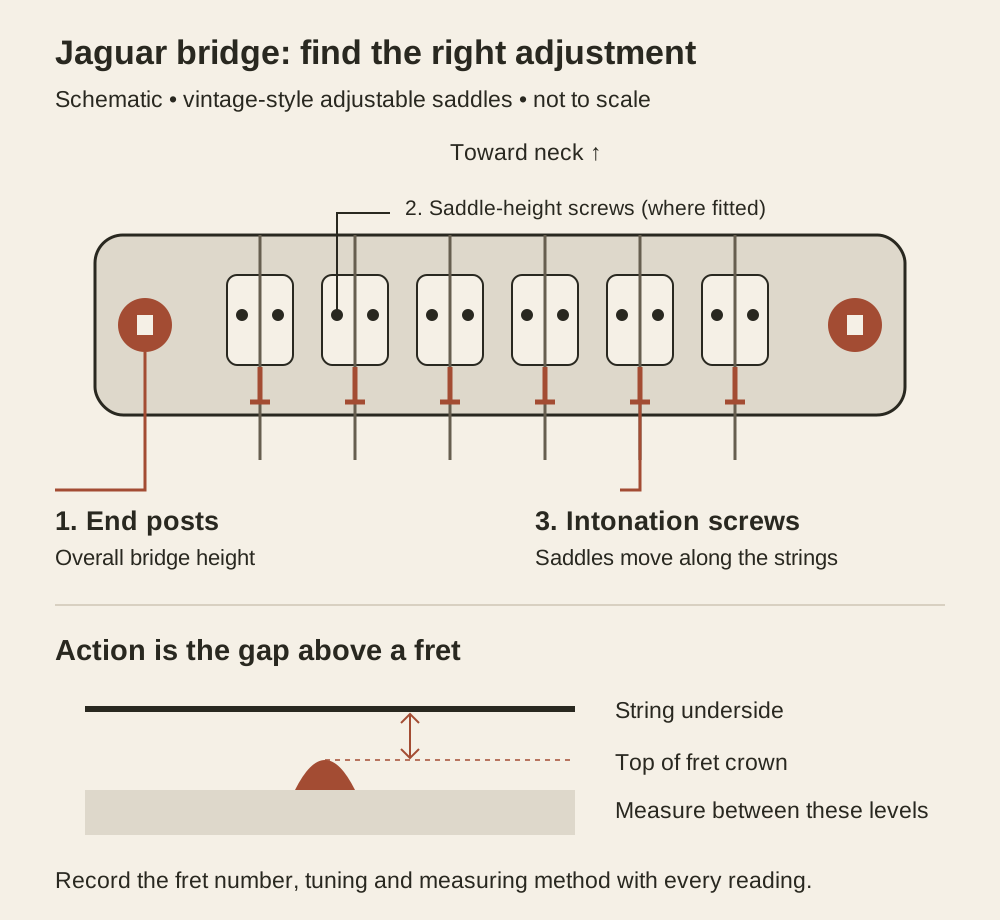
- String Saddle Seating: The stock Jaguar bridge has threaded saddles that can vibrate. Ensure strings are properly seated in the grooves.
- Bridge Height Screws: These can loosen and rattle. Apply a drop of threadlocker (blue Loctite) if needed.
- Tremolo Lock: When engaged, the lock plate can resonate against the tailpiece.
- Pickup Height: Pickups set too high create magnetic interference, causing wolf tones and sitar-like artifacts.
Environmental Factors: How Climate Affects Your Jaguar Neck
Wood is hygroscopic—it absorbs and releases moisture based on ambient humidity. This directly affects neck relief, often dramatically.
Humidity and Neck Behavior
| Humidity Level | Effect on Wood | Effect on Neck | Recommended Action |
|---|---|---|---|
| Below 35% (too dry) | Wood shrinks, loses moisture | Neck straightens, fret ends protrude ("fret sprout") | Use humidifier, store in case with Humidipak |
| 35-55% (ideal) | Wood stable | Relief remains consistent | Maintain this range year-round |
| Above 60% (too humid) | Wood swells, absorbs moisture | Neck may develop more relief (bow) | Use dehumidifier, silica gel packets in case |
Seasonal Adjustment Reality
In climates with distinct seasons, expect to adjust your truss rod 1-2 times per year:
- Winter (indoor heating): Air becomes very dry. Necks typically straighten. You may need to loosen the truss rod slightly to add relief.
- Summer (high humidity): Wood absorbs moisture. Necks often bow forward. You may need to tighten the truss rod slightly to reduce relief.
Pro Tip: Keep a dedicated feeler gauge in your case. Check relief monthly during seasonal transitions (spring and fall). Small, proactive adjustments prevent larger issues.
Temperature Considerations
Avoid leaving your Jaguar in:
- Hot cars: Extreme heat can soften glue joints and warp necks permanently.
- Cold environments: Rapid temperature changes cause finish checking (fine cracks in the lacquer).
- Direct sunlight: UV exposure degrades finishes and can cause uneven wood expansion.
Always allow your guitar to acclimate to room temperature (20-30 minutes in its case) before playing or making adjustments.
Understanding Truss Rod Mechanics
The truss rod is a metal bar (usually steel or graphite-reinforced steel) embedded in the neck. Understanding its mechanics helps you adjust with confidence.
Single-Action vs. Dual-Action Truss Rods
| Type | Found On | Function | Limitation |
|---|---|---|---|
| Single-Action (Vintage) | American Vintage II, '60s Vintera, many reissues | Straightens neck only (counteracts string tension) | Cannot correct back-bow (requires loosening + humidity) |
| Dual-Action (Bi-Flex) | Some American Professional, certain modern models | Can push neck in either direction | More versatile, but more complex mechanism |
Most Jaguars use single-action rods. If your neck has developed a severe back-bow (strings laying on frets with no gap), a single-action rod cannot push the neck forward—only humidity, proper storage, or professional intervention can correct this.
The Tension Balance Equation
Your neck exists in a constant tug-of-war between:
- String Tension (pulling forward): A set of 10-46 strings at standard tuning exerts roughly 90-110 lbs of force.
- Truss Rod Tension (pulling back): When tightened, the rod counteracts string pull.
- Wood's Natural Stiffness: The maple neck has inherent resistance.
The goal is to find equilibrium where the neck has just enough forward bow (relief) to allow strings to vibrate freely without hitting frets.
What Happens During Adjustment
When you turn the truss rod:
- Clockwise (Tighten): The nut compresses against the rod, pulling the heel of the neck backward relative to the headstock. This straightens the neck.
- Counterclockwise (Loosen): Less compression allows string tension to pull the neck forward, increasing relief.
Why Small Adjustments Matter: The relationship isn't linear. A 1/4 turn on a stiff neck might move relief by 0.002"; on a flexible vintage neck, the same turn might move it 0.010". Always adjust in 1/8 turn increments maximum.
Advanced Diagnostics: Is It Really the Truss Rod?
Before touching your truss rod, rule out other common causes of playability issues.
The 3-Point Diagnosis Protocol
Step 1: Visual Neck Inspection Sight down the neck from the headstock, looking toward the body along the fretboard edge.
- Healthy: A slight, even curve (forward bow) visible.
- Problem Signs: S-curves, twists, humps, or dead-flat sections.
Step 2: Fret Rocker Test Use a short straightedge (or specialized fret rocker tool) across 3 adjacent frets.
- If it rocks: The middle fret is higher than its neighbors—this causes localized buzz. Solution: fret leveling, NOT truss rod adjustment.
- If stable: Frets are level in that zone.
Step 3: String Height Check Measure action at the 12th fret using a ruler or dedicated gauge.
- Factory Jaguar Specs: ~4/64" bass side, ~3/64" treble side.
- If action is correct but you still have buzz: It's likely a relief issue.
When NOT to Adjust the Truss Rod
Do not use the truss rod to fix:
- High frets: Requires fret leveling/crowning.
- Nut slot depth issues: Requires nut filing or replacement.
- Bridge buzzing: Specific to Jaguar floating bridge design.
- Dead spots: Caused by resonance, not curvature.
- Intonation problems: Addressed at bridge saddles.
Relief and Bridge Setup: The Jaguar-Specific Challenge
On a Jaguar, neck relief, bridge height, and neck angle (shim) are all interconnected in a way that's unique among Fender guitars.
The Neck Shim Factor
Jaguars use a floating bridge with limited downward saddle travel. If the bridge is set very low, strings may:
- Lack proper downward pressure on saddles (causing buzz/rattle).
- Have insufficient break angle over the bridge.
The Solution: A neck shim in the pocket. By tilting the neck slightly backward, you raise the effective action, allowing the bridge to sit higher while maintaining low string height at the nut. This increases break angle and string pressure on the saddles.
Shim Recommendation: Use a proper tapered shim (e.g., StewMac Full Pocket Shims) at 0.25° to 1°. Avoid makeshift shims like business cards—they don't provide consistent support.
The Setup Order of Operations
For Jaguars, always follow this sequence:
- Neck Relief (truss rod) – Establish the foundation.
- Action Height (bridge saddles) – Set string height.
- Pickup Height – Balance output without interference.
- Intonation (saddle position) – Fine-tune pitch accuracy.
If you start with intonation and then change relief, you'll need to re-intonate. Work in order.
- Use a Jim Dunlop String Height Gauge to set action at the bridge.
- Lubricate the bridge saddles and nut with MusicNomad TUNE‑IT.

Frequently Asked Questions (FAQ)
How much relief do Jaguars need?
Answer: Jaguars typically start at 0.010" (0.25mm) of neck relief measured at the 8th fret — the 9.5"–12"-radius row of Fender's relief chart. Due to the 24" scale length and lower string tension, Jaguars often need slightly more relief than Stratocasters (25.5" scale) or Telecasters to prevent fret buzz, especially with aggressive playing styles. If you use heavier strings (11-49 or higher), add relief in small steps from there.
Do I need to remove the neck to adjust the truss rod?
Answer: It depends on your Jaguar model. Vintage-style Jaguars (American Vintage II, Vintera '60s, Original '60s) feature a heel-adjust truss rod, requiring neck removal for access. Modern series like the Player, American Professional, and some Squier models have headstock access, allowing adjustment without removing the neck. Check your model's specifications or look for an adjustment point at the headstock before assuming you need to remove the neck.
Why does my Jaguar still buzz with correct relief?
Answer: If neck relief is confirmed correct (around 0.010" at 8th fret for a 9.5-inch-radius neck), several other factors commonly cause buzzing on Jaguars:
- Neck angle/shim: Jaguars often benefit from a 0.25°–1° neck shim to improve break angle over the bridge.
- Bridge height: The floating bridge may be set too low, or saddles may be improperly adjusted.
- Nut slots: Slots cut too deep cause open-string buzzing.
- Fret wear/unevenness: High frets cause localized buzz (requires fret work, not truss adjustment).
- Bridge rattle: The threaded saddles on vintage-style bridges are notorious for rattling; consider upgrading to a Mastery or Staytrem bridge.
How often should I adjust the truss rod?
Answer: Under stable conditions (consistent humidity, same string gauge, same tuning), you may never need to adjust. However, seasonal changes often require 1-2 adjustments per year—typically loosening slightly in dry winter months and tightening slightly in humid summers. If you change string gauges (e.g., from 10s to 11s), always recheck and adjust relief.
Can I damage my guitar by adjusting the truss rod?
Answer: Yes, but only through excessive force or improper technique. Follow these safety rules:
- Never force a stuck truss rod—consult a professional.
- Never adjust more than 1/4 turn per day maximum.
- Always tune to pitch before measuring.
- Use the correct size wrench to avoid stripping the nut.
- If you hear cracking or feel unusual resistance, stop immediately.
What's the difference between relief, action, and intonation?
Answer: These are three distinct setup parameters:
- Relief: The slight forward bow in the neck, controlled by the truss rod. Measured at the 8th fret.
- Action: The height of the strings above the frets, adjusted at the bridge saddles. Measured at the 12th fret.
- Intonation: The accuracy of pitch across the fretboard, adjusted by moving bridge saddles forward or backward. Checked by comparing 12th fret harmonic to 12th fret fretted note.
Each affects playability differently, and they should be set in order: Relief → Action → Intonation.
Should I loosen strings before adjusting the truss rod?
Answer: For most adjustments, no—measure and adjust with strings at full tension to see real-world conditions. However, for heel-adjust models where you must remove the neck, you'll need to loosen the strings first.
Related Guides
- Main: Ultimate Fender Jaguar Setup Guide
- Also see: Jaguar Tremolo & Lock Setup
Related Posts
Jaguar-Specific Guides
- Ultimate Jaguar Setup Guide - Complete setup process and specifications
- Jaguar Tremolo Setup Guide - Tremolo system configuration
- Jaguar String Gauge Selection Guide - Action height and string gauge selection
Other Fender Guitar Setup Guides
- Telecaster Setup Guide - Complete Telecaster setup process
- Telecaster Truss Rod Adjustment - Telecaster neck relief techniques
- Stratocaster Setup Guide - Complete Stratocaster setup process
- Jazzmaster Setup Guide - Jazzmaster-specific setup procedures