Fender Fake Checker: Is Your Guitar Authentic?
Free Fender fake checker. Answer a two-minute red-flag checklist built for Fender: decal fonts, string trees, neck plates, serials and workmanship. Get an instant risk band before you pay.
The free Fender authenticity quick-check above runs the exact red-flag checklist experienced Fender buyers use — including the Fender-specific details that copies get wrong: decal fonts, string trees, neck plates, and tuners. Answer each question honestly ("not sure" never counts against the guitar) and you'll get a clear risk band in about two minutes.
No email required, no signup. Just a straight answer on whether the Fender deal in front of you deserves a closer look.
What the Fender Checklist Covers
- Price — is it far below what this model usually sells for? A "US Stratocaster" at Squier money is the oldest trick in the book.
- Seller behaviour — rushing you, dodging questions, refusing returns? Honest sellers welcome scrutiny.
- Serial number — missing, poorly stamped, or inconsistent with the claimed year? Always decode it.
- Weight — copies frequently use cheaper woods that weigh far off spec.
- Hardware — tuners, bridge, and screws that look rough, thin, or poorly finished.
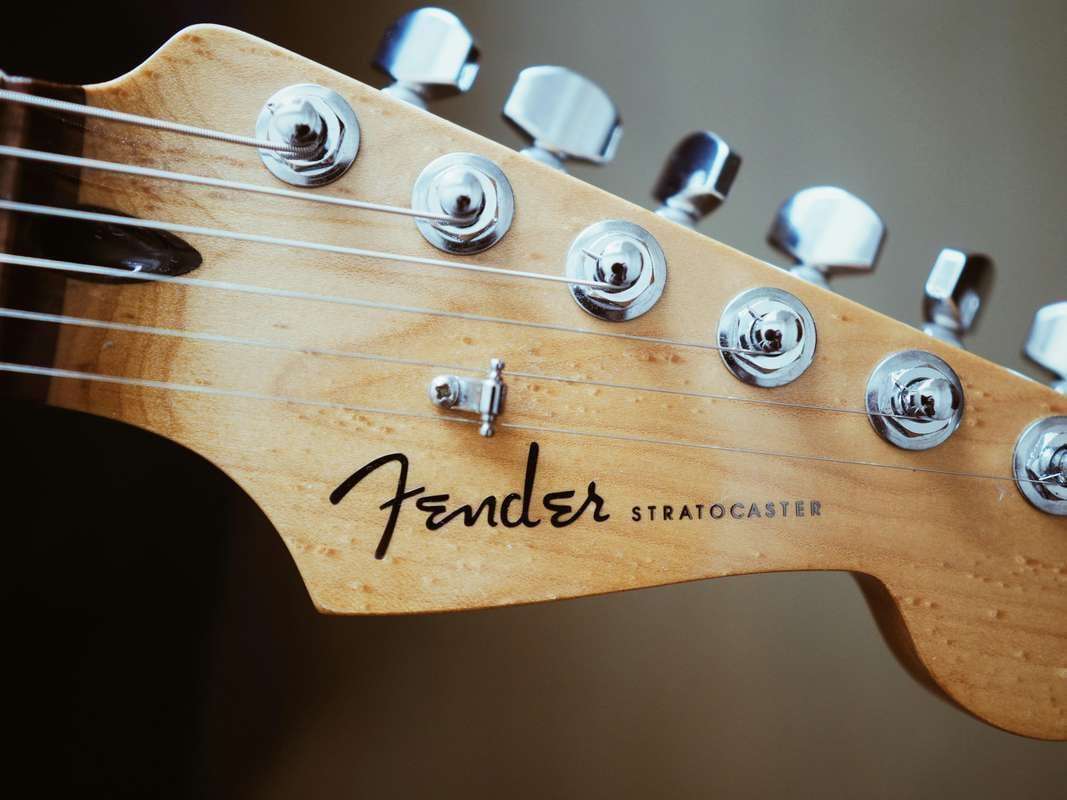
- Logo and decals — spelling, spacing, or printing errors in the logo are what fakes get wrong most often.
- Workmanship — rough fret ends, sloppy finish edges, and glue marks point to a copy shop.
Plus the Fender-family checks: headstock decal font/size/placement against genuine examples, string tree style and position for the era, neck plate bolt pattern and engraving, and tuner style for the claimed model and year.
The Fender Tells That Catch Fakes
Fender used specific details per era, and copies consistently get them wrong:
Decal styles — Fender changed its logo through the spaghetti (1954–1964), transition (1965–1967), CBS block (1968–1975), and modern script (1976+) eras. A guitar claiming to be a 1962 Strat with a modern logo is either modified or fake. Genuine decals sit under the finish — a sticker-like logo with raised edges is a copy.
String trees — round "disc" trees, butterfly trees, and their headstock positions changed by era. A wrong or misplaced tree is a cheap, common copy error.
Neck plates — most Fenders use a 4-bolt plate with era-correct engraving (the 1970s 3-bolt being the exception). Plain or wrongly engraved plates are a flag.
Tuners — a guitar claimed as vintage with modern sealed tuners, or a modern model with the wrong tuner brand, is either modified or not what it says it is.
What the Free Check Can't See
Here's the honest part: a checklist can't look at your Fender. You can answer every question from the listing description and still miss the thing that gives a careful fake away — the slightly wrong logo font in photo three, or a partscaster neck that only looks off once you've seen a hundred real ones.
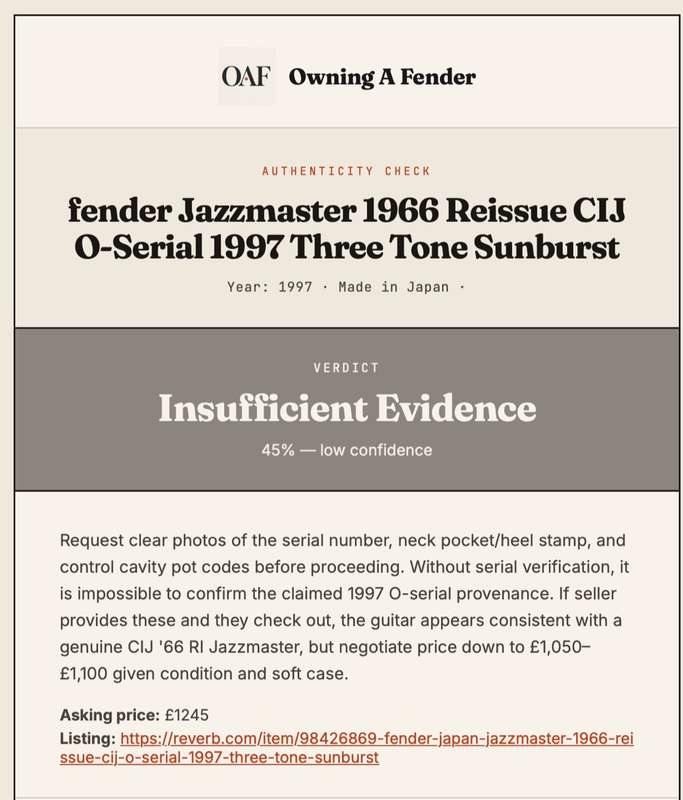
That's exactly what the $9 Authenticity Checker is for. Upload the actual listing photos — headstock, body, hardware, serial — and you get specific risk flags on the real guitar, not a generic checklist. If your quick-check came back with red flags, it's the cheapest insurance you'll ever buy.
Before You Buy: Decode the Serial
A genuine Fender serial decodes to a year, country, and factory. Run yours through the free Fender serial number lookup and check the result against the guitar's claimed age and features. US10+ = USA 2010+, MX/MZ/MN = Mexico, JV/JD = Japan — if the serial's era contradicts the listing, that's a stop-and-ask moment.
Frequently Asked Questions
Is this Fender fake checker really free?
Yes — completely free, and there's no email required. Answer the checklist and you get an instant risk band on the spot, with checks tuned to Fender's details. If you want the actual listing photos screened afterwards, the optional $9 Authenticity Checker goes deeper.
How do I tell if a Fender is fake?
Check the decal (style must match the era and sit under the finish), decode the serial number and compare the year to the claim, then verify the string trees, neck plate, tuners, weight, and workmanship. Two or more mismatches mean stop and ask. This page's checklist runs all of those for you.
Do fake Fenders have serial numbers?
Yes — and the serial is often the giveaway. Counterfeiters copy serials from real guitars, stamp them shallowly or in the wrong font, or use a format that doesn't match the claimed era. Decode it: if the year doesn't match the listing, that's a red flag.
What is a partscaster?
A partscaster is a guitar assembled from Fender and aftermarket parts — often a real neck on a non-Fender body. It's not a counterfeit, but it's not the guitar it claims to be either. Mismatched serials, wrong decal for the era, and hardware that doesn't match the claimed year are the tells.
Are Squiers fake Fenders?
No. Squier is Fender's own budget brand. "Real vs fake" is not "Fender vs Squier" — it's whether the guitar is what the seller says it is. If you're checking a Squier, use the Squier authenticity quick-check instead.
Can a checklist prove a Fender is real or fake?
No — and you should be suspicious of any free tool that claims it can. A checklist tells you how hard to look; a photo check does the looking. For anything over a few hundred dollars, the $9 photo screening is worth it.
Conclusion
The free Fender checklist catches the obvious tells — absurd pricing, evasive sellers, serials that don't decode, wrong decal fonts, and visible workmanship problems. Run it on every used Fender listing before money changes hands.
When it comes back clean, one honest caveat remains: careful fakes pass paper checks. The $9 Authenticity Checker screens the actual photos and flags the details that give careful fakes away.