Acoustic Guitar Humidity: What to Check When Action Changes
Check acoustic guitar humidity before changing action. Compare maker guidance, diagnose dry or damp symptoms, and keep a free humidity and setup diary.
By Nick TheodoulouUpdated

On this page
Acoustic guitar humidity belongs near the top of your checklist when comfortable action suddenly becomes stiff, buzzy or uneven. Before turning the truss rod or removing saddle material, measure the storage environment, inspect the instrument and compare the symptoms with your previous setup.
For many wooden acoustics, 45–55% relative humidity is the maker's recommended storage range. Follow your own manufacturer's guidance rather than treating one percentage as a guarantee. A hygrometer measures the surrounding air; it cannot tell you that the wood has recovered or that a crack needs no repair.
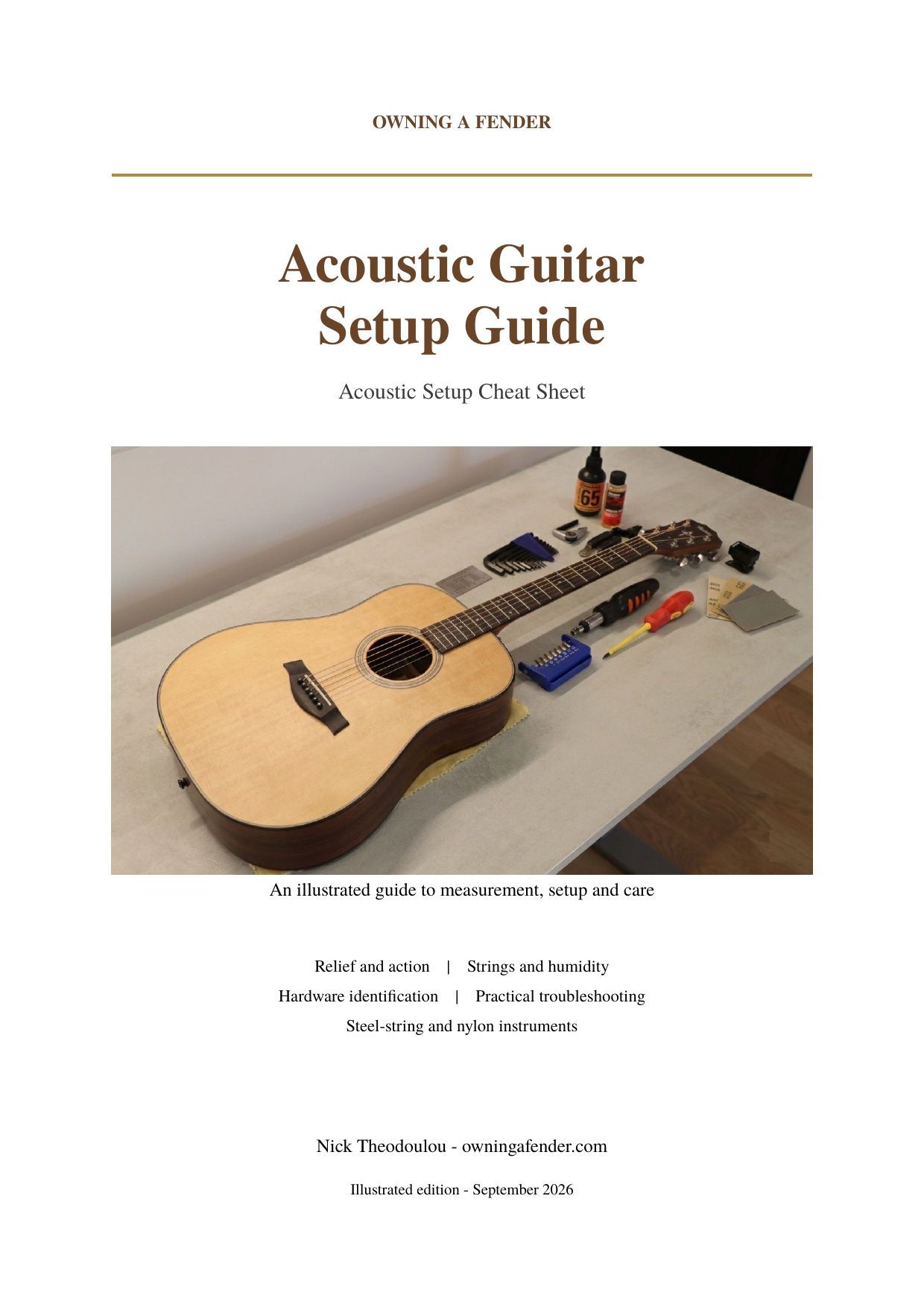
This guide helps you choose the next check and includes a free humidity/action diary. Once the environment and condition are understood, the Acoustic Setup Guide provides a printable care-and-measurement workflow, setup checklist and blank record for future changes.
Already have a reading? Use the acoustic guitar humidity checker to compare it with Taylor’s reference range, then return here for the full measurement diary and care guidance.
Start With the Maker's Humidity Guidance
Humidity advice becomes confusing when a storage recommendation, a sensor alert and a humidifier's operating target are presented as the same thing. They answer different questions. Use the instrument's care instructions to choose its environment, then use the equipment instructions to maintain and measure it.
| Manufacturer reference | Published guidance | How to use it |
|---|---|---|
| Martin care FAQ | 45–55% RH; 72–77°F / 22–25°C | A storage recommendation for Martin instruments; avoid heat sources and abrupt changes. |
| Taylor humidity guidance | 45–55% RH | Measure where the guitar lives; correct the environment when it falls outside the recommended range. |
| Yamaha acoustic care guide | 45–55% RH | Choose storage with little temperature or humidity variation; keep away from direct sun and air-conditioning outlets. |
These sources support a practical starting range, not a promise that every instrument is undamaged at 50%. A guitar recently moved from very dry storage can sit beside a normal-looking sensor while its condition still needs attention. Equally, one brief reading above the target does not prove that a top is swollen.
Taylor's separate sensor-support pages describe alerts outside 40–60% over a sustained period. That broader alert band does not replace its 45–55% ideal-care recommendation.
Temperature and humidity belong in the same record
Relative humidity changes with temperature. Heating indoor air without adding moisture lowers its RH, which is why turning on the heating is a useful trigger to check the guitar room. Outdoor weather reports cannot substitute for an indoor reading beside the instrument.
Avoid trying to predict a room's exact RH from the thermostat alone. Ventilation, outside air, cooking, air conditioning and moisture sources also affect the result. Record the temperature shown by your hygrometer alongside RH and describe any recent change in storage.
Martin's care guide also warns about abrupt temperature changes and finish damage. Keep the case away from radiators, direct sunlight and parked-car heat. After travel between very different temperatures, follow the maker's acclimation instructions before opening and playing.
Measure the Air Where the Guitar Actually Lives
A useful humidity reading has a location and a history. “The house is 50%” tells you little if that sensor is in the kitchen while the guitar sits beside a bedroom heater. Start with the room or closed case used for ordinary storage.
Make the readings comparable
- Identify the meter. Read its instructions for operating range, accuracy, stabilization and any calibration procedure. Replace a weak battery when required.
- Choose a repeatable location. Place a room meter near the guitar's storage area, away from direct mist, vents and sunlight. A case sensor must fit without pressing on the guitar when the lid closes.
- Keep the sensor exposed to the relevant air. Do not bury it beneath accessories or press it against a wet humidifier. A closed accessory compartment may describe that compartment rather than the main case space.
- Let the meter settle according to its instructions. For case readings, keep the case closed during the observation interval and read a logger or check the display promptly on opening. Leaving the case open first turns the measurement into a changing mixture of room and case air.
- Write down the result. Record RH, temperature, location and whether the case had just been opened. Minimum/maximum readings help reveal excursions between checks.
There is no universal ten-minute wait that makes every sensor or case accurate. If two meters disagree, place them together in the same stable environment and follow their instructions before deciding which reading to trust. Agreement is a useful check, but does not prove calibration.
Use a supported calibration method if the manufacturer provides one. Do not place wet salt, loose water or calibration materials in the guitar case. A sensor with a stated tolerance also cannot justify treating a one-percentage-point change as a definite change in the wood.
Separate room control from case control
If you leave an acoustic on a stand for most of the day, an excellent reading inside an empty case does not describe its exposure. Measure the room as well. If the guitar mostly stays cased, verify that the case system maintains the intended conditions between playing sessions.
The monitoring and humidification options below serve different jobs. Check the meter's dimensions against your case; a tabletop display is not automatically suitable for a tight instrument compartment.
Measure First, Then Choose Humidity Control

 Buy on Amazon

Use Symptoms to Choose the Next Check
Humidity can change both the body and neck. It is one possible cause of changing action, alongside strings, tuning, relief, frets, saddle geometry and structural faults. Compare several observations rather than diagnosing the guitar from a single number or one buzzy note.
| What changed? | What to check next | What to avoid assuming |
|---|---|---|
| Sharp fret ends and lower action after dry storage | Case/room history, top condition and maker's dry-guitar guidance | That filing frets or adjusting the rod resolves the underlying cause. |
| Higher action after damp storage | Humidity history, bridge/top condition and then measured relief | That the saddle needs immediate sanding. |
| Buzz on a few notes while storage readings remain steady | Exact string/fret pattern, string condition and repeatable relief/action readings | That more humidification is the answer to every buzz. |
| A visible crack, lifting bridge or new structural rattle | Manufacturer support or a qualified repairer | That a normal hygrometer reading means the damage is repaired. |
| One unexpected sensor result without a playing change | Meter location, battery, recent case opening and repeated readings | That a brief excursion proves permanent damage. |
If the guitar appears too dry
Taylor's dry-guitar guidance describes sharp fret ends and low action with upper-fret buzz, while explicitly warning that low action alone may simply need setup attention. That distinction matters: adding water to an already correctly humidified guitar is not a useful diagnostic test.
Move storage toward the maker's recommended environment and follow its instructions for the actual condition. Continue recording symptoms. A recovery period can take weeks; the source does not support a universal 48-hour deadline or a rule to increase RH by ten percentage points every day.
If the guitar appears too damp
Taylor's wet-guitar explanation describes swelling and damage after prolonged excessive humidity. Exposure duration and the instrument's condition matter; a simple chart saying that glue softens the moment a room reaches 60% is misleading.
Stop adding unnecessary moisture and assess the storage environment. Ask the maker about treatment for a visibly distorted instrument. Do not use a hair dryer, radiator, oven or an uncontrolled quantity of desiccant to force a rapid change. Keep any moisture-control product contained and use it only as directed.
If damage is visible
Photograph the problem without forcing anything apart and contact the manufacturer or repairer. Describe when it appeared, the recent environment and whether action or sound changed. Do not poke under a lifting bridge, squeeze a crack shut or keep adjusting the setup to hide the symptom.
Obtain a repair assessment before making a resale decision. A Guitar Price Estimate can provide market context, but it cannot inspect a crack or replace a quote for the instrument in front of you.
Choose a Humidity System for the Storage Problem
Buy equipment to meet an observed need. A hygrometer tells you whether the storage environment needs attention; a humidifier or dehumidifier changes that environment. A setup PDF helps you organize care and measurements, but does neither of those physical jobs.
Refillable soundhole humidifiers
A refillable humidifier adds moisture. It cannot automatically remove excess humidity from a damp case. Follow the exact product's filling, suspension and maintenance instructions, keep liquid away from the guitar, and inspect it before every installation.
Use the measured result and the manufacturer's refill indicator or procedure to decide when maintenance is needed. A fixed weekly schedule cannot cover every case seal, room condition and humidifier design. If the case remains too dry, investigate the storage setup rather than adding an uncontrolled wet sponge.
Two-way packets: maintenance is a specific job
D'Addario Humidipak Maintain adds or absorbs moisture within a closed instrument case, with a published 45–50% RH operating target. Use the supplied sleeves and installation instructions; loose packets should not be substituted for the intended mounting arrangement.
D'Addario distinguishes Maintain, Restore and Absorb in its humidity-system guidance. A maintenance pack is not a blanket recommendation for every severely dry instrument or persistently damp environment. Identify the starting condition and product before choosing a treatment, especially when the guitar already shows damage.
Packet replacement depends on the current product instructions and condition. Check them when you check the guitar. Do not assume that an old packet continues controlling humidity merely because it remains inside its sleeve.
Room systems and cases
For instruments stored out of their cases, room control may be the practical option. Measure the room independently, follow the appliance's cleaning instructions and position it so mist or airflow does not strike the guitar. Choose humidification or dehumidification according to the readings.
A case can buffer the guitar's environment, but its effectiveness needs checking. Hard cases, padded bags and different seals are not interchangeable. Do not assume that opening the latches periodically will solve a humid case: if the room is wetter, opening it moves conditions in the wrong direction.
In a hotel or unfamiliar room, use your normal case system and meter. Steam from a shower, damp towels beside the guitar and improvised soaking routines offer poor control. If suitable conditions are unavailable, ask the instrument maker for storage advice instead of improvising treatment.
Keep a Free Humidity and Action Diary
Copy these blank tables into a notebook or print this section. They are a record of your guitar, not recommended settings or example test results. Start with the instrument's current condition and keep earlier entries after a repair so that the history remains useful.
Instrument/model: __________ Strings and tuning: __________
Maker's care source and target: __________
Sensor model/location: __________ Case or room system: __________
Environment record
| Date/time | RH / temp | Place | Change |
|---|---|---|---|
| ______ | ______ | ______ | ______ |
| ______ | ______ | ______ | ______ |
| ______ | ______ | ______ | ______ |
| ______ | ______ | ______ | ______ |
Record heating or air-conditioning changes, travel, time out of the case and humidifier maintenance. If a meter reports minimum/maximum values, note the interval they cover; reset only after saving them. A daily record during a change is a practical starting habit, not a promise that the guitar will recover in a set number of days.
Setup comparison record
Tune to the recorded tuning before comparing action. For an open-string action measurement, record the distance from the fret crown to the underside of each outer string at the chosen fret. The same fret, instrument position and open/capoed state must be used each time.
| Check | Method | Earlier | Current |
|---|---|---|---|
| Bass-string action | Fret: ___; open/capoed: ___ | ___ | ___ |
| Treble-string action | Fret: ___; open/capoed: ___ | ___ | ___ |
| Relief | Held frets: ___; measuring fret: ___ | ___ | ___ |
| Playing symptom | String/fret/passage and attack: ___ | ___ | ___ |
Condition concerns: __________ Action taken: __________
Next check or service advice: __________
Keep units consistent. For example, millimetres and sixty-fourths of an inch need conversion before comparison; apparent precision on a ruler does not guarantee repeatable measurement. Retake an uncertain reading rather than writing down a guessed improvement.
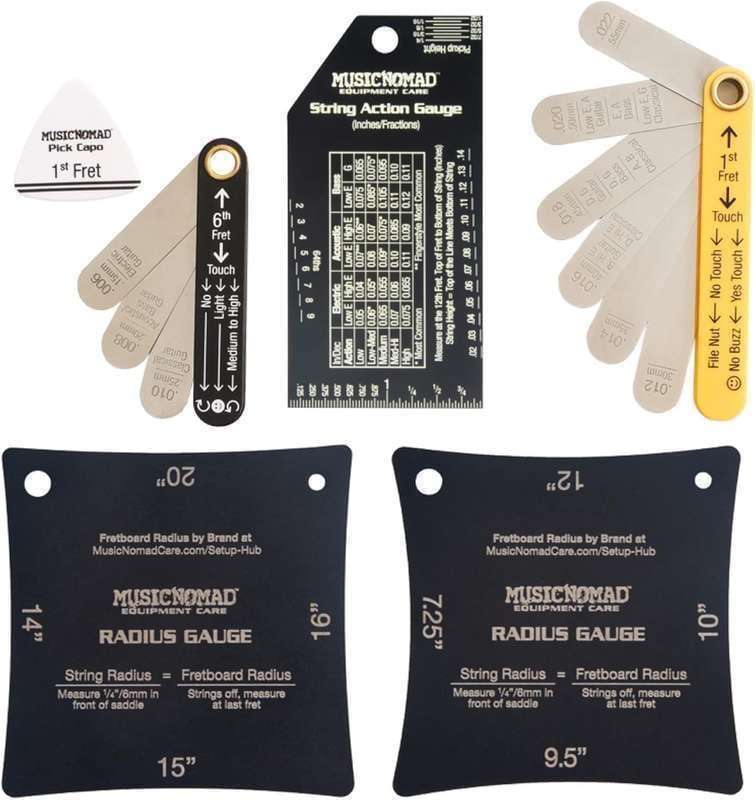
An action gauge is useful if you do not already have a suitable ruler. A full kit is optional, and owning adjustment tools is not a reason to use them before diagnosis.
Decide what the diary supports
If the environment changes and action changes with it, retain that observation while checking the rest of the instrument. It suggests a connection; it does not prove that all movement came from the top or predict how many millimetres another guitar will move.
If storage readings have settled but playability remains poor, compare relief and action using the correct model's method. The acoustic action-height guide explains those measurements, while the acoustic truss-rod guide separates neck relief from other causes of high action.
Use the Taylor setup guide or Yamaha setup guide when those model families apply. Neck-angle service and pickup/saddle arrangements require their own instructions; a generic seasonal adjustment schedule cannot cover them.
There is no obligation to adjust a guitar that plays well. Keep the satisfactory baseline, continue normal care and measure again when something actually changes. If a technician resolves the problem, ask for the method and final readings so your next comparison has a reliable starting point.
Frequently Asked Questions
What is the ideal humidity for an acoustic guitar?
Martin, Taylor and Yamaha guidance linked here recommends 45–55% relative humidity. Follow the instructions for your own instrument and keep temperature and storage conditions stable. A target air reading does not prove that existing damage has healed.
Does 60% humidity mean my guitar is damaged?
A reading alone does not establish damage. Check its duration, sensor location, the maker’s recommendation and any physical or playing changes. Persistent excessive humidity deserves attention; a lifting bridge or visible distortion needs professional assessment.
Can humidity change acoustic guitar action?
Yes. Changes in the body and neck can affect action, but strings, relief and structural problems also matter. Record the environment and repeat the same measurements before deciding what needs adjustment.
Should I adjust the truss rod when the weather changes?
Measure relief first using the correct method for your instrument. The calendar is not an adjustment instruction, and the rod cannot repair a dry top, crack or lifting bridge. Resolve environmental and condition concerns before planning setup work.
Where should a guitar-case hygrometer go?
Use a secure position with air exposure and adequate clearance when the lid closes, following the meter’s instructions. Keep it away from direct moisture and do not bury it in accessories. Record whether the reading describes the main case space or another compartment.
Do I need a humidifier in winter?
Use indoor readings to decide. Heating can lower relative humidity, but climate and storage vary. Add humidity only when the maker’s recommendation and measured conditions call for it, then check that the system is working.
Can I leave my acoustic on a stand?
Measure and control the room where the guitar spends that time, and protect it from impact, direct sun and vents. A humidifier in an empty case cannot control the air around a guitar on a stand.
How long does a dry guitar take to recover?
There is no reliable universal deadline. Follow the maker’s instructions and track condition as well as air readings; recovery can take weeks. Visible damage or a lack of improvement should be discussed with the manufacturer or a repairer.
Is a two-way humidity pack the same as a soundhole humidifier?
A refillable soundhole humidifier normally adds moisture. A two-way system can add or absorb moisture within its specified use conditions. Product ranges also distinguish maintenance from restoring dry instruments or handling excess humidity; choose the exact product for the job.
Will the Acoustic Setup Guide fix humidity damage?
No document can repair damaged wood or control the environment. The guide provides humidity checks, a measurement workflow, a printable setup checklist and a blank record. Use equipment for environmental control and qualified service for structural damage.
Keep the Next Change Measurable
Start with the maker's care guidance, a trustworthy reading and a description of what changed. Keep the diary beside your guitar's records, then recheck playability with the same method. That gives you a useful next step whether the answer is environmental care, an ordinary setup check or a repair appointment.
For an ongoing workbench reference, the Acoustic Setup Guide brings those care decisions together with relief/action measurement, a printable checklist and a blank setup record. Keep your model's manual alongside it.
Keep reading
Next for your Acoustic
- Same guitarAcoustic Guitar Action Height: Measure Before You AdjustRead
- Same guitarAcoustic Guitar Truss Rod Adjustment: Measure FirstRead
- Same guitarAcoustic Guitar String Gauges: Light vs MediumRead
Everything for your Acoustic
Open the hub