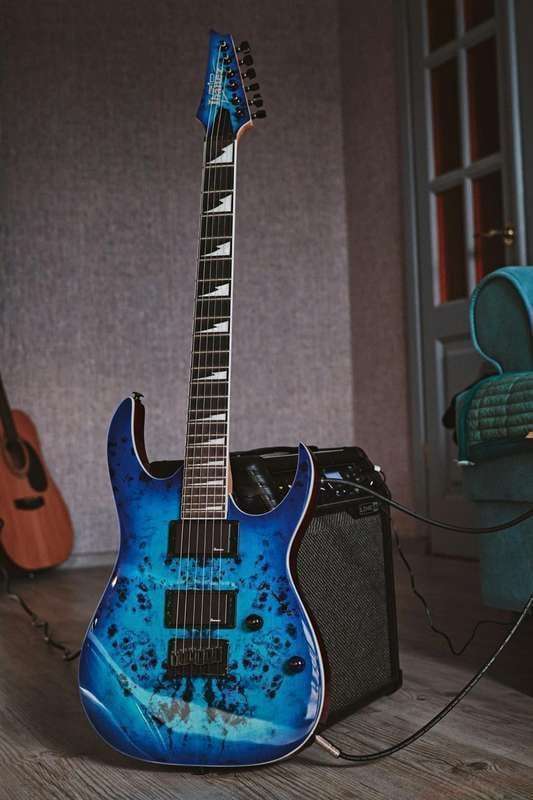
The JPM100 P3 John Petrucci Handed Over in Person
A tour-used Ibanez JPM100 P3, owned by John Petrucci from 1997 to 1999 and handed to its current owner at a 1999 Dream Theater show, a fully documented provenance story.
There's a moment in some guitars' lives where they stop being instruments and become stories. For most, that moment never comes. For one Ibanez JPM100 P3, it came twice: first on stages around the world under John Petrucci's hands between 1997 and 1999, and again on the 11th of November 1999, in a corridor beside the stage of the IJsselhallen in Zwolle, the Netherlands, when Petrucci opened the case and, filming it for his wife Rena, who had arranged the whole sale, remarked that it isn't really black and white. More like ivory.
This is the story of that guitar: a tour-used JPM100 P3 whose chain of custody runs from one of the most influential players in modern progressive music to the fan who has kept it, documented and cherished, for a quarter of a century. It's also a story about why that documentation (the emails, the listing, the photos, the first-hand account) is worth more than the wood it describes.
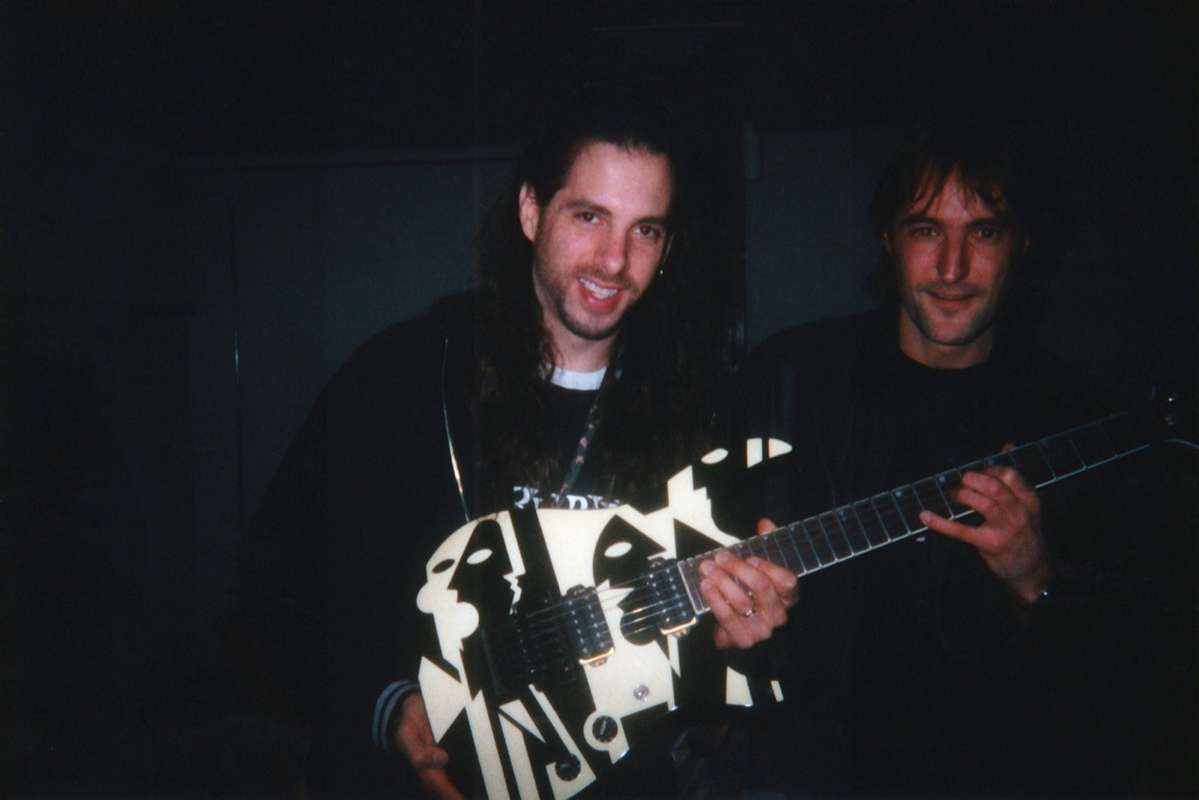 Gert Nijboer with John Petrucci and the P3, side of stage, IJsselhallen Zwolle, 11 November 1999. Photo: Gert Nijboer.
What a JPM100 P3 actually is
In the mid-1990s, John Petrucci, Dream Theater's guitarist and, for a generation of players, the technical benchmark of modern rock, signed with Ibanez. The result was the JPM100, a signature model built to his specifications: basswood body, DiMarzio pickups (a Steve's Special in the bridge, an Air Norton in the neck), a slim, fast maple neck with a rosewood board, and a Lo-Pro Edge double-locking tremolo. The "P" in the name referred to the paint scheme. The JPM100 went into production in four graphic finishes, P1 through P4, between 1995 and 1999. The broader graphic family runs further: a couple of one-off finishes John used on record and on video (an "Another Day" finish and a "Desert Storm" prototype) and the JPM90HAM, a flamed-maple model built in 1998 to mark Hoshino's ninetieth anniversary. Taken together, catalogues of the full graphic family — the Ibanez Wiki among them — count seven "Petrucci Custom Graphic" colours: the four production finishes, those two prototypes, and the anniversary model. There is no P5, P6 or P7; the extra colours carry their own names. Around this same period Petrucci also used a handful of 7-string JPM prototypes that never reached production — collector accounts name a black-and-white "cow" graphic, a pink, green and yellow "swiss camo," and a blue-burst example — though those sit outside the documented chain of custody that is this particular guitar's story.
The P3 is the restrained one of the family. A black body paired with a cream, almost parchment-coloured pickguard and a matching headstock. On a spec sheet, black and white. In the flesh, as Petrucci himself would point out opening the case twenty-five years ago: ivory.
These guitars were Petrucci's main stage and studio instruments through the Falling into Infinity era and into the making of Metropolis Pt. 2: Scenes from a Memory. The JPM100 was discontinued after 1999, and Petrucci would soon move on to Ernie Ball Music Man, where his signature line went on to become one of the most successful in the company's history. The JPM100s, then, occupy a finite and increasingly sought-after chapter (the Ibanez years), and the ones John actually toured are the centrepieces of it.
The provenance
This particular P3 didn't pass through a dealer or a guitar show. It went from John's hands, through his wife Rena Petrucci, to its current owner, Gert Nijboer, a graphic designer and lifelong guitarist in the Netherlands. And Gert has the emails to prove it.
The guitar is listed publicly on Reverb, with its provenance described in full.
As Gert tells it, the instrument was "owned by John himself from 1997 to 1999." Two years. Stage time across two albums. The kind of use that leaves a mark on a guitar, and the kind of provenance that, when it's properly documented, multiplies an instrument's meaning many times over.
The handover
Gert is the deeply documented sort of fan. He knew John was due to play the IJsselhallen in Zwolle on the 11th of November that year, and the date is worth pausing on: Scenes from a Memory had been released a little over two weeks earlier, on the 26th of October 1999. The handover happened at the very dawn of the era that would come to define Dream Theater for the next decade.
"I knew John was to play at the IJsselhallen in Zwolle with Dream Theater on the 11th of November," Gert recalls, "so I asked Rena if, if I bought the guitar, the handover could be arranged there personally by John. She replied that John would be happy to bring the guitar along."
So Gert and his wife, Ageeth, travelled to the show.
They had no trouble getting in. John was already waiting for them off to the side of the stage, near the backstage entrance. They shook hands and introduced themselves. It was almost Sinterklaas (the Dutch festival in early December), and Ageeth had brought pepernoten, the spiced seasonal biscuits, as a small gift. Petrucci offered them a drink.
Then he opened the original hardshell case and started filming, for Rena, who had taken such good care of the whole process. It was to her, as he filmed, that he made the remark about the colour: it isn't really black and white, more like ivory. Then he turned the camera on Gert and his wife as well.
They talked. Gert mentioned his band at the time, MISCHIEF, which had earned a spot on the official Dream Theater website's links page, back when that page was run by a fellow Dutchman, Mark Bredius. In the late-'90s guitar internet, a link from a band's official site was a real passport; being on it meant something. Photos were taken of John and Gert together with the P3. James LaBrie came over; more photographs, with both Gert and his wife.
And then, as always happens before a band goes on, the preparations closed in around them. "We left as they were heading to the stage for the gig," Gert says. The parting image is pure Mike Portnoy: the drummer sitting in a chair, drumming on another chair with a towel draped over his head, glancing the visitors' way, most likely, Gert laughs, checking whether they'd gone yet so the band could get down to preparing for the show.
It's the kind of detail you couldn't invent, and exactly the kind that makes a provenance feel real rather than merely claimed.
Why this is worth more than the guitar
A signature model is a product. A player-owned guitar is an artefact. The difference between the two is almost entirely paperwork: the chain of custody, the photographs, the emails, the first-hand account of how it changed hands.
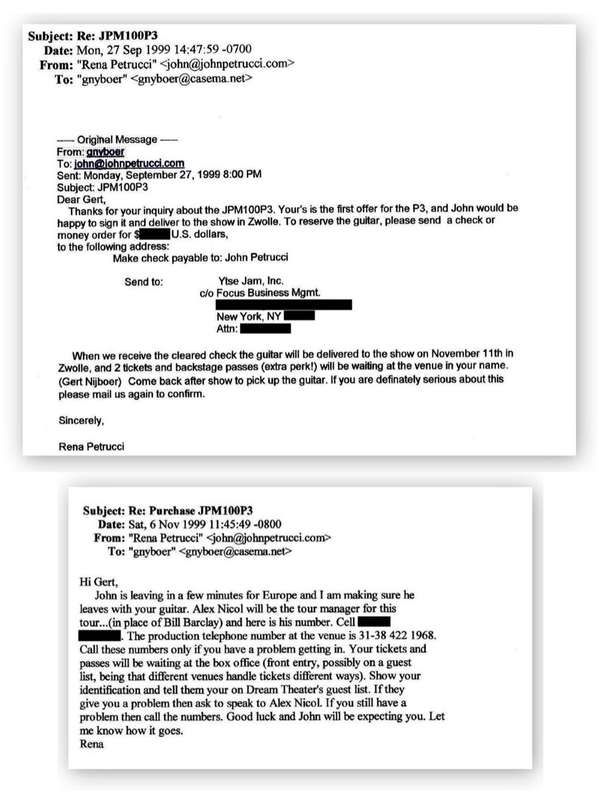 The 1999 correspondence with Rena Petrucci: payment, and delivery of the P3 to the 11 November Zwolle show.
This is the idea everything here is built around. Documentation is what separates a guitar that sells for its model price from one that carries a genuine piece of music history. Gert's P3, stripped of the Reverb listing, the Rena Petrucci emails, the 1999 photographs and his own careful account, is a very nice, and very desirable, JPM100. With those things attached, it is a piece of Dream Theater's Ibanez years, full stop. The story is the value.
It's worth saying plainly that this only works because the story is true and can be checked. A claim of celebrity ownership with nothing behind it is marketing. A claim backed by a public listing, a documented correspondence, and a dated photograph is provenance. Provenance is what collectors, insurers, and future buyers actually pay for.
Where it is now
The guitar lives with Gert in the Netherlands, looked after and "an everlasting memory that will be cherished forever," as he puts it. In his telling, John is "a very nice, down-to-earth guy, even though he is already legendary in life," and Rena "was also very nice during the whole process." A graceful transaction, conducted between two people who cared about doing it properly, a quarter of a century ago.
Gert still has all of the emails from that exchange. That matters. Hold on to every scrap of the chain of custody (the listing, the messages, the photos, anything signed), because that paper trail is precisely what turns a guitar into the story this one has become.
Every guitar has a story
Most of them never get written down. A guitar doesn't need to have passed through famous hands to deserve a record: its real story is where it's been, who played it, and what it's meant to the people who owned it. That's the part that gets lost in a generation if nobody writes it down.
If you've got a guitar with a story attached, or even one without a story yet, a Guitar History Report is where that record starts: the model, the era, the provenance, the care, put on paper so it stays with the instrument.