Ibanez Setup Guide: Action, Tremolo & Relief Specs
Ibanez setup guide with exact specs: 1.5-2.0mm action, Wizard neck relief, Edge and Gotoh floating tremolo balance, pickup height and intonation.
Ibanez Setup Guide: Action, Tremolo & Relief Specs
Last updated: August 14, 2026. Specs and steps verified for current RG, S, JEM, and AZ models, including Edge and Gotoh T1502 floating trems.
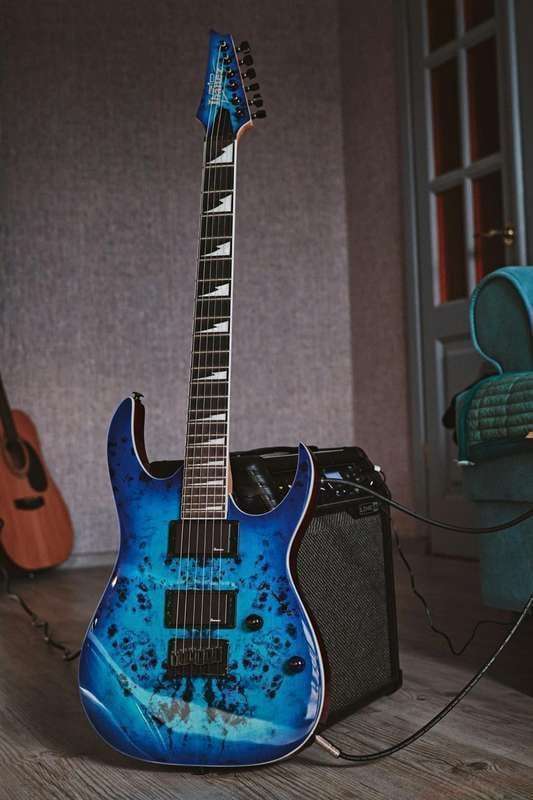
Ibanez guitars are built for speed: thin Wizard necks, flat fretboards, and floating tremolos that are among the best in the business when set up right. But that same hardware punishes a sloppy setup order. Crank the bridge down before setting relief and you get fret buzz everywhere. Adjust the springs before the posts and the plate sits at the wrong angle. This Ibanez setup guide gives you the factory numbers and the order that works, so you only touch each screw once.
If you own an AZ with the Gotoh two-post trem, we cover the gotchas that trip up those owners specifically, including the ones that look wrong but are completely normal.
📋 Quick Answer: A well-set-up Ibanez runs 1.5 mm on the treble side and 2.0 mm on the bass side at the 12th fret, 0.2–0.3 mm (0.008–0.012 in) of relief at the 8th fret, a floating trem plate level with the body, and pickups 2.0–2.5 mm from the strings. Set relief first, then the bridge, then saddles to the radius, then springs, then intonation.
What's in this guide:
- Ibanez setup specs at a glance — factory targets in one table
- Set neck relief first — the step everyone skips
- Ibanez AZ action: two-post tremolo setup — threads, half turns, knife edges
- Edge tremolo setup — studs and locking nut
- Saddle height and fretboard radius — why the bass side sits higher
- Balance a floating tremolo — level plate, claw screws, gauge changes
- Pickup height — humbucker targets
- Troubleshooting — buzz, tuning drift, broken strings
- FAQ — common Ibanez setup questions
Ibanez Setup Specs at a Glance
Here are the factory targets for a standard Ibanez electric, with series-specific notes where they matter:
| Spec | Ibanez Target | Where to Measure |
|---|---|---|
| Neck relief | 0.2–0.3 mm (0.008–0.012 in) | 8th fret, capo at 1st, press last fret |
| Action, treble side | 1.5 mm | 12th fret, high E |
| Action, bass side | 2.0 mm | 12th fret, low E |
| Pickup height, neck | 2.5 mm bass / 2.0 mm treble | Last fret pressed, string to pole piece |
| Pickup height, bridge | 2.0 mm bass / 1.5 mm treble | Last fret pressed, string to pole piece |
| Floating trem plate | Level with body | Side view, parallel to top |
| Springs (floating trem) | 3 for 9-42 or 10-46 | Claw in back cavity |
The 1.5 mm treble / 2.0 mm bass action target is what Ibanez ships on the AZ series, and it is a great starting point for any 25.5-inch-scale Ibanez. If you play aggressively or tune down, you may need to relax those numbers slightly, and that is fine. The order of operations matters more than the exact millimetres.
Not sure which model you own? Run the serial through our Ibanez serial number lookup, then compare your measurements against the factory specs lookup tool.
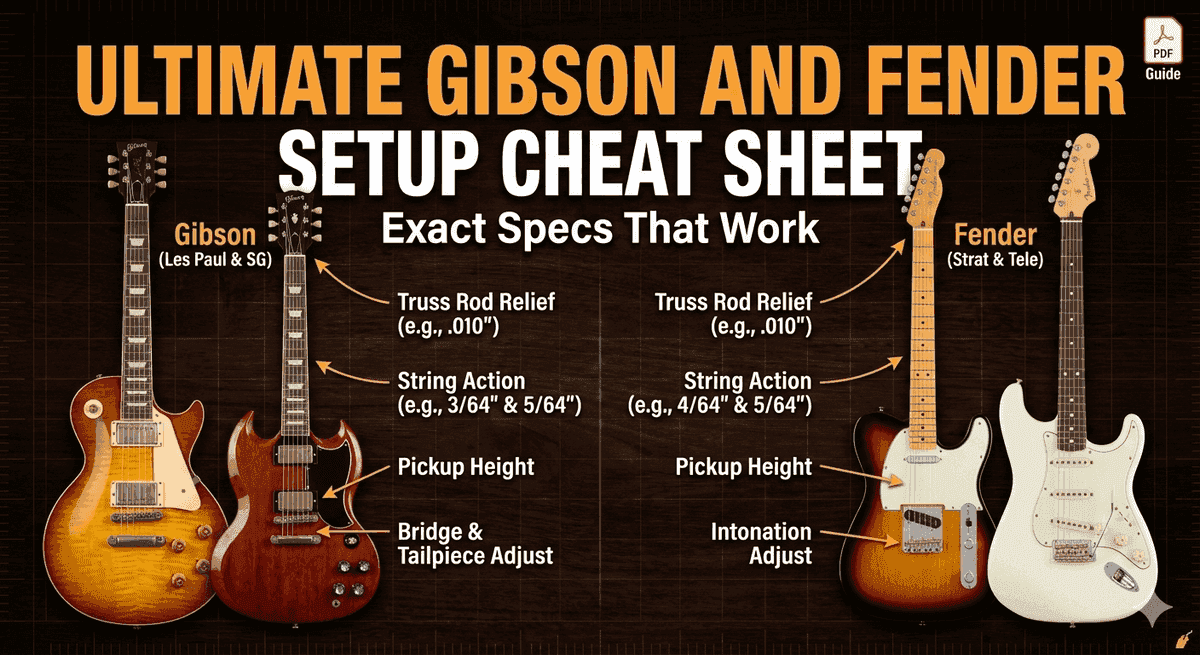
What Makes Ibanez Setup Different
Three things separate an Ibanez setup from a Strat or Les Paul setup, and they change how you work:
- Thin Wizard necks. The slim profile is fast, but it is also more sensitive to humidity and string tension than a chunky Fender neck, so relief moves quickly: check it first and seasonally.
- Flat fretboard radii. RGs run 15.75–17 inches, and the AZ uses a compound board that flattens toward the upper frets. Flat boards sit close to the strings, so a slightly high saddle is more obvious than on a round vintage board.
- Floating trems. Edge, Edge Zero, and Gotoh two-post units balance spring tension against string tension. Any gauge change pulls the whole system out of level, so treat the bridge as a system, not a part.
And if your AZ arrived with visible threads on the tremolo posts, that is by design, not a defect. The AZ section below explains exactly why.
Tools You Need for an Ibanez Setup
You do not need a workbench full of luthier gear. A complete Ibanez setup needs a string height gauge, a feeler gauge, the correct hex keys, and an accurate tuner. A multi-tool that bundles the common wrench sizes saves a trip to the toolbox.
Essential Ibanez Setup Tools
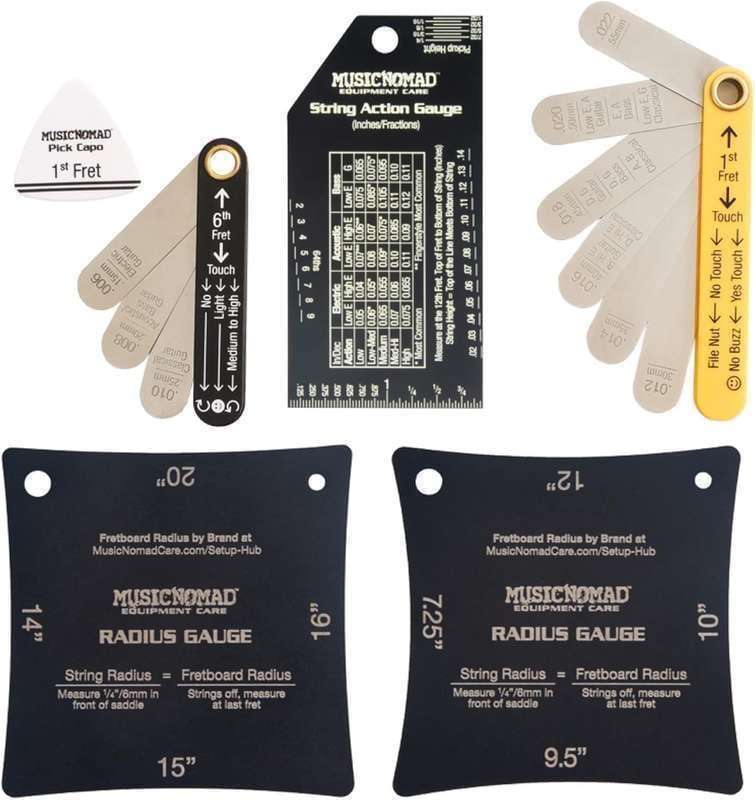
 Buy on Amazon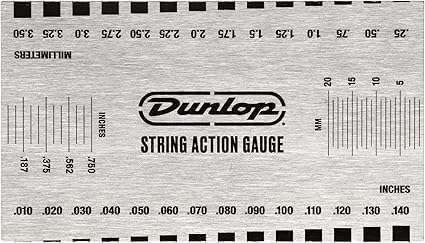
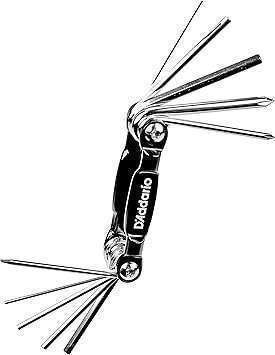
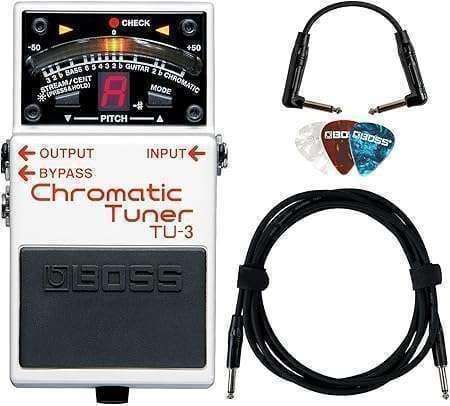
The one tool rule that matters on Ibanez: use the exact-size hex key, always. The Wizard truss rod takes a 4 mm key on most modern models and the AZ posts take a 3 mm key, but check your manual rather than guessing. A rounded key strips posts, and a stripped post is a far bigger job than a setup.
Step 1: Set Neck Relief First
Relief is the foundation of the whole setup. If you adjust action before relief, you are chasing buzz that the truss rod can fix in a quarter turn. Ibanez thin necks respond fast, so go in small increments.
- Capo the first fret.
- Hold down the string at the last fret with your fretting hand.
- Measure the gap between the bottom of the string and the top of the fret at the 8th fret.
- Target 0.2–0.3 mm (0.008–0.012 in), about the thickness of a sheet of printer paper, a "hair of space".
- If the string lies flat on the frets, loosen the truss rod an eighth of a turn. If the gap is too big, tighten it an eighth of a turn.
- Retune, wait a few minutes for the neck to settle, and re-measure.
The truss rod on most Ibanez guitars sits at the headstock behind a small cover plate and takes a 4 mm hex key. Loosen the strings slightly before turning it, work in eighth-turn steps, and never force it. If it feels stuck, stop and take it to a tech; a seized rod is one of the few genuinely expensive Ibanez repairs.
For a full breakdown of how relief works and what happens when it is wrong, see our guitar truss rod adjustment guide.
Step 2: Set Bridge Height and Action
With relief set, the next step is getting the bridge to the right height. How you do this depends on the bridge on your Ibanez.
Fixed Bridges (AZ Essentials, some RG and S models)
Fixed bridges are simple: raise or lower the posts until the string heights at the 12th fret hit your target. Work in half-turn increments and retune after every change, because the strings lose tension as the bridge drops and gain it as it rises.
Ibanez AZ Action: Two-Post Tremolo Setup
The AZ's Gotoh trem is a two-post floating unit, and this is where most AZ owners get confused: posts with visible threads on top, a bridge resting on knife edges in V grooves, and the whole assembly floating on spring tension. Here is what you need to know:
- The visible threads are normal. Ibanez ships the posts partway out so the height is adjustable. A post that shows a few threads is not a defect and not a sign of wear. Screwing them all the way in drops the bridge below the point where the strings clear the frets, which is exactly how you get buzz everywhere.
- Adjust in half-turns. A half turn is roughly 0.5 mm of height change. Two half-turns is already a big move, so measure between turns.
- Follow the bridge-specific adjustment procedure. Use the correct key, check whether the fitted posts have internal locks, and release those locks before moving the main posts. Reduce string load while supporting the bridge for cautious height changes, then retune before measuring. Never force a resistant post.
- Do not detune first on a floating trem. If you slack the strings, the springs immediately pull the bridge down into the body, which can knock the plate or scratch the finish. Under tension is the standard way for a reason.
Aim for 1.5 mm treble and 2.0 mm bass at the 12th fret. If the low E still buzzes after the posts are where you want them, do not keep cranking the bridge down. Buzz at that point is usually relief, a high fret, or pickup height, not bridge height. Our fret buzz troubleshooting guide has the diagnosis.
Edge Tremolo Setup for RG, S and JEM
Use the Ibanez Edge tremolo setup guide to identify the bridge, check stud locks, and follow the correct spring-balance and intonation procedure.
On Edge-equipped guitars, identify the exact bridge before changing action. Release any internal stud locks before moving the main posts, use the correct keys, and follow the bridge manual. Unlock the nut before tuning with the machines; for Edge/Lo-Pro Edge saddle-position changes, sufficiently slacken the string before releasing its saddle lock. Retune and recheck balance before the final nut-locking and fine-tuning pass.
Spring count matters more on Edge trems than any other part of the setup. Start with three springs for 9-42 or 10-46 strings, and add a fourth spring only if you move to heavier gauges or lower tunings. Each spring change means re-running the balance, so make gauge decisions before you set up, not after.
Step 3: Set Saddles to Follow the Fretboard Radius
For a bridge with individually adjustable saddle heights, use its manual and the actual fretboard radius to guide the string curve. Measure each string at the same fret; bass-to-treble action differences also reflect playing clearance, not just radius.
Edge-family bridges set overall action at the posts and do not provide six independent saddle-height screws. Individual radius corrections need the appropriate model-specific hardware procedure. See the Edge bridge action and intonation section before loosening saddle hardware.
Step 4: Balance a Floating Tremolo
On a floating trem, the bridge plate has to sit level with the body or the guitar will never return to pitch. It is separate from post height and the step the AZ crowd gets wrong most often: they set the posts, then wonder why the bridge dives or floats at the wrong angle.
- Tune the guitar to pitch.
- Look at the bridge plate from the side. It should sit parallel to the body.
- If the back of the plate sits up, tighten the claw screws a half turn each, retune, and re-check.
- If the front tilts down, loosen the claw screws a half turn each, retune, and re-check.
- Repeat until the plate sits level, then do a dive bomb and check the guitar returns to pitch.
Changing string gauge is the classic reason a floating Ibanez stops returning to pitch: different tension, different spring balance. Read our best strings for Ibanez guide before you switch, then do the full setup in one session.
Ibanez Strings for Floating Trems


Step 5: Set Pickup Height
With the string side done, set the pickups. Too close to the strings, strong humbuckers cause warble on sustained notes as the magnets pull them. With the last fret pressed, measure from the bottom of the string to the top of the pole piece:
| Pickup | Bass Side | Treble Side |
|---|---|---|
| Neck | 2.5 mm | 2.0 mm |
| Middle (HSH) | 2.5 mm | 2.0 mm |
| Bridge | 2.0 mm | 1.5 mm |
Adjust the two screws on each pickup a quarter turn at a time, and lower them if you hear warble. On AZ models with Seymour Duncan Hyperion pickups these numbers are a safe starting point; the pickups tolerate slightly lower settings than vintage-voiced humbuckers.
Intonation
Intonation is the final step, and on a floating trem it must wait until the bridge is balanced: moving the plate changes tension and therefore pitch.
- Tune to pitch.
- Compare the 12th-fret harmonic with the fretted 12th-fret note.
- If the fretted note is sharp, move the saddle back (away from the nut). If flat, move it forward.
- On Edge trems, loosen the saddle lock screw before moving the saddle, and re-tighten after.
- Retune and re-check until every string matches.
On floating bridges, intonation tweaks can pull the plate out of level, so re-check its angle when you finish. It is normal for the two E strings to need slightly different saddle positions than the middle strings.
Troubleshooting Common Ibanez Setup Problems
Bridge lowered, buzz everywhere. This is the most common Ibanez setup failure, and it is almost always a sequence problem: relief never set, or the bridge cranked below the point where the strings clear the frets. Raise the posts, set relief first, then lower a half turn at a time until the low E stops buzzing. More in our guitar action height guide.
Bridge height does not change string tension. A higher bridge does not make strings feel slinkier. Tension comes from scale length, string gauge, and pitch, nothing else. Raising the bridge changes the break angle over the saddles, which affects feel and sustain slightly, but not tension.
Tremolo returns sharp or flat after bends. Usually a balance problem: the plate is not level, or the springs and strings are fighting. Re-run Step 4, and check the knife edges are clean; a tiny amount of lubricant helps stability, just do not overdo it.
Strings keep breaking at the saddle. Check for a burr on the slot and file it gently with fine sandpaper. On Edge trems, also check the locking nut pads for sharp edges.
Selling up? Get a professional 3-tier valuation report before you list your Ibanez.
FAQ
Are the visible threads on Ibanez AZ tremolo posts normal?
Yes. The Gotoh T1502 on the AZ is a two-post tremolo where the posts are height-adjustable, and Ibanez ships them partway out so the height can be adjusted. Visible threads are by design, not a defect, and not a sign of wear.
Does bridge height change string tension?
No. String tension comes from scale length, string gauge, and pitch only. A higher bridge changes the break angle over the saddles but does not make strings looser or tighter.
Is it safe to adjust Ibanez tremolo posts under full string tension?
Follow the exact bridge manual and release any internal stud locks first. As a cautious working method, reduce string load before height changes while supporting the bridge and preserving its seating, then retune before measuring. Do not force a post that resists adjustment.
What action height should an Ibanez be set to?
Ibanez ships the AZ at about 1.5 mm treble and 2.0 mm bass at the 12th fret, and that is a good target for any 25.5-inch-scale Ibanez. Adjust to taste from there, raising the posts a half turn at a time if you get buzz.
How much neck relief should an Ibanez have?
About 0.2–0.3 mm (0.008–0.012 in) at the 8th fret, measured with a capo on the first fret and the last fret held down. Thin Wizard necks move fast, so check relief seasonally.
How do I level a floating tremolo on an Ibanez?
Tune to pitch, then adjust the claw screws in the back cavity in half-turn increments until the bridge plate sits parallel to the body. Tighten the claw to pull the plate down, loosen it to let the plate float higher. Use three springs for 9-42 or 10-46 strings.
What string gauge should I use on an Ibanez with a floating trem?
9-42 is the factory standard and keeps the Edge tremolo balanced with three springs. On fixed-bridge AZ models, 10-46 gives more body and sustain. Any gauge change on a floating trem means re-balancing the springs.
Why does my Ibanez buzz when I lower the bridge?
Almost always because relief was not set first, or the bridge was lowered past the point where the strings clear the frets. Raise the posts, set relief, then lower in half-turns until the low E stops buzzing. If buzz persists, check for a high fret and pickup height before touching the bridge again.
How do I set saddle height to match the fretboard radius?
Set the saddles so the string heights follow the curve of the board: lower on the treble side, higher on the bass side, with an even progression between. On flat-radius RGs the saddles sit nearly level; on the AZ compound board the bass side sits noticeably higher. Do not chase equal numbers across all six strings.
Where is the truss rod on an Ibanez?
On most modern Ibanez models the truss rod is at the headstock behind a small cover plate and takes a 4 mm hex key. Loosen the strings slightly before adjusting, work in eighth turns, and stop if it will not turn.
Conclusion
An Ibanez setup is not hard once you respect the order: relief first, bridge height second, saddles to the radius, tremolo balanced, pickups last, intonation to finish. The specs are the easy part, 1.5 mm treble and 2.0 mm bass at the 12th, 0.2–0.3 mm of relief at the 8th, and a level plate on the floating trems. The discipline is in the small turns and the retuning between every change.
And when something looks wrong, ask whether it is actually wrong. Visible threads alone do not prove a fault; check the bridge model, its seating, and its adjustment instructions before moving anything. Half of an Ibanez setup is knowing what not to touch. For the full lineup overview, start at our Ibanez hub page.
Have a floating trem and want to sell it on? Get a Guitar Valuation Report before you list it, and know your Ibanez's exact production year and factory with our free Ibanez serial number lookup.
Related Posts
Ibanez Resources
- Ibanez Hub — RG, S, JEM and AZ series overview
- Best Strings for Ibanez — gauge picks for Edge and fixed bridges
- Ibanez Serial Number Lookup — date and factory your guitar
Universal Setup Guides
- Guitar Action Height Guide — perfect your string height
- Guitar Truss Rod Adjustment — neck relief for all guitars
- Fret Buzz Troubleshooting — diagnose buzz at the source
- Factory Specs Lookup Tool — free online reference
🛠️ Done with this setup? Log the spec — action, relief, strings — in My Gear Garage so you remember exactly what you did in six months. Free, no password — magic-link sign-in.