How to Spot a Fake Gibson: 9 Telltale Checks
How to spot a fake Gibson (Chibson): headstock angle, inlays, scarf joints, serial stamps, hardware. 9 checks that catch counterfeit Les Pauls and SGs.
How to Spot a Fake Gibson (Chibson)
"Chibson" is the collector's nickname for counterfeit Gibsons — Chinese-made copies passed off as real Les Pauls, SGs, and Explorers. Some are laughably bad, with a headstock that's clearly wrong from across the room. Others are good enough to fool a dealer for a few minutes. The good news: every Chibson fails the same set of checks, and most are catchable from listing photos.
A genuine Gibson is a set-neck guitar with a steeply angled headstock carved from the same piece of mahogany as the neck, specific inlays, era-correct serial stamping, and heavy, quality hardware. Copies get at least one of those wrong. This guide walks you through the nine checks in the order experienced buyers run them.
Short on time? Run the free fake Gibson quick-check — a two-minute red-flag checklist that returns an instant risk band, no email required. Then confirm with the deep-dive checks below. (Buying a Fender instead? Our guide to telling a fake Fender covers that brand's tells, and the used-guitar buying checklist works for any brand.)
Why "Chibson" Fakes Exist
A real Gibson Les Paul Standard costs $2,500 to $3,500 new and holds value. A Chibson costs $150 to $400 to produce and can be sold for $800 to $1,500 to a buyer who's never held a genuine one. At that margin, counterfeiters don't need many sales.
The Two Flavors of Fake Gibson
- Full copies — a complete fake guitar, usually sold on Facebook Marketplace or Craigslist as "my dad's Les Paul, need gone today"
- Partscasters / Frankensteins — a genuine or aftermarket neck on a non-Gibson body, or a real body with a cheap replacement neck. Often sold as "vintage" with a story
Both fail the checks below — usually at the headstock and the serial.
Model-Specific Tells: Les Paul vs SG vs Others
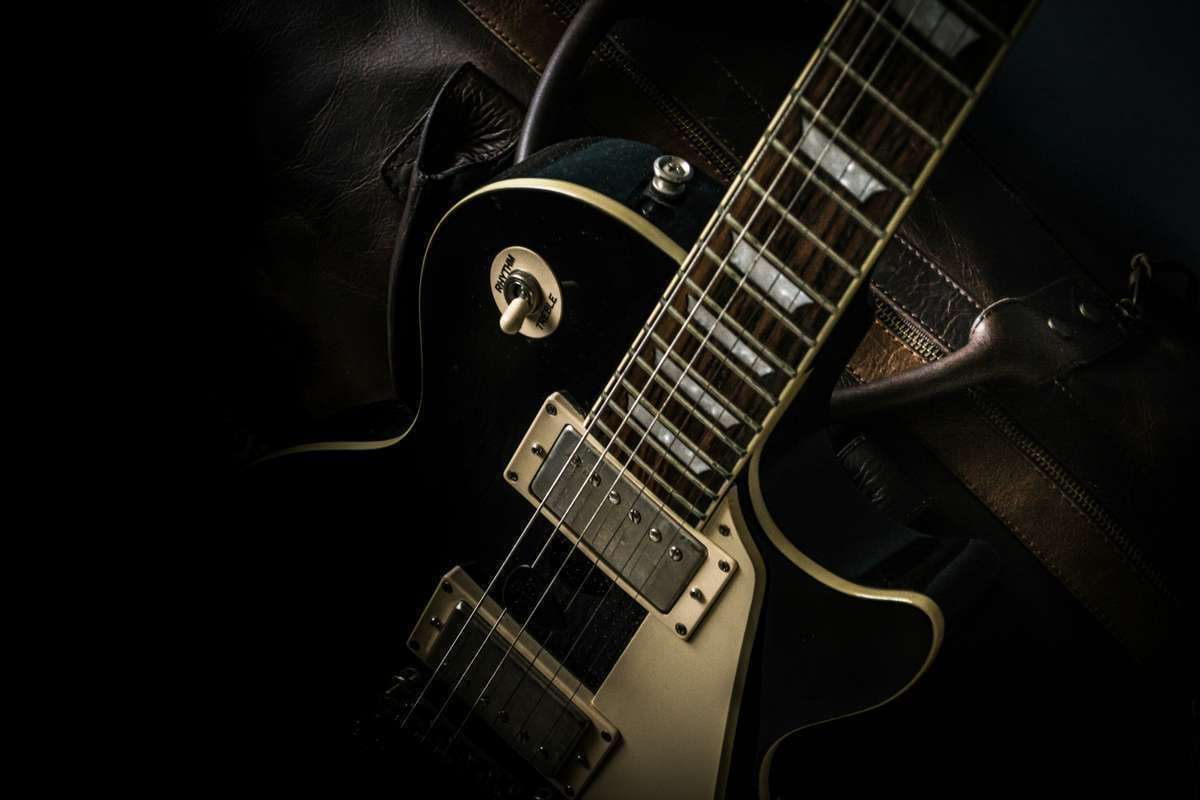
Les Paul-Specific Checks
- Carved top — genuine Les Pauls have a carved maple top with a visible (usually matching) binding; copies often use a flat or poorly carved top with thick plastic binding
- Weight — a Les Paul Standard is 8.5–10 lbs; a suspiciously light one is either chambered (fine, if stated) or a copy using cheaper wood
- Neck joint — the set-neck joint on a genuine Les Paul is tight, with clean finish; copies show gaps, glue lines, or a bolt-on neck hidden under the pickguard
- Trapezoid inlay spacing — the spacing narrows as the inlays approach the body; copies often keep them evenly spaced (a quick visual check that catches many Chibsons)
- Headstock volute — many genuine Gibsons (especially 1969–early 70s) have a volute at the headstock base; its absence on a guitar claiming that era is a flag
SG-Specific Checks
- Horn proportions — the SG's asymmetric horns are hard to copy; a too-fat or too-thin top horn is a classic tell
- Neck dive — genuine SGs are famously neck-heavy; a perfectly balanced fake usually means different wood
- Pickguard shape — the SG pickguard's bat-wing shape with correct screw placement is a detail copies routinely botch
- Lyrebird logo — the small "Les Paul" lyrebird silkscreen below the SG logo must be crisp; blurry printing is a shortcut tell
Explorer / Flying V / Firebird Checks
- Body outline — these shapes are trademarked and hard to copy accurately; compare the outline against official photos line by line
- Firebird neck-through — genuine Firebirds are neck-through construction; a bolt-on Firebird is not a Gibson
The "It's Too Perfect" Tell
Counterfeiters overcorrect. A genuine 1970s guitar has 50 years of honest wear: scratches, fading, a slightly yellowed binding. Chibsons sold as vintage arrive in "mint condition, just polished!" with no wear patterns at all — because the parts are new.
Check the wear against the claim: a "1969 Les Paul" with shiny frets, unworn hardware plating, and a case that smells new is a story, not a guitar. Genuine vintage instruments age; their fakes don't have time to.
Check 1: The Headstock Angle (The Definitive Tell)
Genuine Gibsons have a 14 to 17 degree headstock angle, carved from the same piece of mahogany as the neck. This is expensive to make, which is exactly why counterfeiters skip it.
How to check from photos: a side-on shot of the headstock shows the angle clearly. A shallow angle — 5 to 10 degrees — or a headstock that looks like it's glued on rather than carved, is a Chibson signature. This is the single most reliable fake-Gibson tell in existence.
Check 2: The Scarf Joint
Because genuine Gibson headstocks are carved from the neck's wood, there is no seam where the headstock meets the neck.
Red flag: a visible scarf joint — a diagonal seam or glue line at the base of the headstock — means the guitar isn't a Gibson. This is a production shortcut used by budget factories, and it's visible in a close-up photo and obvious in person.
Note: the opposite is true on Epiphone — many genuine Epiphones use scarf-jointed necks, so don't flag a seam on an Epiphone. This check is Gibson-specific.
Check 3: Headstock Shape and Inlays
The Gibson headstock is the "open book" shape, with a raised center. Copies get the outline subtly wrong — too fat, too flat, or with the wrong curve at the top.
Inlay checks:
- Genuine Les Pauls have trapezoid inlays (or block inlays on Customs), made of mother of pearl, sitting flush in the board
- Genuine SGs have small block inlays
- Genuine firebird/explorer variants have their own specific inlays
Red flags: inlays that look printed or plastic-like rather than pearl; inlays that sit proud of the fretboard (raised edges); wrong inlay shape for the claimed model; and the classic — a "Custom" with a diamond headstock inlay on a guitar that's clearly not a Custom.
Check 4: The Serial Number
Gibson serial numbers follow recognizable formats, and the format must match the claimed era:
| Era | Format | Example |
|---|---|---|
| 1952–1961 | No serial (or batch numbers) | — |
| 1961–1969 | Stamped number | 500123 |
| 1970–1975 | 6-digit, no prefix | 123456 |
| 1975–1977 | 6-digit + "Made in USA" | 123456 |
| 1977–present | YDDDYRRR (year, day, factory) | 81123854 |
| 2005–present | First digit = last digit of year | 51424001 |
Red flags: a serial that decodes to a different year than the claim; digits that are stamped shallowly or with a hand-held stamp (genuine serials are pressed with a single stamp, evenly); "MADE IN USA" in the wrong font or location; or a serial on a guitar claiming to be from an era that had none.
Run any serial through the free Gibson serial number lookup and compare the result to the listing.
Check 5: The Control Cavity
Flip a genuine Gibson over and remove the cavity cover: clean, routed edges and tidy wiring. Copies show rough, uneven routing with ragged edges, cheap unshielded wiring, and solder joints that look like they were done with a lighter.
Red flag: sharp, uneven cavity edges; wires that just dangle; no shielding where a genuine guitar would have it. Sellers rarely photograph the cavity — ask them to.
Check 6: Bridge and Tailpiece Posts
Genuine Gibsons use a Tune-o-Matic bridge with substantial, correctly-spaced posts and a stopbar tailpiece. Copies commonly use lightweight zinc hardware with:
- Thin posts that look fragile
- Wrong post spacing (genuine Les Pauls are 3.5 inches between posts on most eras)
- Cheap plating that flakes or looks rainbow-tinted
- Wrong bridge type for the model — e.g. a modern Nashville bridge on a guitar claimed to be a 1970s guitar (which should have an ABR-1)
Check 7: Price and Seller Behaviour
A genuine Les Paul Standard sells for $2,500+. A Chibson gets listed at $800–$1,500 with a story.
Red-flag listing language:
- "Need it gone today, cash only"
- "Not sure what model this is, my uncle left it to me"
- "No trades, no questions, first come first served"
- Photos that never show the headstock angle or the serial clearly
Compare the asking price with the free guitar worth calculator — if a "Standard" is priced at a third of its range, the burden of proof is on the seller.
Check 8: Weight and Finish Quality
Genuine Les Pauls are famously heavy — 8.5 to 10 lbs for most solid-body models, with chambered models around 7.5 to 8.5. SGs run 6.5 to 7.5 lbs.
Red flags: a Les Paul that feels suspiciously light (copies often use cheaper, lighter woods); thick, plastic-looking finish that hides the grain; visible glue or rough binding edges; fret ends that snag. Genuine Gibsons have consistently dressed frets and clean binding — copies cut corners here because it's expensive to do right.
Check 9: Documentation and Provenance
A genuine modern Gibson ships with a case, COA (for Customs), and hang tags. Vintage guitars have documented histories, often with photos and receipts.
Red flags: no case, no paperwork, and a seller who "lost" all of it; a "vintage" guitar with zero provenance; or paperwork that's clearly a printout of a printout. The absence of documentation isn't proof of a fake — but combined with any other check above, it's enough to walk away.
What to Do If You Find a Fake
If the checks above come up red, don't confront the seller — disengage. Confrontation rarely recovers money and can escalate. Instead:
- Stop the transaction — don't pay, don't leave a deposit, don't "reserve" it
- Report the listing — Marketplace, eBay, and Reverb all have counterfeit-reporting flows, and platforms act on them
- Tell the community — a short post in the relevant guitar subreddit or forum with the listing photos warns other buyers; include the seller's username
- If you already paid: document everything and file a dispute through the payment method within the platform's window
And if you want a Chibson — some players buy them as cheap mod platforms — price it as a copy, not as a Gibson. The problem is never the guitar; it's paying Gibson money for one.
What If It Passes All the Checks?
A good Chibson — real wood, correct headstock angle, copied serial — can pass a checklist. That's the honest limit of any list you read online, including this one. The details that give careful fakes away are the ones that need eyes on the actual photos: the logo's font weight, the inlay's lustre, the stamp's depth.
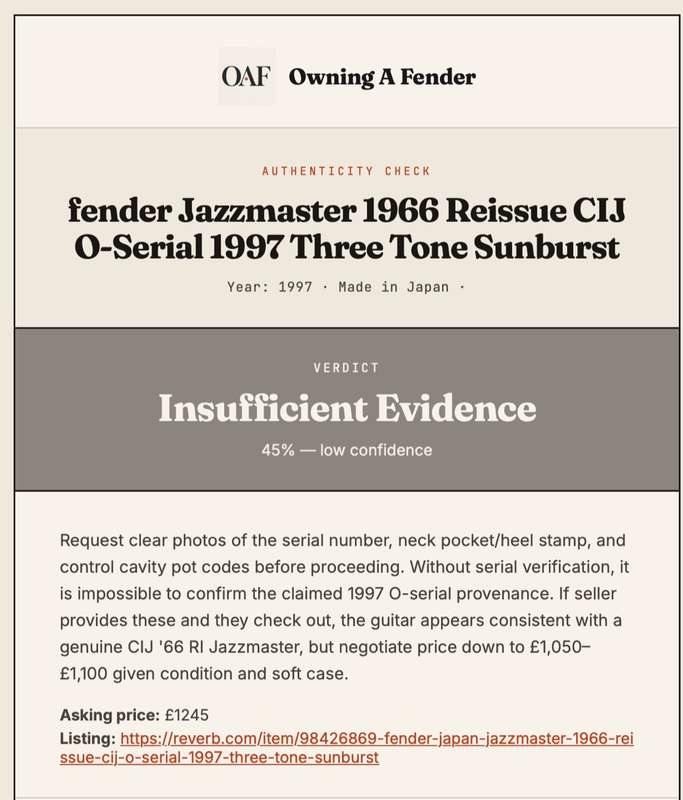
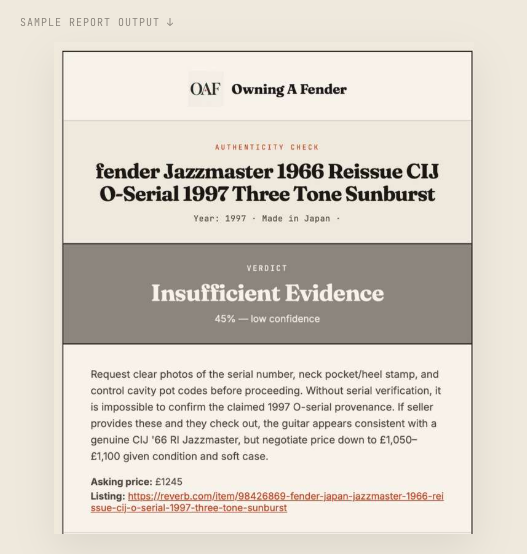
That's what the $9 Authenticity Checker does: upload the listing photos — headstock, body, hardware, serial — and get specific risk flags with human review. On a $2,000+ purchase, it's the cheapest insurance you'll ever buy.
FAQ
What is a Chibson?
"Chibson" is slang for a counterfeit Gibson made in China — the name combines "China" and "Gibson." Chibsons range from obviously fake (wrong headstock, no serial) to convincing copies that need close inspection. They're commonly sold on marketplace sites as genuine guitars.
How can I tell if a Gibson is fake?
Check the headstock angle (genuine Gibsons are 14–17 degrees and carved from the neck wood), look for a scarf joint seam (genuine Gibsons never have one), verify the serial format and year, and inspect the inlays, cavity routing, and bridge posts. Two or more mismatches means walk away.
Do fake Gibsons have serial numbers?
Yes — and the stamp is often the giveaway. Genuine Gibsons use a single-press stamp with consistent depth; fakes show shallow, uneven, or hand-stamped digits. The format must also match the claimed era — a 1970s-format serial on a "1960s" guitar is a red flag.
Where is the serial number on a Gibson?
On the back of the headstock for most models from 1961 onward. Some 1950s guitars have serials on the back of the headstock too, but many early guitars have no serial at all. A serial in an unusual location, or missing on a guitar that should have one, is suspicious.
Do genuine Gibson headstocks have scarf joints?
No. Genuine Gibson headstocks are carved from the same piece of mahogany as the neck, so there is no seam. A visible scarf joint is one of the most reliable fake-Gibson tells. (The opposite is true for Epiphone — genuine Epiphones often have scarf-jointed necks.)
How much does a fake Gibson sell for?
Chibsons typically sell for $500 to $1,500 when passed off as genuine — a fraction of the $2,500+ a real Les Paul Standard costs. If a "Standard" is priced at a third of market, the price itself is the red flag. A real Gibson's parts alone are worth more than most Chibsons sell for.
Are Epiphones fake Gibsons?
No. Epiphone is Gibson's own budget brand, made in China, Korea, Indonesia, and Japan. A genuine Epiphone is a legitimate Gibson product. The problem is only when a copy is sold as something it isn't — or when a cheap guitar gets an Epiphone or Gibson decal and a markup.
Can you spot a fake Gibson from photos?
Most of the time — the headstock angle, scarf joint, inlay quality, and serial stamp all show up in photos if the seller takes decent ones. Ask for a side-on headstock shot and a close-up of the serial. Careful fakes can still pass a photo review, which is why the $9 photo screening exists.
What is a Gibson partscaster?
A Gibson partscaster (or Franken-Les Paul) is a guitar assembled from genuine Gibson and aftermarket parts — often a real neck on a non-Gibson body. It's not a counterfeit, but it's also not the vintage guitar it's being sold as. Mismatched serials, wrong era hardware, and missing provenance are the tells.
Should I buy a Gibson without paperwork?
Modern Gibsons ship with case, COA (Customs), and hang tags; vintage guitars should have some provenance story. Missing paperwork isn't proof of a fake — but on a high-value claim ("1970s Les Paul, no papers") it's one more reason to verify before paying.
Conclusion
Chibsons fail on the headstock: the angle, the scarf joint, the inlays, the serial, the cavity, and the hardware. Run these nine checks on every used Gibson listing and you'll catch the overwhelming majority of fakes before money changes hands.
The honest caveat: a careful copy can pass a checklist — the details that catch it need eyes on the real photos. The $9 Authenticity Checker screens the actual listing photos with human review, and the free fake Gibson quick-check gets you a risk band in two minutes. On a $2,000+ guitar, verifying before paying is not paranoia — it's standard practice.