How to Buy a Used Guitar Online Without Getting Scammed
How to buy a used guitar online without getting scammed: a 10-point checklist covering fakes, partscasters, stolen guitars, and seller red flags.
How to Buy a Used Guitar Online Without Getting Scammed
Buying a used guitar online is the best way to get a great instrument for less — and the easiest way to lose $500 to a fake, a partscaster, or a "too good to be true" listing that turns out to be exactly that. Every week, buyers get burned on Facebook Marketplace, eBay, and Craigslist by counterfeit Fenders, Chibsons, and outright scams.
The good news: almost every bad deal was avoidable. Legitimate sellers expect questions. Scammers rush you. This guide is the 10-point checklist I run on every used guitar listing — from the first photo to the final payment — so you can buy used online with confidence.
Start here: run the free fake guitar quick-check — a two-minute red-flag checklist that scores the listing for classic counterfeit tells and returns an instant risk band. Brand-specific deep dives: spotting fake Fenders and spotting fake Gibsons.
1. Know What the Guitar Should Cost
Before you look at any listing, know the market range for the model. The single biggest predictor of a scam is a price that's dramatically below market.
- A Fender Player Stratocaster: $550–$700 used
- A Gibson Les Paul Standard: $2,500–$3,200 used
- A Squier Classic Vibe: $250–$350 used
- A Martin D-18: $2,000–$2,800 used
Use the free guitar worth calculator to get an instant used-market range for any brand, era, and condition. If the asking price is 40%+ below the range, the seller owes you a very good explanation — and "need it gone" isn't one.
2. Decode the Serial Number
Every major brand stamps a serial number, and the serial is your first identity check. It should decode to a year, country, and factory that matches the guitar's claimed age and features.
The catch: a correct serial doesn't prove authenticity — counterfeiters copy real serials. But a wrong serial is a stop sign: a serial that decodes to 2015 on a "1998 vintage" guitar means the guitar is not what it claims to be.
Run any serial through the free multi-brand serial number lookup — it covers 22 brands from 1950 to present.
3. Match the Details to the Claimed Era
The serial tells you the era; the guitar must match it. Check:
- Headstock logo — style must match the era (e.g. Fender's spaghetti vs block logos)
- Hardware — tuners, bridge, and pickups should be era-appropriate
- Neck construction — a "1960s Fender" with a modern truss-rod adjuster at the headstock is a parts guitar or a fake
This is where the free fake guitar quick-check earns its keep: it walks you through the brand-specific tells for Fender, Gibson, Squier, and Epiphone families.
4. Ask for the Five Photos
A legitimate seller has nothing to hide. Ask for these five photos before you commit to anything:
- The serial number — close up, in focus
- The back of the headstock — logo and any markings
- The neck pocket / cavity — body routes tell you if it's a parts guitar
- The full body, front and back — for wear patterns that match the claimed age
- A handwritten note with the date next to the guitar — proves the photos aren't stolen from another listing
Red flag: a seller who refuses, deflects, or sends blurry "close-ups" that never quite show the serial. This one request filters out a shocking number of scammers.
5. Know the Parts Guitar Tell
A partscaster or franken-guitar is assembled from parts — often a real Fender or Gibson neck on a cheaper body. It's not a counterfeit, but it's not what it's being sold as.
Tells:
- Serial says one era, hardware says another
- Neck plate missing or blank on a guitar that should have one
- No logo on the body but a decal that looks recently applied
- The seller says "custom build" or "partscaster" only after you ask
Parts guitars can be great deals if priced as parts guitars. The problem is when they're priced as genuine vintage.
6. Screen the Seller
The seller is 50% of the deal. Scammers share behavioural tells:
- Rushing — "someone's coming tonight," "need cash today"
- Vague answers — "not sure about the year, it was my uncle's"
- Photo evasiveness — never quite showing the serial or the back of the headstock
- New account, no history — especially on Marketplace and eBay
- Payment pressure — "send a deposit to hold it," "pay via friends & family," "wire transfer only"
Legitimate sellers answer questions, take photos, and accept normal payment methods. If it feels like a race, that's the scam working.
7. Watch the Payment Method
Payment method is where the deal actually happens — and where scams complete:
Safe: PayPal Goods & Services, credit card, platform checkout (Reverb's integrated checkout, eBay's), cash in person at a safe location.
Danger: PayPal Friends & Family, wire transfer, Venmo/CashApp to strangers, cryptocurrency, "deposit to hold."
Rule of thumb: any seller who insists on an unprotected payment method when you've offered a protected one is a scammer. There is no legitimate reason a real seller needs Friends & Family.
8. Check for Stolen Guitars
Fakes aren't the only risk — stolen guitars get sold online every day. Before paying, search the serial number on:
- Guitar Dater / serial databases — identify the guitar, then search the serial
- Google — "serial number stolen guitar" often surfaces registry posts
- The Guitar Dater Project's stolen registry and similar forums
You can't always tell, but a quick serial search takes two minutes and occasionally saves a buyer from receiving stolen goods — and from having the guitar seized later.
9. Price the "Cost of Trust" for High-Value Deals
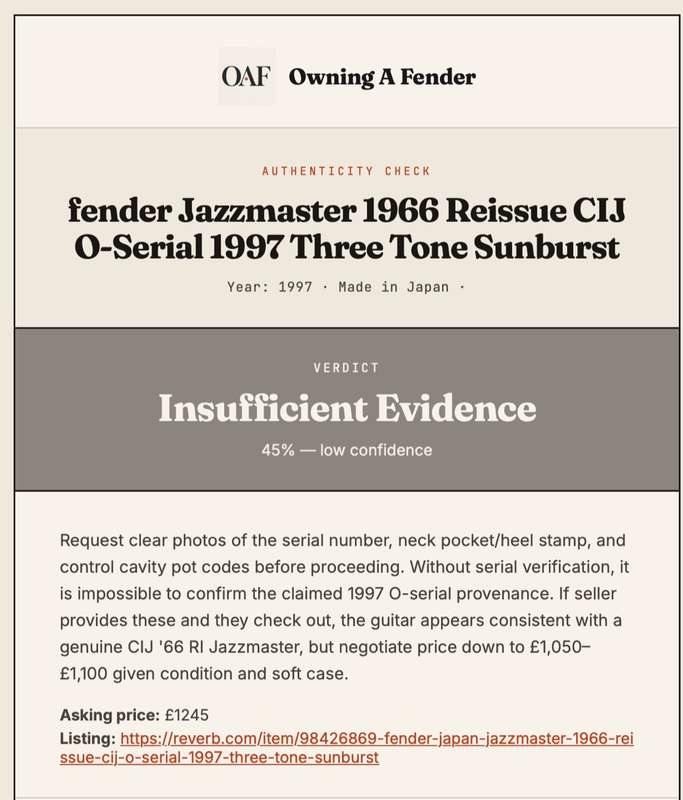
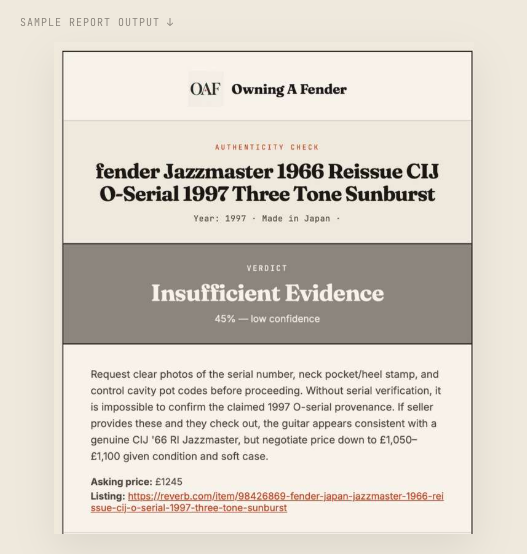
For guitars over a few hundred dollars, the checklist has an honest limit: it can't see the guitar. Careful fakes pass paper checks. That's why the paid $9 Authenticity Checker exists — upload the listing photos (headstock, body, hardware, serial) and get specific risk flags with human review.
On a $1,000+ purchase, $9 is 0.9% of the deal for actual eyes on the guitar. On a $3,000 Les Paul, it's a rounding error. The free checklist tells you how hard to look; the photo check does the looking.
10. Know Your Return Position
Before paying, know what happens if the deal goes wrong:
- Reverb and eBay — buyer protection for items not as described; document everything
- PayPal Goods & Services — purchase protection, but you must dispute within 180 days and keep evidence
- Marketplace and Craigslist cash deals — zero recourse. The money is gone the moment you hand it over
Practical steps: pay with a protected method, keep the listing screenshots, keep the messages, and photograph the guitar the moment it arrives. If it's not as described, the evidence is your only weapon.
Platform-by-Platform: How the Risk Changes
Reverb
Reverb is the safest major platform for used guitars: integrated checkout with buyer protection, seller ratings, and an authenticity program for high-value listings. Prices run 10–20% higher than elsewhere — you're paying for the protection. Watch for: sellers who push "off-platform" deals to avoid Reverb fees. That's the scam; stay on-platform.
eBay
Strong buyer protection (Money Back Guarantee) and decades of seller history to check. Watch for: "parts or repair" listings that bury the truth, sellers with recently created accounts selling expensive guitars, and listings that use stock photos. If the photo is from the manufacturer's site, the guitar in the box may not match.
Facebook Marketplace
The best prices and the worst protection. There is no platform payment system and no recourse after cash changes hands. Watch for: everything in this guide — fakes, partscasters, stolen guitars, and "deposit to hold" scams are endemic here. Meet in a public place, bring a friend, and pay cash only after inspecting.
Craigslist / OfferUp / Gumtree
Same risk profile as Marketplace, with even less accountability. Watch for: listings with one blurry photo, phone numbers that never answer, and prices that are just tempting enough. If it's local, treat it like Marketplace: inspect in person, test it plugged in, and pay after.
The Shipping Check: Buying a Guitar That Gets Posted
If the guitar is shipped, add these steps:
- Ask how it's packed — a real seller describes the case, the bubble wrap, the box within a box. A vague "I'll pack it well" is a risk
- Insist on tracked, insured shipping — seller covers insurance; a "no insurance" deal is a red flag
- Film the unboxing — video from the moment the box arrives. If it arrives damaged or wrong, the video is your proof for the platform dispute
- Check the serial at the door — the guitar in the box must match the serial in the listing. This one catches bait-and-switch sellers
The 10-Point Pre-Purchase Checklist
Print this and run it on every listing:
| # | Check | Pass | Fail |
|---|---|---|---|
| 1 | Price within market range (worth calculator) | ✓ | ✗ |
| 2 | Serial decodes to the claimed era | ✓ | ✗ |
| 3 | Logo, hardware, and details match the era | ✓ | ✗ |
| 4 | Seller supplies the five photos | ✓ | ✗ |
| 5 | No parts-guitar tells (neck, plate, cavity) | ✓ | ✗ |
| 6 | Seller answers questions, no rush | ✓ | ✗ |
| 7 | Protected payment method accepted | ✓ | ✗ |
| 8 | Serial search shows no stolen registry | ✓ | ✗ |
| 9 | High-value deal: photos screened ($9 checker) | ✓ | ✗ |
| 10 | Return position clear (platform, evidence) | ✓ | ✗ |
Two or more ✗ marks — walk away. There are always more guitars.
After You Buy: The First 24 Hours
The deal doesn't end at payment. In the first 24 hours after a used guitar arrives:
- Photograph everything — the case, the guitar, the serial, any damage. Store the photos with the listing screenshots and messages
- Play it plugged in — check every pickup position, the switch, both volume/tone pots, and the output jack for crackle or dropouts
- Check the truss rod — a gentle turn with the correct wrench should move freely; a stuck truss rod is a $300+ repair and grounds for a return
- Check the neck — straightness, fret wear, and the action; if the guitar needs a setup, budget $75–$100
- Register the guitar — record the serial, model, and photos in My Gear Garage; if it's ever stolen, the documentation is what insurance and police ask for
- Insure it — most renters'/homeowners' policies cover guitars only up to a limit; a dedicated instrument policy is cheap for anything over $1,000
Most issues surface in that first session. The window for platform disputes is finite — don't let a week pass before you plug it in.
FAQ
Is it safe to buy a used guitar online?
Yes, if you follow a process: check the price against market value, decode the serial number, ask for the five photos, screen the seller, and pay only with a protected method. Most bad deals are avoidable — scammers rely on buyers skipping exactly these steps.
What is the best site to buy used guitars?
Reverb and eBay offer the strongest buyer protection for online deals; Guitar Center's used section is another option. Facebook Marketplace and Craigslist have the best prices and the worst protection — meet in person, pay cash only after inspecting, or use a protected payment method.
How do I know if a used guitar is stolen?
Search the serial number on Google along with "stolen guitar," check serial databases and stolen-guitar registries, and ask the seller for the guitar's history. A legitimate seller has a story; a stolen guitar usually has a vague one.
Can you get scammed on Reverb?
Yes, though it's rarer than on open marketplaces — Reverb's buyer protection covers items not as described, and its authenticity checks help on high-value listings. Still apply the same checklist: verify the serial, ask for photos, and check the seller's history.
How do I check if a guitar is real before buying?
Run the serial through a brand decoder, compare the guitar's details to the claimed era (logo, hardware, neck construction), and use a red-flag checklist for the classic counterfeit tells. For high-value deals, have the listing photos screened — that's what the $9 Authenticity Checker does.
What is a partscaster and why does it matter?
A partscaster is a guitar assembled from parts, typically a real brand neck on a non-genuine body. It can play brilliantly, but it's worth far less than the genuine guitar it resembles. Sellers often list them as "vintage" or "custom" — check the serial, neck pocket, and hardware era to spot them.
What payment method is safest for used guitars?
PayPal Goods & Services, credit cards, and platform checkout systems offer buyer protection. Never pay with Friends & Family, wire transfer, cash deposits, or crypto — those methods have no recourse, which is exactly why scammers demand them.
Should I buy a guitar without a serial number?
Not without a heavy discount and a convincing explanation. Missing serials happen (replaced necks, worn plates), but on budget listings they usually hide a parts guitar or a fake. Ask for photos of the neck heel and cavity, and price the guitar as parts.
How much below market price is a red flag?
Anything 40% or more below the used-market range for the model is a red flag. Genuine sellers price within 10–20% of market and negotiate from there. A "steal" that's 40%+ off is usually either a fake, a parts guitar, or a scam.
What should I do if I bought a fake guitar?
Stop payment if you can (dispute within the platform's window), document everything — listing, messages, photos — and report the seller to the platform. If you paid with a protected method, file a claim immediately. If it was cash, the guitar can still be a fun player — but it's worth parts value, not brand value.
Conclusion
Buying used online is safe when you have a process: know the price, decode the serial, match the details, ask for the five photos, screen the seller, and pay protected. That checklist filters out the overwhelming majority of scams before money changes hands.
The last honest step: for anything over a few hundred dollars, have the actual photos screened. The free fake guitar quick-check gives you an instant risk band, and the $9 Authenticity Checker puts eyes on the guitar itself. Verify first, pay second — and enjoy the deal you actually meant to make.