Mustang Pickup Height: Measure, Adjust and Balance
Set Fender Mustang pickup height for the pickups actually fitted. Check covers and mounting screws, balance output, and use a free measurement worksheet.
Getting Fender Mustang pickup height right starts with the pickups actually installed. A traditional covered single-coil, a Mustang 90 and a Mustang HH do not share one verified factory setting. Identify the hardware, record a repeatable string clearance, and make one controlled change before deciding whether it helps.
Quick answer: Tune the guitar, finish relief and action adjustments, then follow the installed pickup maker's measuring method. If it specifies pole-to-string clearance, hold the last fret and measure from pole top to string bottom. A closed cover needs a clearly labelled cover measurement instead. Identify the mounting before turning a screw; balance neck and bridge through a clean amp.
This guide separates identification, measurement and listening. You can complete the worksheet without buying replacement pickups. An unfamiliar mount or a pickup that will not move calls for investigation, not a larger screwdriver.
In this guide:
- Choose a specification and identify the pickups
- Check mounting, switches and bridge
- Prepare and measure four gaps
- Adjust and compare output
- Free diagnostic table and worksheet
- Frequently asked questions
Mustang pickup height specs: which reference applies?
There is no verified universal Mustang neck/bridge table here. Fender's general guidance organises pickup settings by pickup type and allows adjustment for the strings and player. Its measuring instructions hold the last fret and use the pole piece as the lower reference. That does not make every single-coil category a Mustang factory specification. Fender's factory setup guidance is the primary general reference.
This page previously presented 2.4 mm bass and 2.0 mm treble as factory figures for both pickups on all Fender and Squier Mustangs. Those universal claims were not supported by an applicable manufacturer source. The revised method preserves your own baseline and uses a numerical target only when its pickup and measuring reference match.
Identify the installed configuration
| Example | Verified hardware distinction | What it changes for this job |
|---|---|---|
| Squier Classic Vibe '60s Mustang | Two alnico single-coils and switchable phase settings | Establish the normal combined sound before judging balance |
| Fender Player II Mustang | Two Mustang single-coils, three-way toggle and six-saddle hardtail | No Dynamic Vibrato adjustment belongs in its pickup procedure |
| Squier Sonic Mustang HH | Two ceramic humbuckers and a hardtail | Identify humbucker mounting and any adjustable pole screws |
| Fender Mustang 90 | Two MP-90 pickups | Separate soapbar mounting screws from individual pole screws |
| Modified Mustang, including a Bullet HH with replacement pickups | Original model information may no longer describe the installed parts | Find the replacement maker/model before selecting a target |
These examples come from Fender's Classic Vibe Mustang, Player II Mustang, Sonic Mustang HH and Mustang history, including the Mustang 90. Product descriptions identify equipment; they do not prove interchangeable pickup gaps.
Write down the exact name from your paperwork and any known modifications. An SS label means two single-coils; HH means two humbuckers. A P90 is a single-coil design, but its appearance, mounting and pole adjustment can differ from the narrow covered Mustang pickup. Those distinctions matter more here than the logo on the headstock.
Keep the reference with the number
A useful instruction includes the pickup model, held fret, measuring points and units. A bare “2.4 mm” omits most of the information needed to reproduce it. If an aftermarket maker supplies a different method, use that complete method rather than combining its number with another guide's ruler position.
The pickup-height calculator can help interpret an applicable category. Check its assumptions against the installed parts. For the surrounding work, the Mustang setup guide provides the broader setup route; finish changes to the string position before recording final pickup clearances.
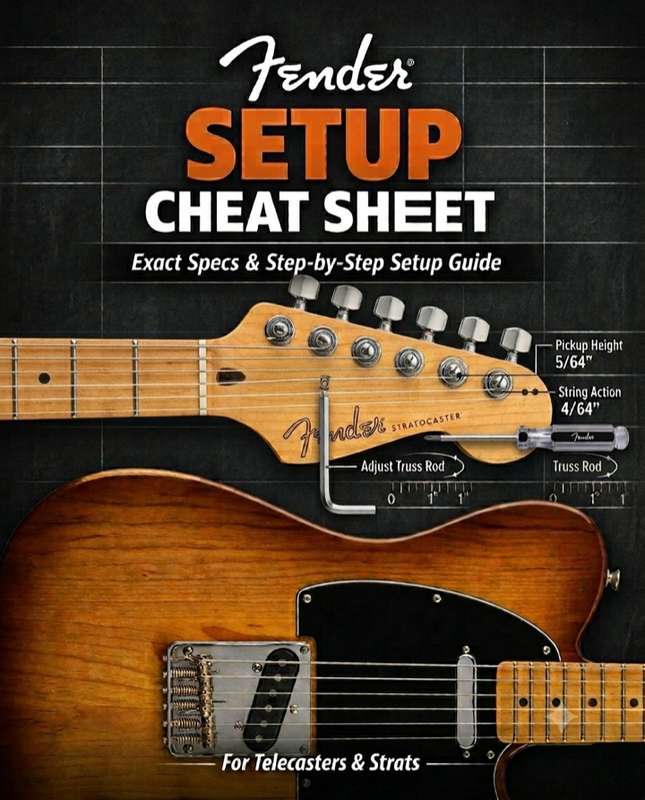
For a printable record: the Fender Setup Cheat Sheet includes setup methods, offset hardware checks and blank pickup and setup worksheets. It supports recording your Mustang's identified hardware and measured results; it does not promise a prefilled factory row for every Mustang variant.
Check the mount, switches and bridge first
Identify what the screw actually moves
Look directly at the screw head when describing clockwise or counterclockwise rotation. A pickup suspended from a pickguard or ring normally rises when its height screw tightens. A pickup screwed down into the body against compressible support normally lowers when tightened. The mounting arrangement determines the direction, not the word Mustang.
| Confirmed mount | Clockwise | Counterclockwise |
|---|---|---|
| Suspended from guard or ring | Raises pickup; reduces string gap | Lowers pickup; increases gap |
| Screwed into body with foam or springs beneath | Lowers pickup; increases string gap | Allows pickup to rise; reduces gap |
| Unidentified, altered or stuck assembly | Stop and identify it | Stop and identify it |
Fender's 1986 Jaguar manual, printed page 15 documents the opposite directions of body-mounted and guard-suspended pickups. That is a mounting distinction, not permission to apply its Jaguar height numbers to a Mustang.
A screw fixing the pickguard or pickup ring to the guitar is not necessarily a pickup-height screw. On a soapbar P90, the body mounting screws sit between the pole screws. On many humbuckers, the height screws are beside the pickup, while a row of smaller screws adjusts individual poles. Seymour Duncan's adjustment guide illustrates these mounting differences.
Do not push solid rod magnets through a coil, prise off a closed cover or keep loosening a screw until it releases. If a pickup will not follow a small adjustment, stop. Compressed support, binding, the wrong screw or limited travel needs inspection before another turn.
Check phase before diagnosing a thin sound
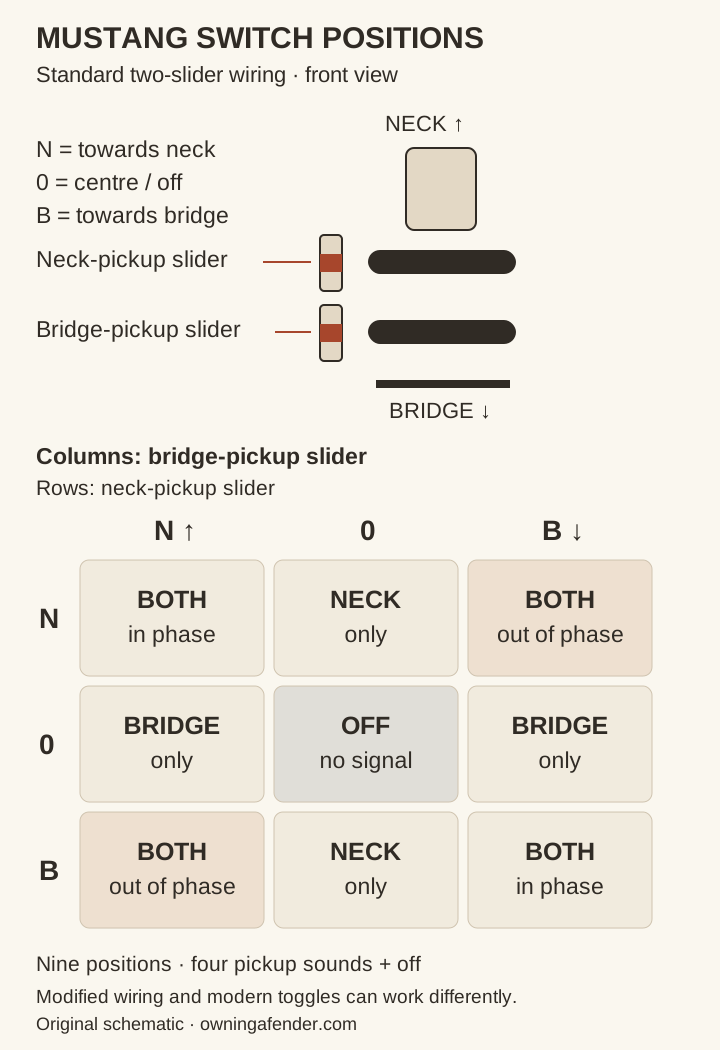
Traditional Mustang sliders provide individual pickup selection and relative phase choices. Both pickups can produce an in-phase sound or an intentionally thinner out-of-phase sound. There is no single “third slider” that universally selects both, and phase switching does not by itself mean series wiring.
Fender's Vintera '60s Mustang service manual shows the circuit and switching chart. Use the Mustang controls guide to identify the combinations on a matching two-slider guitar. A modern toggle model needs its own control map.
Record the switch settings before changing height. If the thin sound disappears when you select the normal combined sound, the original observation was a control choice. A sudden intermittent or silent pickup position is also a reason to check the circuit, not automatically lower or raise a pickup.
A Mustang does not always have a vibrato
Fender's 1973 Mustang manual describes Dynamic Vibrato. The Player II and Sonic HH examples above are hardtails. Set a fitted vibrato at its normal resting position for baseline measurements, then include your normal arm movement in the final playing check.
A pickup adjustment cannot repair a loose bridge component or make an unfamiliar tailpiece return reliably. Establish where a noise occurs before changing pickup height. Keep bridge and tailpiece adjustments separate so the result remains interpretable.
Prepare the guitar and measure four gaps
Use a readable gauge and a fitting screwdriver
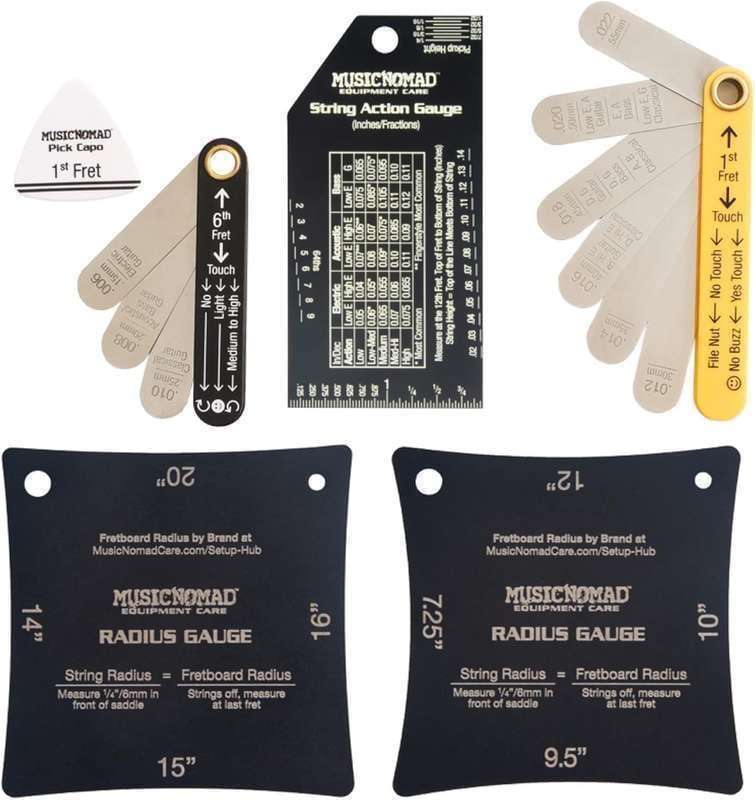
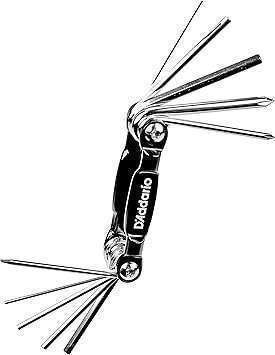
You need a tuner, a ruler or action gauge with legible small graduations, good lighting and a screwdriver that fits the actual screw. A capo is optional if it can hold the last fret without contacting the body. Support the guitar securely and keep the ruler from scratching the finish.
Tools for measuring Mustang pickup height
 Buy on Amazon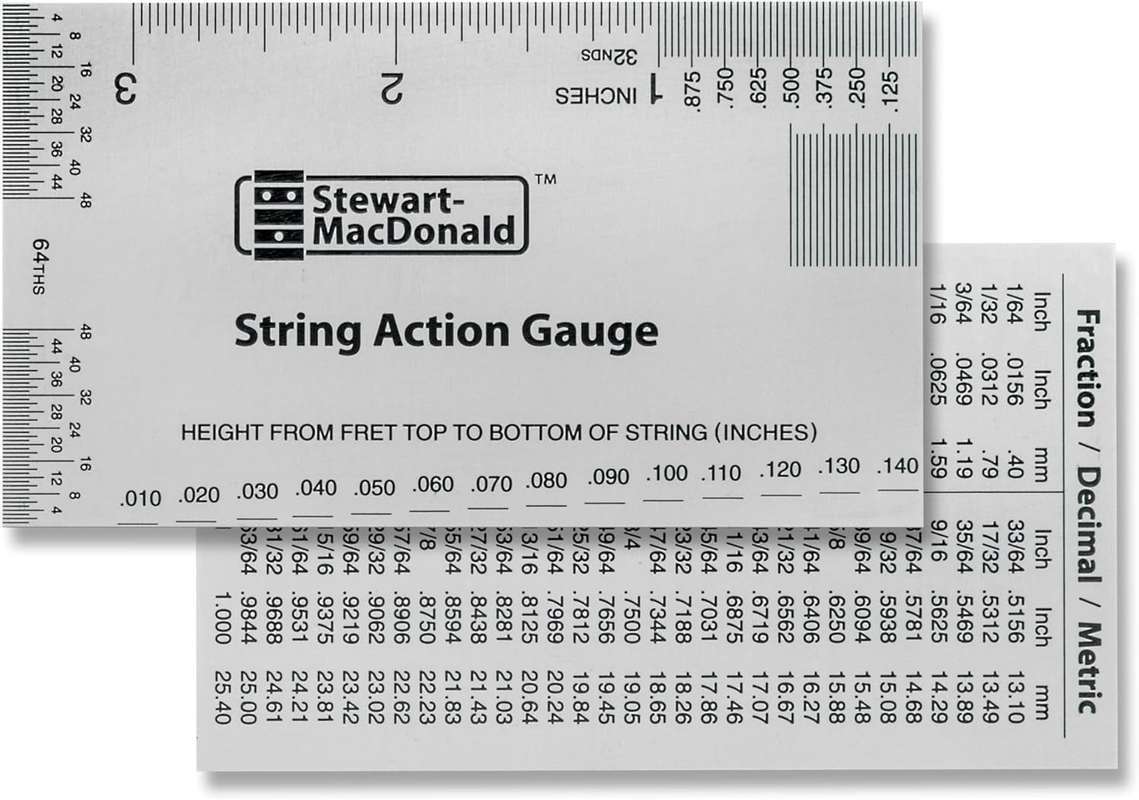
Use one unit throughout your record. For orientation, 1/16 inch is about 1.6 mm and 3/32 inch is about 2.4 mm; these conversions are not recommended Mustang settings. Record what the gauge can resolve rather than claiming hundredths of a millimeter from a coarse ruler.
Set up a repeatable comparison
Tune to the tuning you normally use. Complete needed relief, action and bridge work first, then tune again. If strings need replacement, fit your chosen set before comparing output; a pickup adjustment alone does not require buying new strings.
The Mustang string guide covers that separate choice. Keep gauge, tuning and string condition in the record. Do not assume a gauge change requires moving every pickup by the same amount.
String options when replacement is already due



Choose one clean amplifier setting and leave its gain and EQ unchanged. Turn off effects that obscure the comparison. Pick a short phrase with low notes, a chord and a high note or bend that represents how you actually play. Use that same phrase for every trial.
Exposed poles and closed covers need different labels
If the maker calls for a pole-to-string measurement and the poles are accessible, hold the low E at the last fret and read the gap from pole top to string underside. Repeat with the high E. Record both sides of both pickups, without depressing the string with the ruler.
If an opaque cover hides the poles, you cannot read their clearance directly. Record cover top to string underside, with the held fret and exact spot noted. That is useful for repeating your own trial, but it is not a pole-gap measurement. Ask the pickup maker which reference and target apply before treating it as a factory setting.
Do not subtract an assumed cover thickness. Covers and hidden pole positions vary, and a guessed correction creates false precision. A replacement pickup with exposed poles does not establish what is under a different guitar's closed cover.
Measure each gap twice before making a change. If the readings disagree, check the held fret, ruler angle and whether the pickup is rocking. Resolve that inconsistency before concluding that the pickup has moved.
Adjust one side and compare the result
Make a small trial with the mount confirmed
Start with the pickup connected to the symptom. If the bridge is disproportionately loud, a small lowering trial is more informative than moving both pickups at once. If there is no specific complaint and no applicable source target, keep the documented baseline while identifying the parts.
- Note the current gap, selected pickup and symptom.
- Turn the confirmed height screw a small amount, such as a quarter-turn, watching which way the pickup moves.
- Remeasure both sides of that pickup using the same reference.
- Retune if necessary and play the comparison phrase.
- Keep or reverse the trial according to the result, then write it down.
A quarter-turn is a convenient small step, not a guaranteed 0.2 mm movement. Screw pitch, support compression and pickup tilt affect the result. If the pickup does not move as expected, stop and identify the reason.
Balance useful pickup positions
Compare neck alone, bridge alone and the normal combined setting without changing the amp. They do not have to sound identical or measure the same distance. The aim is usable contrast and enough physical clearance, not equal numbers in four boxes.
A neck pickup may need more clearance when balancing output, but there is no mandatory neck-to-bridge offset here. Lowering the louder pickup is a reversible trial; it is not proof that the other pickup can never need raising. Any raising trial must respect the maker's guidance and leave clearance during normal playing.
Test your playing, rather than a genre preset
An indie, surf or punk label cannot specify the magnet, string excursion or amplifier setting on your instrument. Once the clean comparison works, restore your usual effects and listen again. Record whether the original complaint returns only with a particular effect or control setting.
Check low sustained notes, high fretted notes and bends, and your normal picking force. If a vibrato is fitted, test the arm movement you use. A string touching a cover or pole during that check needs clearance; a good static measurement does not overrule actual contact.
If a trial makes the guitar worse, return to the recorded baseline. You do not need to keep adjusting until every pickup reaches an internet number. An unchanged but documented setup is a useful outcome when the proposed change fails its test.
Free Mustang pickup diagnostic table and worksheet
These are checks to narrow the problem, not claims that every symptom has one cause.
| Observation | First controlled check | If it persists |
|---|---|---|
| Low notes warble or decay oddly | Record the gap; try slightly lowering a close pickup and repeat the note | Check strings and the wider setup rather than assuming magnetic pull |
| Bridge is weak relative to neck | Confirm selection and clean amp settings; compare both pickups separately | Investigate the pickup or wiring if a sensible height trial changes little |
| Combined sound is thin | Confirm intended in-phase versus out-of-phase selection | Have altered wiring checked if behaviour does not match the circuit |
| One string is much louder | Repeat the same attack; inspect the pickup tilt and measurement | Consult maker guidance before adjusting individual pole screws |
| Pickup sinks, rocks or stops moving | Stop turning; identify support and screw engagement | Have foam, springs, threads or fit inspected |
| Buzz or rattle seems mechanical | Compare unplugged and amplified sound; locate the vibration | Diagnose bridge, strings or other hardware separately |
| Sound cuts out when a control moves | Repeat the control movement without changing height | Investigate switching or connection faults |
Record the hardware and method
Copy these blanks into your notes or print them. Fill in what you can identify and leave uncertainty visible.
| Field | Your record |
|---|---|
| Guitar/model and known changes | ____________________ |
| Neck pickup maker/model | ____________________ |
| Bridge pickup maker/model | ____________________ |
| Mount and identified height screws | ____________________ |
| Strings, tuning and date | ____________________ |
| Source target, if applicable | ____________________ |
| Held fret and measuring points | ____________________ |
| Units and amp/control settings | ____________________ |
Record four gaps and one decision
| Pickup / side | Before | One trial | Final |
|---|---|---|---|
| Neck / low E | ______ | ______ | ______ |
| Neck / high E | ______ | ______ | ______ |
| Bridge / low E | ______ | ______ | ______ |
| Bridge / high E | ______ | ______ | ______ |
Complaint: ____________________
Screw movement and observed result: ____________________
Neck / bridge / combined comparison: ____________________
String contact, bends and fitted vibrato check: ____________________
Decision: keep, reverse or refer: ____________________
The listening note matters as much as the measurement. “Bridge less abrupt when switching from neck; no string contact” is more useful than “better.” It describes the result you can try to reproduce later without pretending you performed a laboratory output test.
Frequently asked questions
What is the correct Fender Mustang pickup height?
Use the installed pickup maker's target and measuring method. This guide does not claim one factory gap for every Mustang single-coil, P90 or humbucker. Record your current setting before a controlled adjustment.
Should Mustang neck and bridge pickups be the same height?
Not necessarily. Compare their measured string gaps and their output at unchanged amp settings. Keep useful balance and clearance rather than forcing the neck and bridge to match numerically.
Do I measure from the pickup cover or the pole piece?
Use the contact point specified by the pickup maker. For hidden poles, label a cover-to-string measurement explicitly; do not treat it as a pole gap or subtract a guessed cover thickness.
Which way do Mustang pickup screws turn?
Identify the mount first. Tightening a suspended pickup height screw normally raises the pickup; tightening a body-mounted screw against support normally lowers it. View rotation from the screw head and stop if the pickup does not move as expected.
Can Squier Classic Vibe and Mustang HH use the same settings?
Do not assume so. Classic Vibe single-coils and HH humbuckers are different pickup configurations. Identify the actual pickups and mounting, including any replacements, before choosing a reference.
Why does the combined pickup sound thin?
On a traditional two-slider Mustang, an out-of-phase selection intentionally changes the combined sound. Confirm the controls first. Unexpected or intermittent behaviour may require a wiring check rather than a height adjustment.
Does every Mustang have Dynamic Vibrato?
No. The 1973 Mustang manual describes Dynamic Vibrato, while Player II Mustang and Sonic Mustang HH examples have hardtails. Include a vibrato check only when that hardware is fitted.
Does a quarter-turn always move the pickup 0.2 mm?
No. Thread pitch, support compression and pickup tilt affect movement. Use a small turn as a trial, then measure the actual change on both sides of the pickup.
What if the pickup will not rise or stay level?
Stop before the screw disengages. Check the mount, support and available travel, or ask a technician to inspect them. Repeated turning cannot repair failed support or damaged threads.
Should I adjust pickup height before action and relief?
Finish needed relief, action and bridge work first because they change the string position. Tune again, measure the pickup gaps, then compare output and check the completed setup.
Keep a setting you can reproduce
Identify the pickup and mount, use an honest measuring reference, and make one change with a clear purpose. Keep your final four gaps and listening notes with the guitar. Revisit them after relevant setup or hardware changes, rather than turning screws simply because a date has passed.