Musicmaster Serial Numbers: Dating & Identification Guide
Learn how to read Musicmaster serial numbers to date your Fender student guitar by year, country, and era. Covers vintage, CBS-era, S/E prefixes, and reissues.
Musicmaster Serial Numbers Explained
Musicmaster serial numbers are the key to dating Fender's first student electric guitar. Introduced in 1956 with a 22.5-inch short scale and a single pickup, the Musicmaster was built for beginners but has become a genuinely collectable vintage model. Whether you have a 1950s slab-body original, a 1970s CBS-era example, or a modern reissue, the serial number is the fastest way to find out when and where it was made.
Fender used several different numbering systems on the Musicmaster during its original 1956–1982 run. The same prefixes overlap with the Stratocaster and Telecaster systems, which means a serial alone is not always enough. This guide walks you through every era, shows you where to look, and explains how to cross-check the number against the guitar's physical features. Start with the Fender serial number lookup tool, then use this article to understand what the result means.
What a Musicmaster Serial Number Tells You
A serial number is a starting point, not a complete history. On a Musicmaster it usually reveals:
- Production year — the calendar year the instrument left the factory
- Manufacturing country — almost always USA for vintage originals
- Era classification — pre-CBS, CBS-era, or post-1976 letter-prefix
- Approximate batch or sequence — useful for narrowing down transitions
It does not prove originality. Necks, bodies, and neck plates swap over decades, and decals can be reproduced. For high-value vintage Musicmasters, pair the serial decode with a careful physical inspection. The Fender authenticity check gives you a structured checklist of red flags to look for before you buy.
Where to Find the Serial Number on a Musicmaster
Vintage Musicmasters carried their serials in a few standard places. Modern reissues usually follow current Fender practice. Check every likely location before deciding the number is missing.
Neck Plate (Vintage Originals)
Most 1956–1976 Musicmasters have the serial stamped on the metal neck plate at the back of the guitar. You can read it without disassembling anything by looking where the neck bolts meet the body. Early plates are plain chrome with a small serial; CBS-era plates often show the large Fender "F" logo surrounding the number.
Back of the Headstock (Modern and Reissues)
Contemporary Fender and Squier Musicmaster reissues usually print the serial on the back of the headstock, like modern Strats and Teles. Look for a black or silver decal near the bottom edge. These serials often include a two-letter country or factory prefix followed by year digits.
Neck Heel and Body Cavity
Some vintage examples also have a date pencil-written inside the neck pocket or on the heel of the neck. You may need to loosen the neck bolts to see it. These handwritten dates are often more precise than the serial, because they record the exact week the neck was finished. If the neck pocket date and the neck-plate serial disagree by more than a year or two, suspect a replacement neck.
Pro Tip: Photograph Before You Decode
Take a clear photo of the neck plate, headstock back, and any cavity stamps before you start. Side lighting makes faint stamps readable, and the photos are useful for insurance claims, resale listings, and future setup work.
Decoding Vintage Musicmaster Serial Numbers (1956–1982)
The original Musicmaster run spans the entire classic Fender serial timeline. Because the model was introduced in 1956 and discontinued in 1982, you will find examples from every major numbering system Fender used in that period.
1956–1959: Four-Digit Neck Plate Numbers
The earliest Musicmasters were stamped with plain four-digit numbers on the neck plate. These guitars predate the synchronized tremolo and feature the original slab-sided body with a single pickup and a 22.5-inch scale length.
| Approximate Year | Serial Range |
|---|---|
| 1956 | 0001 – 1000 |
| 1957 | 1000 – 3000 |
| 1958 | 3000 – 5000 |
| 1959 | 5000 – 7000 |
First-year 1956 Musicmasters are rare and command a premium. The body was 1.5 inches thick with no contour carving, and the pickup was a single-pole single-coil similar to the early Esquire and Telecaster units. If a seller claims a 1956 example, the serial should fall in the very low four-digit range and the hardware should match.
1959–1965: Pre-CBS Five- and Six-Digit Numbers
By 1959 Fender had moved to five- and then six-digit sequential numbering shared across electric models. Musicmasters from this era carry plain numbers on the neck plate, with no letter prefix.
| Approximate Year | Serial Range |
|---|---|
| 1959 | 00001 – 10000 |
| 1960 | 10000 – 20000 |
| 1961 | 20000 – 30000 |
| 1962 | 30000 – 50000 |
| 1963 | 50000 – 70000 |
| 1964 | 70000 – 90000 |
| 1965 | 90000 – 110000 |
Pre-CBS Musicmasters are the most sought-after vintage tier. They have thinner nitrocellulose finishes, fuller neck profiles, and the classic spaghetti-logo decal. For a deeper look at this era, see the Fender pre-CBS serial guide.
1965–1976: CBS-Era Six-Digit Numbers
After CBS bought Fender in January 1965, the Musicmaster continued with six-digit plain sequential numbering. Build changes from this period include thicker finishes, a transition to polyester, and gradual cost engineering.
| Approximate Year | Serial Range |
|---|---|
| 1966 | 110000 – 200000 |
| 1967 | 200000 – 210000 |
| 1968 | 210000 – 250000 |
| 1969 | 250000 – 280000 |
| 1970 | 280000 – 300000 |
| 1971 | 300000 – 340000 |
| 1972 | 340000 – 370000 |
| 1973 | 370000 – 520000 |
| 1974 | 500000 – 580000 |
| 1975 | 580000 – 690000 |
| 1976 | 690000 – 750000 |
CBS-era Musicmasters are still collectable, especially the 1965–1968 transition examples that retain some pre-CBS features. By the mid-1970s the model had gained a second pickup in the Duo-Sonic II style, so always match the serial to the pickup configuration. For the full CBS-era timeline, read the Fender CBS-era serial guide.
1976–1982: S and E Prefixes
In 1976 Fender added a letter prefix that indicates the decade. The final original USA Musicmasters used this system until the line was discontinued around 1982.
| Prefix | Decade |
|---|---|
| S | 1970s (S8 = 1978) |
| E | 1980s (E2 = 1982) |
So S9 12345 points to 1979 and E2 12345 points to 1982. These late original Musicmasters are less valuable than 1950s and 1960s examples, but they are still legitimate vintage instruments. The Fender S-Series serial guide and Fender E-Series serial guide cover the overlap with Japanese models, which is a common source of confusion.
Modern and Reissue Musicmasters
After 1982 the original Musicmaster lay dormant for decades. Fender and Squier have since released several reissue and tribute versions.
Squier Musicmaster Reissues
Squier has released Musicmaster reissues in its Vintage Modified and Classic Vibe lines. These guitars are made in Asia and carry Squier prefixes such as IC for Indonesia or CY for China. They are legitimate Musicmaster-style instruments, but they are not vintage Fenders. Use the Squier serial number lookup for any guitar with a Squier decal.
Fender Modern Musicmasters
Fender occasionally reissues the Musicmaster as part of limited or artist-signature runs. These modern examples carry the standard Fender headstock-back serial format, with a country prefix followed by year digits.
Musicmaster Serial Number Tables by Era
Here is a quick reference covering the full original run. These ranges are approximate because Fender reused and overlapped number blocks during transitions.
| Era | Serial Format | Example | Years Covered |
|---|---|---|---|
| 1956–1959 | 4-digit neck plate | 4321 | 1956–1959 |
| 1959–1965 | 5- to 6-digit plain | 34567 | 1959–1965 |
| 1965–1976 | 6-digit plain | 456789 | 1965–1976 |
| 1976–1982 | S or E prefix | S9 12345 | 1976–1982 |
| Modern reissues | Country + year code | MX21A12345 | 2010s–present |
| Squier reissues | IC, CY, CN prefixes | IC210123456 | 2010s–present |
If your serial falls near a transition year, always cross-check the hardware and finish. Serials alone cannot separate a late-1965 CBS guitar from an early-1965 pre-CBS example with absolute certainty.
Common Musicmaster Serial Number Mistakes
Buyers and sellers make the same errors repeatedly. Avoiding these will protect your wallet and help you list accurately.
Confusing Musicmaster with Mustang or Duo-Sonic
The Musicmaster, Duo-Sonic, and Mustang are all short-scale Fender student models, and their serial systems overlap. A short-scale Fender with a 22.5-inch scale and one pickup is usually a Musicmaster; two pickups and the same scale often indicate a Duo-Sonic. The Mustang arrived later, in 1964, with a different body shape and tremolo option. Compare the body shape and scale before deciding the model.
Treating Modern Reissues Like Vintage Instruments
A Squier Classic Vibe Musicmaster with an IC prefix is a fine guitar, but it is not a 1960s Fender. Always read the full prefix and check the country of manufacture. Modern reissues are worth a fraction of what a genuine pre-CBS example commands.
Trusting the Decal Over the Serial
Headstock decals are easy to reproduce. A headstock can say "Fender Musicmaster" while the serial points to a 1990s Squier or a partscaster. If the serial and the decal disagree, trust the serial and investigate further.
Ignoring the Neck Pocket Date
For vintage Musicmasters, the neck heel or pocket date is often more precise than the neck-plate serial. A serial might decode to 1963, but a neck pocket date of October 1964 tells you the guitar was assembled after the neck was finished. Large gaps between serial and neck date suggest a replacement part.
What to Do After You Decode Your Musicmaster
Once the serial tells you the year and era, the next steps are value, authenticity, and setup.
Check the Market Value
A serial decode gives you the baseline era. For an actual market range, plug the details into the Guitar Price Estimate. It weights year, model, condition, and current demand so you know whether a listing is fair before you make an offer.
If you are selling, use the value estimate to set a realistic price. A "1962 Fender Musicmaster with original case" will sell faster and for more than a vague "old Fender student guitar."
Verify Authenticity
Serial decoding is step one. Step two is checking that the guitar matches the serial. Red flags include:
- A 1950s-style single-pole pickup on a guitar with a 1970s serial
- A large "F" neck plate on a guitar claimed to be pre-1965
- A neck-plate serial that conflicts with the headstock serial
- Missing or reprinted decals
For a structured red-flag checklist, use the free Fender fake checker.
Set It Up for the Correct Era
A 1958 Musicmaster needs different setup expectations than a 1978 example or a modern reissue. Neck profiles, fretboard radius, bridge type, and pickup output all affect the ideal action and pickup height.
A good starting point for a vintage or reissue Musicmaster is:
- Neck relief: roughly 0.010 inches at the 7th fret with the string held at the 1st and last frets
- Action at the 12th fret: about 1.6 mm (1/16 inch) on the high E and 2.0 mm (5/64 inch) on the low E
- Pickup height: around 2.4 mm (3/32 inch) on the bass side and 2.0 mm (5/64 inch) on the treble side, measured from the pole piece to the bottom of the string with the string held at the last fret
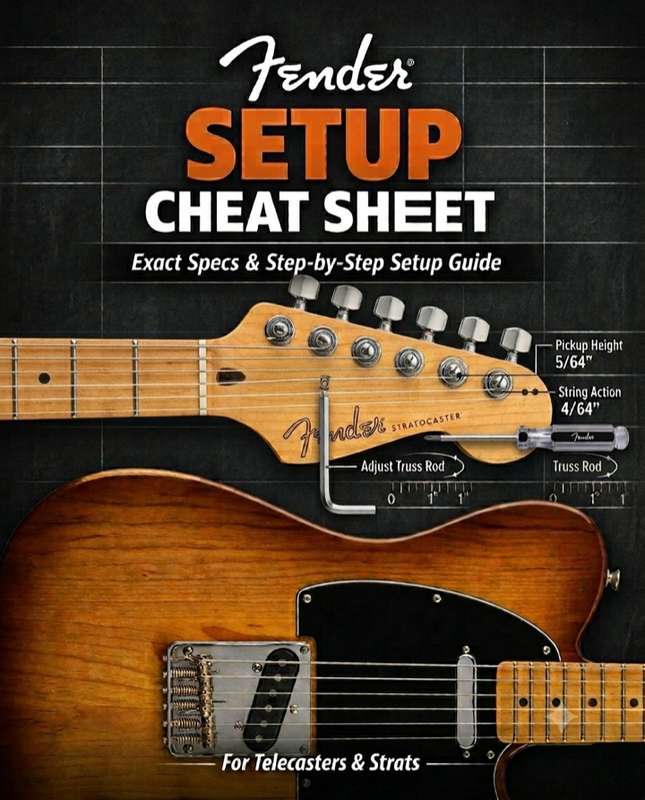
The Fender Setup Guide has action, relief, and pickup heights for short-scale Fenders and other models on one printable card.
Internal Links and Next Steps
Here are the best pages to visit after you decode your Musicmaster:
- Fender serial number lookup — enter the serial and get the year, country, and era
- Fender authenticity check — run a structured red-flag checklist before buying
- Fender pre-CBS serial guide — deeper detail on 1950s and early-1960s numbering
- Fender CBS-era serial guide — full 1965–1976 timeline and transition quirks
- Mustang serial numbers — compare the Musicmaster to its short-scale cousin
- Jaguar serial numbers — for offset Fender dating context
- Jazzmaster serial numbers — another offset model with overlapping prefixes
- Fender Setup Guide — printable action, relief, pickup height, and intonation specs
- Guitar Price Estimate — get a current market range for your decoded guitar
Frequently Asked Questions
How do I read a Musicmaster serial number?
Locate the serial on the neck plate, back of the headstock, or inside the neck pocket. Note the full prefix and digits, then enter them into the Fender serial number decoder. Plain numbers usually point to 1956–1976, while S or E prefixes indicate 1976–1982.
Where is the serial number on a Musicmaster?
Vintage Musicmasters usually have the serial stamped on the metal neck plate. Modern and reissue models often print it on the back of the headstock. Some guitars also have a secondary date written inside the neck pocket or on the neck heel.
What does a vintage Musicmaster serial number look like?
Vintage Musicmaster serials are typically plain four-, five-, or six-digit numbers stamped on the neck plate. Late original examples from 1976–1982 add an S or E prefix. Modern reissues use country-coded prefixes like MX or IC.
What year is my Musicmaster by serial number?
Enter the serial into the Fender serial number lookup. For most guitars it returns the production year or a narrow range. Transition-year serials may return a range rather than a single year.
Is a Musicmaster serial number the same as a Mustang serial number?
The numbering systems overlap because both models were made by Fender in the same factories. However, the model itself is different: the Musicmaster has a simpler body, usually one pickup, and a 22.5-inch scale. Always verify the model by features, not just the serial.
Can a Musicmaster serial number be fake?
Yes. Decals and stamps can be reproduced, and neck plates swap easily. A fake serial may decode to a year or factory that does not match the guitar's hardware, logo, or wear. Always cross-check the serial against physical features, especially on expensive vintage examples.
How do I know if my Musicmaster is pre-CBS?
Pre-CBS Musicmasters were made from 1956 to early 1965 and carry plain four-, five-, or six-digit neck-plate serials generally below 110000. They also have thinner finishes, spaghetti logos, and fuller neck profiles than CBS-era examples. See the Fender pre-CBS serial guide for details.
What is the scale length of a vintage Musicmaster?
The original Musicmaster has a 22.5-inch scale length, shorter than the 25.5-inch Stratocaster and even slightly shorter than some later Mustang variants. This short scale is part of what gives the Musicmaster its easy-playing, mellow character.
Does the serial number affect Musicmaster value?
Indirectly. The serial identifies the year and factory, which are two major value drivers. Condition, originality, finish thickness, and included case then refine the price. Use the Guitar Price Estimate for a current market range.
Why does my Musicmaster have two serial numbers?
Some guitars carry a neck-plate serial and a separate neck-heel or neck-pocket stamp. This is normal for vintage Fenders. If the two numbers conflict by several years, the guitar may have had a replacement neck or body.
Bottom Line: Decode Your Musicmaster, Then Decide
Musicmaster serial numbers turn a mysterious string of digits into a clear year, factory, and era. Start with the Fender serial number decoder, confirm the physical details, check the market value with the Guitar Price Estimate, and set the guitar up with the specs that match its era.
If you are buying used, never skip the serial check. If you are selling, lead your listing with the decoded year and origin. And if you just want to know your guitar better, the serial is the quickest history lesson you can get.
Return to the Fender serial number lookup to decode any other Fender or Squier serial.