CBS-era Fender Serial Numbers: 1965–1985 Dating Guide
Decode CBS-era Fender serial numbers from 1965–1985. Learn the F-series neck plates, S/E/N/Z letter prefixes, big headstock era, three-bolt neck, and how to date your guitar or bass through the CBS and early FMIC years.
CBS-era Fender Serial Numbers Explained
CBS-era Fender serial numbers cover the two decades after Columbia Broadcasting System bought Fender in January 1965, plus the brief Fullerton Music Instruments Company (FMIC) transition that followed in 1985. The serial formats from this period are more varied than the pre-CBS years, but they still follow a clear pattern once you know what to look for.
This guide explains the F-series neck plates of the 1960s, the letter-prefix system that ran from the mid-1970s through the 1980s, and the physical changes that help confirm a CBS-era date. If you already have a serial number, start with the free Fender serial number decoder for an instant year and country read.
What Does CBS Era Mean?
CBS era refers to Fender instruments built while the company was owned by CBS, from January 1965 until March 1985. The sale brought new management, larger production targets, and gradual cost-driven changes to materials and construction.
Collectors often split this long period into smaller chunks:
- 1965–1969: Transition years. F-series neck plates, big headstock introduced, three-bolt neck appears late in the decade.
- 1970–1976: Full CBS era. Heavier bodies, thicker finishes, grey-bottom pickups, three-bolt necks common.
- 1976–1981: S-prefix decade. Return to four-bolt necks on some models, quality improvements toward the end.
- 1982–1985: E-prefix and early N-prefix years. American Standard development, JV Squier launch in Japan.
The CBS era ended when a group of employees and investors bought Fender back from CBS, forming FMIC in March 1985. Serials from 1985 onward are usually considered modern Fender production.
CBS-era Fender Serial Number Ranges
F-Series Neck Plates (1965–1976)
In 1965 Fender introduced a neck plate with a large stylized "F" stamped into it. The serial number sits below or beside the F. These plates ran from 1965 into 1976, with overlapping ranges because Fender reused numbers and mixed parts.
| Approximate Year | Serial Range | Notes |
|---|---|---|
| 1965 | L00001 – L20000 | Transition from pre-CBS L plates; F plate appears late |
| 1966 | 100000 – 110000 | Six-digit plain numbers overlap with F plates |
| 1967 | 110000 – 140000 | Big headstock becomes standard |
| 1968 | 140000 – 180000 | Block logo replaces transition logo |
| 1969 | 180000 – 250000 | Three-bolt neck with micro-tilt introduced |
| 1970 | 250000 – 320000 | Thicker finishes, heavier bodies common |
| 1971 | 320000 – 390000 | Three-bolt neck common on most models |
| 1972 | 390000 – 480000 | Bullet truss rod appears on some models |
| 1973 | 480000 – 580000 | Grey-bottom pickups standard |
| 1974 | 580000 – 680000 | Some production moves toward Corona planning |
| 1975 | 680000 – 760000 | End of six-digit F-plate era |
| 1976 | 760000 – 800000 | Overlap with S-prefix system |
Letter-Prefix Era (1976–1985)
Starting in 1976, Fender added a letter prefix that indicates the decade. The number after the letter is the last digit of the year.
| Prefix | Decade | Example |
|---|---|---|
| S | 1970s (S9 = 1979) | S9 12345 = 1979 |
| E | 1980s (E4 = 1984) | E4 12345 = 1984 |
| N | 1980s (N9 = 1989) | N9 12345 = 1989 |
| Z | 2000s (Z5 = 2005) | Z5 12345 = 2005 |
For CBS-era dating, only S and E prefixes matter. N and Z prefixes are post-CBS. For detailed pages on each prefix family, see:
- Fender S-Series Serial Numbers
- Fender E-Series Serial Numbers
- Fender N-Series Serial Numbers
- Fender Z-Series Serial Numbers
USA, Mexico, and Japan in the CBS Era
- USA: F plates through 1976, then S and E prefixes. Corona production begins in 1985.
- Mexico: Early Mexican production in the 1980s used E prefixes. The Ensenada factory opened in 1987, with MN and MZ prefixes following.
- Japan: Fuji-Gen and other Japanese factories produced Fender Japan models starting in 1982. Early JV and SQ prefixes are covered in the JV/SQ serial guide, while the broader Japanese timeline is in the Fender Japan serial guide.
Where to Find the Serial Number on a CBS-era Fender
Neck Plate (1965–1976)
The F-series neck plate is the signature CBS-era location. Look on the back of the guitar where the neck bolts to the body. The large "F" logo is usually centered, with the serial below it. Some transition plates from 1965 carry an L prefix but no F logo; these overlap with the pre-CBS guide.
Headstock Back (1976–1985)
Starting in 1976, Fender moved many serial numbers to the back of the headstock. S-prefix and E-prefix numbers are often printed in black or silver ink near the bottom edge of the headstock. This location became standard for USA and Mexican models.
Headstock Front (Vintage Reissues)
Some 1980s reissues and Custom Shop models place a short serial on the front of the headstock near the logo, mimicking 1950s and 1960s style. Always cross-check this against the back-of-headstock number or neck plate.
Neck Heel and Body Cavity
Japanese and Custom Shop guitars sometimes add a secondary stamp inside the neck pocket or on the heel. These internal numbers can confirm the headstock number or reveal a replacement neck.
Key CBS-era Visual Markers
Big Headstock (Late 1965 Onward)
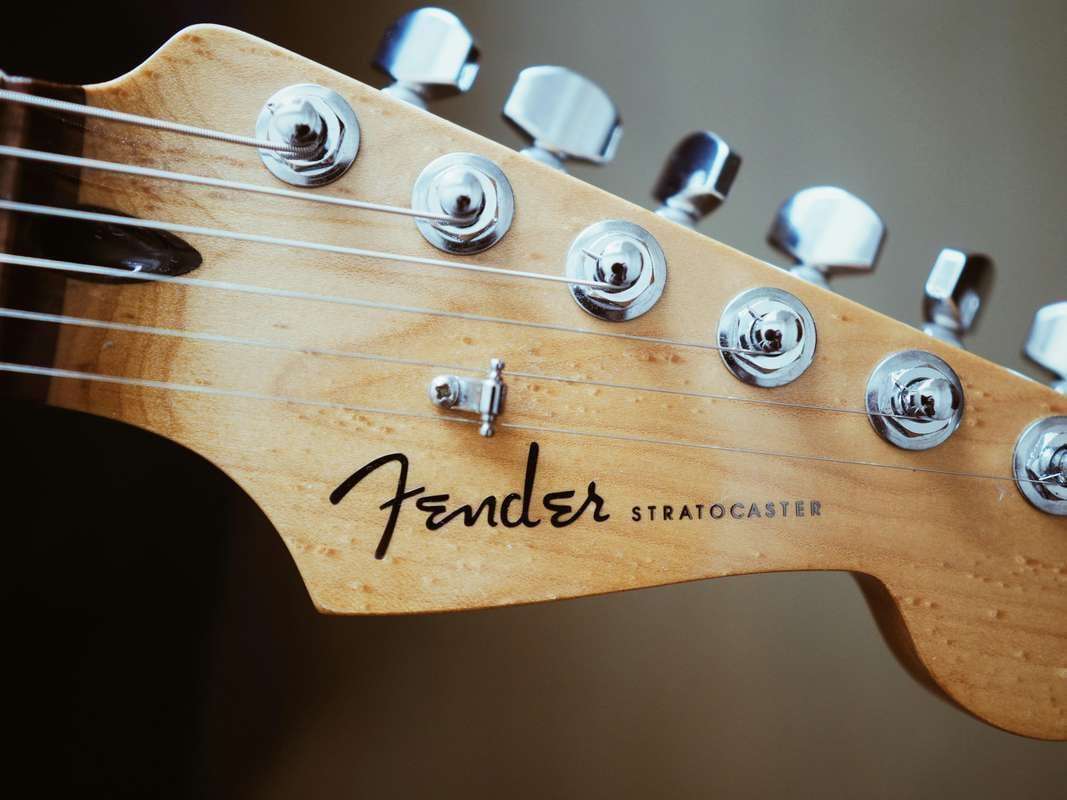
The most visible CBS change is the larger headstock, often called the "big headstock" or "CBS headstock." It appeared on Stratocasters and Telecasters in late 1965 and became standard through the 1970s. Pre-CBS instruments have a smaller headstock with a spaghetti or transition logo.
Block Logo (1968 Onward)
CBS replaced the cursive transition logo with a bolder block-style "Fender" decal around 1968. This logo remained standard through the 1970s and into the 1980s.
Three-Bolt Neck (1969–1981)
From 1969 through about 1981, many Fender guitars used a three-bolt neck plate with a micro-tilt adjustment. Pre-CBS guitars used four bolts. The return to four-bolt necks began in the early 1980s and became standard again with the American Standard series.
Grey-Bottom Pickups (Late 1960s–1980s)
Pre-CBS pickups usually have black bottoms. CBS-era pickups often have grey bottoms, though the transition was gradual. For dating purposes, grey-bottom pickups are consistent with 1970s production.
CBS-era Value Implications
CBS-era Fenders are generally worth less than equivalent pre-CBS models, but they are still collectible and usable instruments. Value drivers include:
- Early CBS (1965–1969): Higher values, especially for transition-feature guitars that retain pre-CBS specs.
- 1970s models: Values vary widely. Clean, original examples with desirable features can command strong prices; heavy refinished bodies do not.
- 1980s models: Early 1980s Fullerton reissues and Japanese JV/SQ models have dedicated followings. Late CBS Standard models are more affordable.
- Originality: Refinished bodies, replaced pickups, or swapped necks reduce value more than minor play wear.
For a market estimate, use the guitar price estimate tool after decoding the serial.
Common CBS-era Serial Mistakes
- Confusing L-prefix plates: Some 1965 L-prefix plates are pre-CBS; others are early CBS. Check the neck plate for the F logo and the neck heel date.
- Reading S-prefix numbers wrong:
S8 12345is 1978, not 1988. The letter is the decade; the digit is the year. - Assuming all big-headstock guitars are 1970s: The big headstock arrived in late 1965, so a 1966 guitar can already have it.
- Ignoring country of origin: Mexican and Japanese E-prefix guitars are not USA models. The decoder will show the factory.
FAQ
What does CBS stand for on a Fender? CBS stands for Columbia Broadcasting System, the company that bought Fender in January 1965 and owned it until March 1985.
How do I know if my Fender is CBS era? Check the serial number with the Fender serial decoder. Serials from 1965 through early 1985 are CBS era. Visual clues include the F-logo neck plate, big headstock, block logo, and three-bolt neck.
What is an F-series neck plate? An F-series neck plate has a large stylized "F" stamped into it and was used from 1965 through 1976 on most USA Fenders. The serial number appears below or beside the F.
When did Fender stop using the big headstock? The big headstock arrived in late 1965 and remained the standard on most models through the 1970s. Smaller headstocks returned on some models in the early 1980s.
Are CBS-era Fenders good guitars? Quality varied during the CBS years. Early CBS instruments often retain pre-CBS traits, while mid-1970s models can be heavier with thicker finishes. Late CBS and early FMIC guitars saw quality improvements.
What is the difference between S and E prefixes?
S-prefix serials were used in the 1970s (S9 = 1979). E-prefix serials were used in the 1980s (E4 = 1984).
Did Fender make guitars in Japan during the CBS era? Yes. Fender Japan production began in 1982 while CBS still owned the company. Early Japanese models carry JV and SQ prefixes.
When did the CBS era end? The CBS era ended in March 1985 when Fender employees and investors bought the company back, forming FMIC.
How much is a CBS-era Stratocaster worth? Values range from a few hundred pounds for a refinished 1970s model to several thousand for a clean early-CBS transition guitar. Use the price estimate tool for a range based on year and condition.
Can a CBS-era Fender have a four-bolt neck? Yes. Four-bolt necks returned on some models in the early 1980s, so a 1982–1985 guitar may have four bolts even though three-bolt necks were common in the 1970s.
Bottom Line
CBS-era Fender serial numbers are easy to read once you recognize the F-series plates and the S/E letter-prefix system. The serial gives you the year; the headstock, neck plate, and hardware details confirm whether the guitar matches that year. Always run the number through the Fender serial number lookup, and for high-value instruments, back up the serial check with the Fender authenticity checker.