Vintage Fender Stratocaster Identification Guide
Identify vintage Fender Stratocasters by era. Learn body contours, headstock decals, pickup changes, neck profiles, and hardware differences from 1954 through 1985.
Vintage Fender Stratocaster Identification: What to Look For
Vintage Fender Stratocaster identification is the process of matching a guitar's physical details to the era it was built. The Stratocaster changed visibly and measurably from 1954 through 1985, with each period carrying distinct body contours, decals, pickups, neck profiles, and hardware. A single feature can place a guitar within a five-year window.
Start with the Fender serial number decoder for the year and factory, then use this guide to confirm that the wood, finish, and hardware match that serial. For high-value instruments, pair this guide with the Fender authenticity checker and a hands-on inspection.
The Four Eras of Vintage Stratocaster Production
Most collectors divide vintage Stratocasters into four eras. Each one has a distinct set of identification markers.
| Era | Years | Ownership | Key Identification Traits |
|---|---|---|---|
| Early Pre-CBS | 1954–1957 | Fender family | One-piece maple neck, small headstock, spaghetti logo, ash or alder body |
| Late Pre-CBS | 1958–1964 | Fender family | Slab-board then veneer rosewood, three-tone sunburst, contour body |
| CBS Era | 1965–1976 | CBS | F-series neck plate, big headstock, block logo, three-bolt neck, grey-bottom pickups |
| Late CBS / FMIC Transition | 1977–1985 | CBS, then FMIC | S and E prefixes, five-way switch standard, return to four-bolt necks |
These boundaries are not perfectly sharp. Fender used parts until they ran out, so transition guitars can carry mixed features. The serial gives you the calendar year; the physical details tell you which production batch the guitar came from.
Serial Numbers: The First Filter
Before you study wood or hardware, find the serial number and run it through the Fender serial number lookup. The number tells you the year and factory, which narrows the list of features the guitar should have.
- 1954–1976: Serial on the metal neck plate.
- 1976–1985: S-prefix or E-prefix on the neck plate or headstock.
The serial is the starting point, not the final verdict. Necks, bodies, and hardware get swapped, and decals are easy to reprint. Always cross-check the serial against the physical features in this guide. For a deeper dive into the pre-CBS numbering system, see our pre-CBS Fender serial numbers guide. For the CBS-era F, S, and E prefixes, see the CBS-era Fender serial numbers guide.
Body and Construction by Era
1954–1957: Early Stratocaster
The first Stratocasters had a deeply contoured ash or alder body, a one-piece maple neck with a soft V profile, and a spaghetti logo decal. The pickguard was single-ply white celluloid with eight screws.
Key markers:
- Wood: Ash on early examples, alder increasingly common by 1956.
- Finish: Two-tone sunburst (yellow center, black edge) through 1958. Nitrocellulose lacquer, thin enough to wear quickly.
- Neck: One-piece maple, no separate fingerboard. Soft V profile.
- Pickguard: Single-ply white, eight screws.
- Tremolo: Two-point synchronized tremolo with six bent-steel saddles.
1958–1964: Late Pre-CBS
Fender added rosewood fingerboards in 1959, first as thick slab boards and later as thinner veneer boards. The sunburst became three-tone (red added between yellow and black). Body contours softened slightly.
Key markers:
- Fingerboard: Slab-board rosewood from mid-1959, veneer rosewood from 1962.
- Finish: Three-tone sunburst; custom colors available.
- Neck profile: V profile early, gradually moving toward a C profile.
- Pickguard: Three-ply white-black-white (W/B/W) nitrate from 1959.
- Logos: Spaghetti logo through most of the era; transition logo appears very late in 1964.
1965–1976: CBS Era
CBS ownership brought visible changes. The headstock grew larger, the logo became a block decal, and finishes thickened. Bodies were generally heavier, and three-bolt necks with micro-tilt appeared in 1969.
Key markers:
- Headstock: Big headstock from late 1965; block logo from 1968.
- Neck: Three-bolt neck with micro-tilt from 1969; maple or rosewood fingerboard.
- Pickups: Grey-bottom pickups common from the late 1960s.
- Finish: Thicker polyester became common by the late 1960s.
- Tuners: "F" tuners on many 1970s models.
1977–1985: Late CBS / FMIC Transition
The five-way pickup selector became standard in 1977. Quality improved toward the end of the CBS era, and the American Standard line launched as FMIC took over in 1985.
Key markers:
- Switch: Five-way selector standard from 1977.
- Neck: Return to four-bolt necks on many models in the early 1980s.
- Serial: S-prefix through 1979, E-prefix through 1985.
- Reissues: The Vintage Reissue series began in the early 1980s, recreating pre-CBS specs.
Headstock Decals and Logos
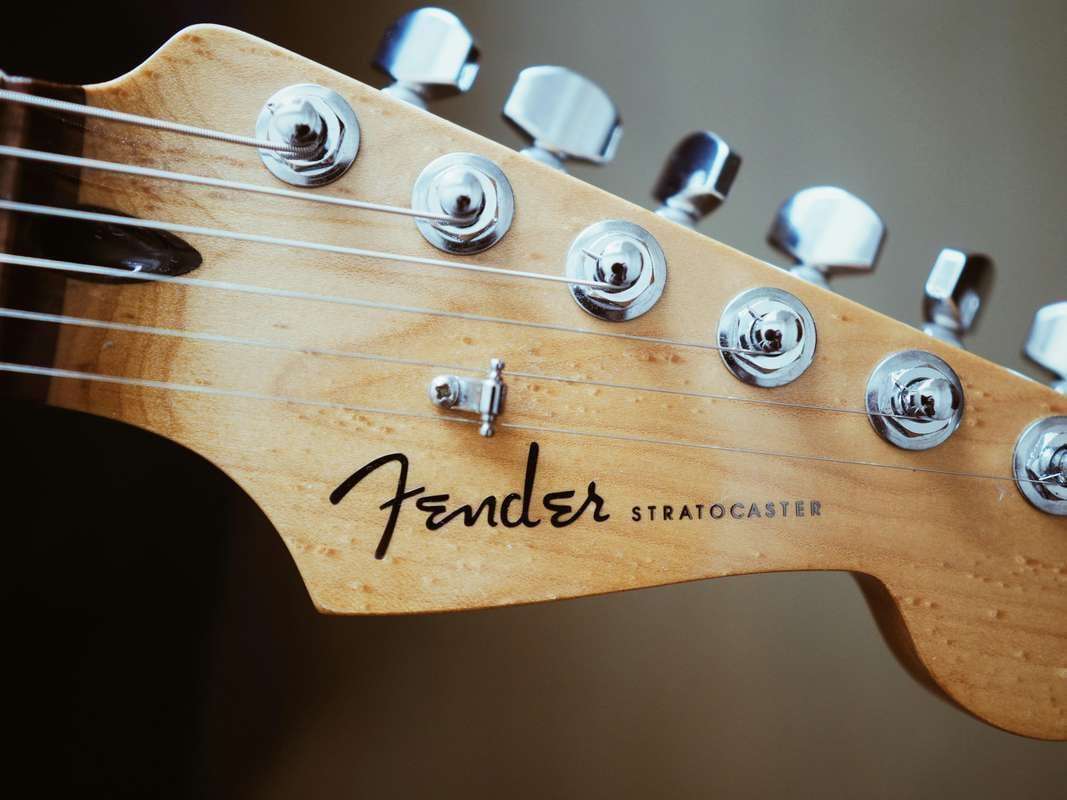
The headstock decal is one of the quickest visual clues for a vintage Stratocaster.
Spaghetti Logo (1954–1964)
The original Fender logo is a thin, cursive "spaghetti" script in gold. It appears on the headstock front through most of the pre-CBS era. A small spaghetti logo on a small headstock strongly suggests a pre-CBS guitar.
Transition Logo (1964–1967)
The transition logo adds "WITH SYNCHRONIZED TREMOLO" in a smaller font below the spaghetti logo. It appeared in late 1964 and ran into 1967. Guitars with this logo sit right on the pre-CBS/CBS boundary.
Block Logo (1968–1985)
The CBS block logo is a bold, sans-serif "Fender" decal with a patent number below it. It became standard in 1968 and remained through the 1970s and early 1980s.
Neck Profiles and Fingerboards
Stratocaster neck profiles changed gradually:
- 1954–1957: Soft V, one-piece maple.
- 1958–1961: Thicker V or early C, slab-board rosewood from 1959.
- 1962–1964: C profile, veneer rosewood.
- 1965–1969: C profile, maple or rosewood.
- 1970s: Often a U or deeper C profile, especially on three-bolt necks.
- 1980s: Return to slimmer C profiles on reissues and improved standards.
The fingerboard radius remained 7.25 inches on vintage-style models until the 1980s, when some models moved to flatter radii.
Pickups and Electronics
- 1954–1964: Black-bottom single-coils with staggered pole pieces. Cloth wire, low output by modern standards.
- 1965–1979: Grey-bottom pickups became common, though black bottoms appear in transition years. Output increased slightly in the 1970s.
- 1980–1985: Improved pickups, including the early Vintage Reissue sets designed to mimic 1950s and 1960s tone.
Hardware and Bridges
- 1954–1971: Six-screw tremolo with bent-steel saddles.
- 1971–1981: Some models moved to a larger tremolo block and different saddle designs.
- 1982–1985: Vintage-style bridges returned on reissue models; American Standard models introduced a two-point tremolo late in the period.
Value Implications by Era
Vintage Stratocaster values follow the era hierarchy:
- 1954–1957: Highest values, especially clean original examples.
- 1958–1964: Strong values, with slab-board and custom-color guitars commanding premiums.
- 1965–1969: Values drop from pre-CBS peaks but remain solid for clean transition guitars.
- 1970–1985: More affordable vintage options. Clean, original examples can still be valuable, but refinished or heavily modified guitars are worth much less.
For a market estimate by year and condition, use the guitar price estimate tool.
Common Authenticity Red Flags
- Sanded neck heel: A neck heel that has been sanded may have had its date stamp removed.
- Reproduction decals: Modern repro decals are common; cross-check decal style against the serial year.
- Swapped necks: A 1954 body with a 1970s neck is not a 1954 Stratocaster.
- Incorrect pickups: Black-bottom pickups in a 1975 guitar are suspicious unless documented.
- Refinished body: Refinishes destroy most of the premium for collectible vintage Strats.
FAQ
How do I identify a vintage Fender Stratocaster? Start with the serial number using the Fender serial decoder, then check the headstock logo, neck plate, body contours, pickups, and neck profile against the era indicated by the serial.
What is the difference between pre-CBS and CBS Stratocasters? Pre-CBS Stratocasters were built before January 1965. They typically have smaller headstocks, spaghetti or transition logos, lighter bodies, and black-bottom pickups. CBS-era Strats have bigger headstocks, block logos, and often heavier bodies.
When did the Stratocaster get a rosewood fingerboard? Rosewood fingerboards appeared around mid-1959. Early rosewood boards were thick slabs; thinner veneer boards appeared around 1962.
What does a spaghetti logo look like? The spaghetti logo is a thin, cursive gold Fender script on the headstock. It was used from 1954 through most of 1964.
When did the big headstock appear on Stratocasters? The larger CBS headstock appeared in late 1965 and became standard through the 1970s.
Are three-bolt necks only on CBS guitars? Yes. The three-bolt neck with micro-tilt appeared in 1969 and was used through about 1981. Pre-CBS guitars use four-bolt necks.
How can I tell if a Stratocaster is refinished? Look for finish thickness, orange peel, color matching around the neck pocket, and whether the serial number or stamps are buried under finish. Original finishes are thin nitrocellulose on pre-CBS guitars.
What pickups should a 1965 Stratocaster have? 1965 was a transition year. Early 1965 guitars may still have black-bottom pickups; later 1965 guitars may have grey-bottom pickups.
When did the five-way switch become standard? The five-way pickup selector became standard in 1977. Earlier Stratocasters used a three-way switch.
How much is a vintage Stratocaster worth? Values range from a few hundred pounds for a refinished 1970s model to six figures for a clean 1954–1957 example. Use the price estimate tool for a range.
Bottom Line
Vintage Fender Stratocaster identification is a matter of matching the serial number to the physical details. The serial gives you the year; the logo, headstock size, neck profile, fingerboard, pickups, and hardware confirm whether the guitar is consistent with that year. For expensive or suspicious instruments, use the Fender authenticity checker and consider a professional inspection.