Taylor Guitar Setup: Action, Relief & Saddle Specs
Taylor guitar setup using Taylor's own published specs: neck relief, saddle height, nut slots and humidity — plus which fixes are DIY and which need Taylor service.
By Nick TheodoulouUpdated

Your Taylor setup0 of 4 done
Let the neck settle before you set the string height
A bigger truss rod change keeps moving for hours, so pros leave it overnight. Re-measure the relief tomorrow, then carry on.
Your ticks are saved on this device.
On this page
- The Complete Taylor Guitar Setup Guide
- In This Guide
- Taylor's Setup Order: Check Before You Adjust
- Essential Tools and Prep Checklist
- Taylor Guitar Setup: Neck Relief and Truss Rod Adjustment
- Taylor Guitar Setup: Neck Angle and the NT Neck Difference
- Taylor Guitar Setup: Action Height and Saddle Adjustment
- Taylor Guitar Setup: Nut Slot Depth
- Taylor Guitar Setup: Humidity Care
- Taylor Guitar Setup: Intonation
- Taylor Guitar Setup: Best Strings
- When to Take Your Taylor to a Professional
- FAQ
- Conclusion
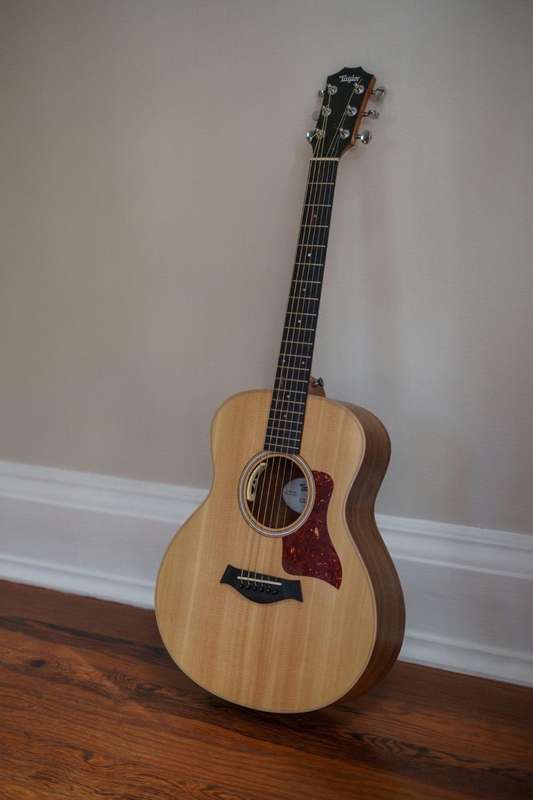
Photo by Brent Ninaber on Unsplash
The Complete Taylor Guitar Setup Guide
A proper Taylor guitar setup is the fastest way to make an already-great acoustic feel even better under your fingers. Taylor guitars are built with tight tolerances and a patented bolt-on neck joint — but wood moves, humidity swings, and string tension still push every acoustic out of spec eventually. The key thing that separates Taylor from most brands: the company publishes its own setup logic, and it starts with humidity and neck angle, not the saddle.
This guide follows Taylor's own published service guidance. Whether you just used our Taylor Serial Number Lookup to date your guitar or you want to refresh a neglected used model, you'll learn what to check at home, in what order, and which jobs belong with a Taylor service tech.
Setting up a different brand? Our Takamine Guitar Setup Guide covers GD, GN, G Series, and Pro Series models, including the pickup-aware saddle adjustments Takamine players need.
Quick Answer: Start a Taylor guitar setup by checking humidity, tuning to pitch and measuring before adjusting. Check relief with Taylor's owner method, then assess neck angle, action and the nut. Conventional steel-string models have truss-rod access at the peghead; some older nylon models differ. Identify the neck joint before changing action: NT shim work needs a technician, while an Action Control Neck has its own adjustment instructions.
In This Guide
- Taylor's Setup Order: Check Before You Adjust
- Essential Tools and Prep Checklist
- Taylor Guitar Setup: Neck Relief and Truss Rod Adjustment
- Taylor Guitar Setup: Neck Angle and the NT Neck Difference
- Taylor Guitar Setup: Action Height and Saddle Adjustment
- Taylor Guitar Setup: Nut Slot Depth
- Taylor Guitar Setup: Humidity Care
- Taylor Guitar Setup: Intonation
- Taylor Guitar Setup: Best Strings
- When to Take Your Taylor to a Professional
- FAQ
- Conclusion
Taylor's Setup Order: Check Before You Adjust
Taylor's own service documentation is explicit about sequence: never adjust a dried-out or over-humidified guitar to spec, set the neck straight before judging anything else, establish neck angle before touching the saddle, and cut the nut last. Skipping the order is how a small buzz turns into a new saddle, a new nut, and a trip to the repair shop.
| Step | What to check | DIY or service? |
|---|---|---|
| 1. Humidity | 45–55% RH in the case; inspect for dry/wet symptoms | DIY — rehumidify first and let the guitar stabilize before any adjustment |
| 2. Tuning | Tuned to pitch, the way you actually tune | DIY |
| 3. Neck relief | Nearly straight; use the owner relief check below | DIY if the correct tool fits and the nut turns freely |
| 4. Neck angle | Straightedge along the frets should land at the top of the bridge | NT neck shim changes = Taylor service; Action Control Neck = owner-adjustable |
| 5. Saddle height | 1/8" bass / 1/16" treble above the bridge | Measure at home; saddle modification needs experience |
| 6. Nut slots | .019"–.024" gap over the 1st fret, adjusted last | Measure at home; ask a tech to cut or replace the nut |
High Action? Match the Symptom to the Cause
"High action" is the most common Taylor setup complaint, and the right fix depends entirely on where the height comes from:
| Symptom | Likely cause | First move |
|---|---|---|
| Action has dropped, top looks sunken, fret ends sharp | Dry guitar | Restore humidity gradually, then re-measure after stabilization |
| Action highest around the middle of the neck | Too much relief | Measure relief before considering a small adjustment |
| Action high everywhere, saddle already at or below spec | Neck angle | Stop sanding — this is an NT shim / service decision |
| Stiff open chords, first-position notes sharp | Nut slots too high | Nut check comes last, after relief and saddle are right |
Essential Tools and Prep Checklist
Before you adjust anything, gather the right tools and record your starting measurements. A rushed setup on a Taylor can turn a small buzz into a multi-day project.
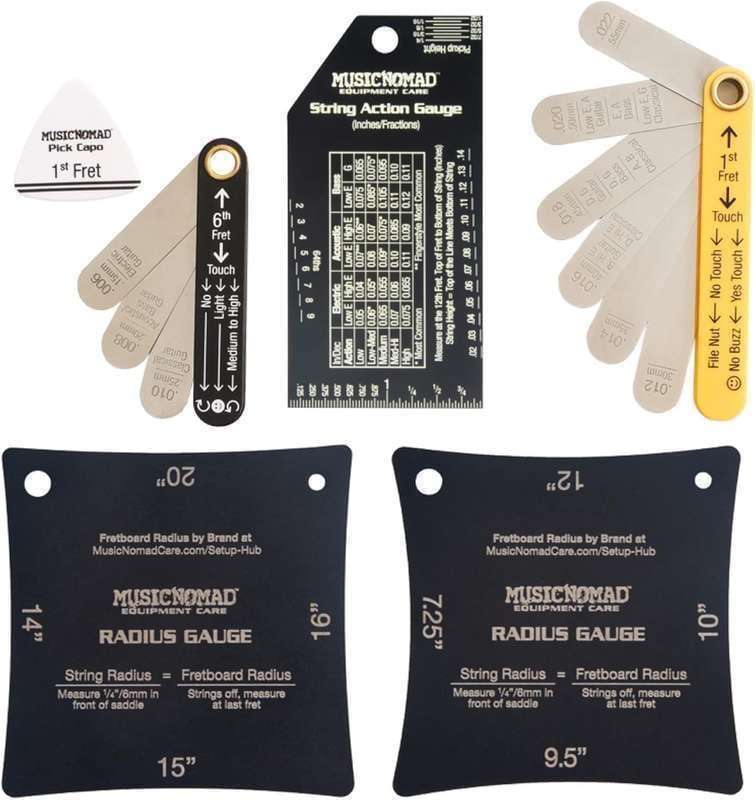
- Measuring kit: StewMac String Action Gauge on Amazon, feeler gauges (.002"–.025"), a capo, and a straightedge for fret and neck-angle checks.
- Adjustment tools: Taylor's truss rod wrench or a 1/4" thin-walled nut driver (a magnetic-tip screwdriver with no bit inserted often fits, per Taylor), plus fine-grit sandpaper for saddle work.
- Tuner: A Boss TU-3 on Amazon or clip-on tuner you trust. Every adjustment requires retuning first.
- Workspace: Padded bench, neck rest, bright task lighting, and a notebook to log "before" and "after" measurements.
| Task | Taylor Spec | Tool(s) | Cross-Reference |
|---|---|---|---|
| Humidity | 45–55% RH (acceptable 40–60%) | Digital hygrometer + humidifier | Acoustic Guitar Humidity Guide |
| Neck relief | Owner check: hold frets 1 + 14, inspect fret 6 | Capo + feeler gauges | Acoustic Truss Rod Adjustment |
| Saddle height | 1/8" bass / 1/16" treble above bridge | Ruler or depth gauge | Acoustic Action Height Guide |
| Action | Measure @ 12th fret; log before/after | String action gauge | Guitar Action Height Guide |
| Nut slot depth | .019" high E – .024" low E @ 1st fret | Feeler gauges | — |
Quick Tools: Factory Specs | Taylor Serial Number Lookup | Acoustic Serial Number Lookup | My Gear Garage
Taylor Guitar Setup: Neck Relief and Truss Rod Adjustment
Quick Answer: On conventional steel-string Taylors, remove the small truss-rod cover at the peghead and use Taylor's matching wrench or a 1/4-inch thin-walled nut driver. Do not assume soundhole access: Taylor identifies that arrangement on some older nylon models. The Action Control Neck's neck-block adjuster changes neck angle/action and is a separate mechanism.
Taylor's owner instructions describe a nearly straight neck using the check below. Its service assessment discusses a more detailed workshop setup. Do not mix measurement positions or turn a small difference from a workshop number into an automatic instruction to tighten the rod.
Step-by-Step Relief Check (Taylor's Owner Method)
- Stabilize humidity and tune to pitch using your normal strings and tuning.
- Hold a string at the 1st and 14th frets simultaneously. Inspect the gap above the 6th fret. Taylor describes a gap slightly thinner than a business card as an owner reference.
- Compare the gap with the playing symptom. An unusually large gap can indicate excessive forward bow; no gap needs closer inspection. Do not diagnose a back-bowed neck or a high fret from this observation alone.
- If an adjustment is indicated, identify the access and tool first. Taylor's universal wrench fits peghead-access models; its nylon-model wrench covers older soundhole-access examples. Stop if the tool does not seat fully or the nut resists.
- Make a small adjustment, then retune and repeat the same check. Viewed directly at the nut, clockwise reduces relief and counterclockwise adds it. An eighth-turn is a cautious first adjustment; never force the mechanism.
- Record the result before assessing action or neck angle. Buzz confined to one fret or the fretboard extension needs a separate diagnosis.
Identify Your Taylor's Neck Joint First
| Identified neck system | What it means for setup |
|---|---|
| NT neck | A technician can change neck angle with the appropriate precision shims. |
| Action Control Neck | Follow the specific model instructions for its neck-block height adjuster; this is separate from truss-rod relief. |
| Older, modified or unidentified joint | Confirm the construction with Taylor or a qualified repairer before choosing a procedure. A production year alone is not enough. |
The NT design was introduced in 1999, but that date does not justify treating every earlier Taylor as a glued dovetail or every later model as identical.
Essential Taylor Setup Tools
 Buy on Amazon
Taylor Guitar Setup: Neck Angle and the NT Neck Difference
Quick Answer: On a Taylor, a correct setup keys off neck angle — the alignment of the fret plane relative to the bridge. Sight down a straight neck toward the bridge: your line of sight should land right at the top of the bridge (a straightedge held along the frets, just outside the E strings, should touch the bridge about .002" below its top surface). If it doesn't, no amount of saddle sanding will produce a proper setup.
This is where Taylor ownership genuinely differs from other acoustics. On a traditional glued dovetail neck, correcting geometry means steaming the neck off and resetting it — expensive, invasive luthier work. On a Taylor fitted with the NT neck, a technician changes neck angle by selecting precision shims in the joint. Confirm that construction before booking the work; cost depends on the instrument and service required. Taylor's own service guidance goes further: if lowering the saddle by more than 1/32" on the treble side or 1/16" on the bass side would be needed to hit your target action, a neck angle adjustment is the correct fix — not more sanding.
Two practical takeaways for the home setupper:
- Do the sighting test before you sand anything. Straight neck, straightedge along the frets, eyes at the headstock. If the fret plane points below the bridge top, put the sandpaper away and book a service appointment.
- Check whether you have an Action Control Neck. Introduced in 2025 on the Gold Label Collection, this joint lets you (or a tech) micro-adjust string height by turning a bolt in the neck block with a 1/4" nut driver — without removing the neck or strings. If your Taylor has one, action height is an owner adjustment; consult the documentation for your specific model.
Taylor Guitar Setup: Action Height and Saddle Adjustment
Quick Answer: Taylor doesn't publish one universal 12th-fret action number — factory geometry is defined by neck angle and saddle height: 1/8" above the bridge at the bass end of the saddle, 1/16" at the treble end (measured at the extreme ends of the saddle, not where the strings sit). As a reference point, many players and techs find roughly 2.0 mm high E / 2.5 mm low E at the 12th fret a comfortable medium action on a Taylor — a target, not a factory spec. Lower action by sanding the bottom of the saddle only, using the 2:1 ratio: every 1 mm of saddle removed lowers 12th-fret action by 0.5 mm.
Taylor uses a drop-in saddle on most models: it sits in a routed slot in the bridge, held by string tension. That makes action adjustments accessible — and easy to overdo. Two Taylor-specific cautions from the company's own guidance:
- Respect the limits. Taylor states that lowering the saddle 1/32" changes 12th-fret action by 1/64" (the 2:1 ratio). If you need to remove more than 1/32" (treble) or 1/16" (bass) to get the action you want, the correct fix is a neck angle adjustment — see the previous section.
- Don't raise action with a taller saddle. An over-tall saddle hurts the break angle and can cost you tone and top drive — and on models with an under-saddle pickup, a too-low saddle can do the same to string-to-string balance. Taylor's recommended route for higher action is a slight relief increase or a neck angle change, keeping the saddle at spec height.
Action Reference Points by Playing Style
These are common targets techs use as starting points — measure and log what works on your guitar:
| Style | High E @ 12th | Low E @ 12th | Notes |
|---|---|---|---|
| Light fingerstyle | 1.8 mm | 2.3 mm | Cleanest tone, easiest fretting |
| Standard strumming | 2.0 mm | 2.5 mm | Good all-around reference point |
| Heavy strummer / flatpick | 2.2 mm | 2.7 mm | Extra headroom for hard attack |
| Drop tunings | 2.3 mm | 2.8 mm | Prevents buzz with lower tension |
Saddle Sanding Rules
- Confirm relief and neck angle first. Sanding around a geometry problem creates a too-low saddle and a pickup balance problem.
- Mark the current saddle height with a pencil line on the front and back.
- Calculate removal using the 2:1 ratio. To lower action by 0.5 mm at the 12th fret, remove 1.0 mm from the saddle base — and stay within Taylor's 1/32" treble / 1/16" bass limits.
- Sand on a perfectly flat surface. A flat countertop with 220-grit sandpaper taped down works. Keep the saddle base square.
- Remove only the amount established by your measurements. Do not automatically tilt the saddle base or take more off one side. Preserve the required fit and contact; ask a technician if pickup balance or saddle geometry is uncertain.
- Retune and recheck after every pass. It's easy to take off too much, and material doesn't go back on.
Taylor Guitar Setup: Nut Slot Depth
Quick Answer: Taylor's factory nut heights, measured as the gap between the bottom of the string and the top of the 1st fret with the guitar tuned to pitch and the neck straight: low E .024", A .022", D .022", G .022", B .019", high E .019".
Order matters here. Taylor's service documentation is blunt: nut heights are affected by neck angle, relief, and saddle height, so the nut is always cut last. Lowering nut slots on a guitar whose neck still needs straightening is how you end up buying a new nut. If open chords feel stiff or first-position notes play sharp after relief and saddle are confirmed, the nut slots are the remaining suspect.
Checking Nut Height
- Confirm relief, neck angle, and saddle height are right. Nut checks on an unset neck give false readings.
- With the guitar tuned to pitch, slip feeler gauges between each string and the top of the 1st fret and compare against Taylor's .019"–.024" spec above. (The fret-at-3rd-and-tap-over-the-1st test works as a quick field check: the string should just barely move.)
- If slots appear too high, ask a qualified technician to confirm the diagnosis before filing. A small cut changes both height and string support.
- If a slot is too low, the string buzzes on the 1st fret. The fix is a new nut or a shim — that's tech work, not more filing.
Taylor Guitar Setup: Humidity Care
Quick Answer: Taylor builds its guitars in a controlled environment at 46% relative humidity and calls 45–55% RH the optimal range; its service documentation treats 40–60% as acceptable. Below that risks cracks, protruding fret ends, a sinking top, and a lifting bridge. Above it risks swelling and glue problems.
No single factor affects a Taylor setup more than humidity — which is why it's step one of Taylor's own setup order. A guitar that measures perfectly in April can buzz in February because the top has sunk and the geometry has shifted. Taylor's service guidance is unambiguous: never attempt to adjust a dried-out or over-humidified guitar to spec. Restore proper humidification first, let the instrument stabilize, then measure. For the full care routine, see our Acoustic Guitar Humidity Guide.
Humidity Targets by Season
| Season | Target RH | Tool |
|---|---|---|
| Winter (heated rooms) | 45–50% | Case humidifier + room humidifier |
| Summer (humid climates) | 50–55% | Dehumidifier or silica packs if needed |
| Stable climates | 45–55% | Monitor with a digital hygrometer |
Practical Humidity Routine
- Keep a digital hygrometer in the case. Taylor recommends digital over analog needle gauges, which drift out of calibration.
- Use a soundhole-plus-headstock humidification system in dry months. Taylor recommends two-way systems (such as the D'Addario Two-Way Humidification System) or refillable case humidifiers, and warns against sealing the soundhole without also humidifying the headstock area — the neck needs that moisture too.
- Never store a Taylor near a heat vent, radiator, or direct sunlight. Rapid temperature swings are as damaging as low humidity.
- Let the guitar acclimate for 15–20 minutes after moving it from a cold car to a warm room before opening the case.
- Re-check your setup twice a year — once when the heat goes on, once when it goes off.
Taylor Guitar Setup: Intonation
Quick Answer: On a Taylor with a compensated saddle, intonation is set at the factory and rarely needs adjustment. If notes are sharp at the 12th fret, the saddle needs to move back (more compensation). If flat, it needs to move forward.
Unlike electric guitars, acoustic intonation is adjusted by reshaping the saddle break point, not by moving individual saddles. Most modern Taylors use a B-string compensated saddle that handles the plain B's awkward intonation quirks.
When to Check Intonation
- After a saddle replacement
- After significant fret work
- When the guitar plays in tune open but chords sound off higher up the neck
- When switching between very different string gauges
Intonation Check Process
- Tune the open string to pitch.
- Compare the 12th fret harmonic to the fretted 12th fret note.
- If the fretted note is sharp or flat, repeat with fresh strings, normal fretting pressure and verified relief/action. A pitch error does not by itself prove the saddle needs filing.
- If the error persists, record which strings and notes are affected and take the guitar to a technician. Changing the saddle contact point requires a controlled compensation assessment.
- Retune and recheck after any approved setup change.
Taylor Guitar Setup: Best Strings
Quick Answer: Taylor currently ships its guitars with D'Addario XS Phosphor Bronze strings — light gauge .012–.053 on many models — after switching from Elixir. Not every model ships with lights: the GS Mini, for example, is designed around medium .013–.056 strings, so check your model's spec page before assuming.
String choice affects action, relief, and intonation. If you switch gauges, plan to re-check the full setup afterward. A jump from .012s to .013s adds significant neck tension and will usually increase relief.
| String Gauge | Tension | Best For |
|---|---|---|
| Extra Light (.010–.047) | Low | Fingerstyle, smaller bodies, older players |
| Light (.012–.053) | Medium | Standard all-around Taylor spec |
| Medium (.013–.056) | High | Strumming, bigger bodies, more volume; GS Mini design gauge |
For a deeper dive, see our guide to the best acoustic guitar strings for every playing style.
When to Take Your Taylor to a Professional
Most of the checks above are manageable at home, but Taylor's own setup guidance draws a clear line. See a qualified tech — ideally one familiar with the NT neck — when you hit:
- Neck angle problems — the saddle is already at or below spec and action is still high, or your straightedge sighting lands below the bridge top. An NT neck may need a shim change; other joints require their own service procedure. Identify the joint instead of assuming it from the year.
- Fret leveling or dressing — buzz that follows the fretboard pattern regardless of relief adjustments.
- Cracks, loose braces, or bridge lifting — structural repairs need proper humidity control and glue work.
- A too-low nut slot — after over-filing, the fix is replacement.
- Broken truss rod — stop immediately and see a pro.
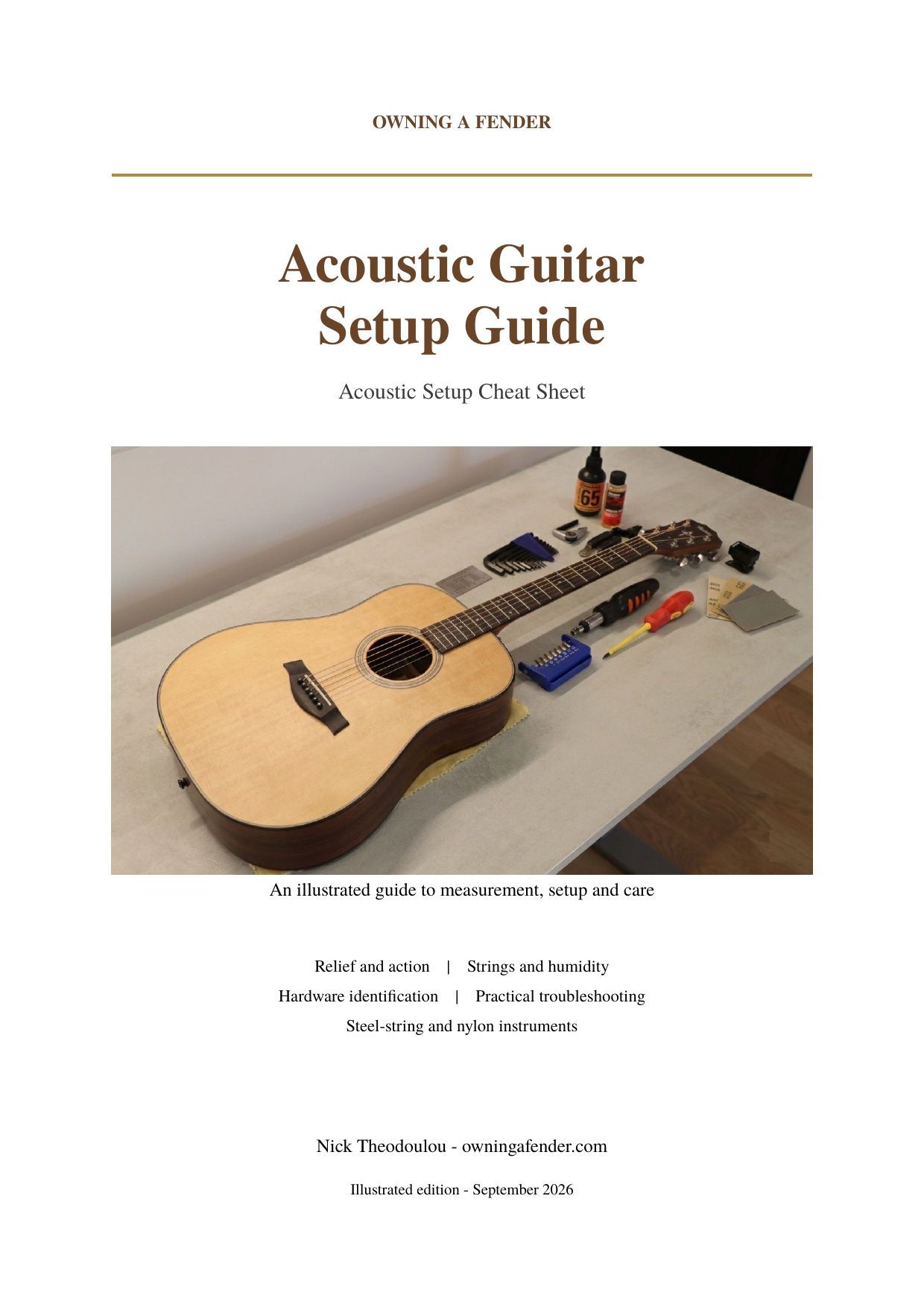
If your diagnosis says the job is in the DIY column, the Acoustic Setup Cheat Sheet gives you the rest of the workflow in printable form — the setup order, the saddle math, a Buzz Map for tracing rattles, and log sheets so next season's check takes minutes. It won't re-shim an NT neck, and it won't pretend to: that's what Taylor service is for.
FAQ
How often should I set up my Taylor guitar?
Most Taylors benefit from a setup check every 6–12 months, or whenever the season changes. If you play daily, travel often, or live in a climate with big humidity swings, check relief and action every 3–4 months.
What is the correct action height for a Taylor guitar?
Taylor doesn't publish one universal 12th-fret action number — it defines factory geometry by neck angle and saddle height (1/8" bass / 1/16" treble above the bridge). Many techs use roughly 2.0 mm high E / 2.5 mm low E at the 12th fret as a comfortable medium-action reference on a Taylor. Measure yours, log it, and adjust by preference within the saddle limits.
How do I adjust the truss rod on a Taylor?
Conventional steel-string Taylors use peghead access beneath the truss-rod cover and a matching Taylor wrench or 1/4-inch thin-walled nut driver. Some older nylon models use soundhole access, so identify yours first. Follow the owner relief check: hold frets 1 and 14 and inspect the gap at fret 6. Make only small, justified adjustments, retune and recheck; stop if the nut resists.
Why does my Taylor buzz in winter?
Winter dryness lowers humidity, which can sink the top and flatten or back-bow the neck. The fix is humidifying the guitar first — then checking relief and action once it stabilizes. Never adjust a dried-out guitar to spec; per Taylor's own guidance, that's the path to real damage.
Can I lower the action on my Taylor by sanding the saddle?
Yes, within limits. Sand the bottom of the saddle only, using the 2:1 ratio — removing 1/32" from the saddle lowers 12th-fret action by 1/64". If you need to remove more than 1/32" on the treble side or 1/16" on the bass side, Taylor says the correct fix is a neck angle adjustment, not more sanding.
What humidity level is best for a Taylor guitar?
Taylor builds at 46% RH and recommends 45–55% relative humidity as the optimal range (40–60% acceptable). Below 40% risks cracks and fret sprout. Above 60% can cause swelling and glue issues.
What strings come on a Taylor from the factory?
Current Taylors ship with D'Addario XS Phosphor Bronze strings — light .012–.053 on many models. Check your specific model: the GS Mini, for instance, is designed around medium .013–.056 gauge. Older Taylors shipped with Elixir strings before the switch.
How do I know if my Taylor nut slots are too high?
With the neck straight, saddle correct, and the guitar tuned to pitch, measure the gap between each string and the top of the 1st fret. Taylor's factory spec is .019" on the high E up to .024" on the low E. A large gap, stiff open chords, or sharp first-position notes point to high slots.
What is the Taylor NT neck, and why does it matter for setup?
The NT (New Technology) neck is Taylor's patented bolt-on neck joint, introduced in 1999. Its neck angle is adjusted with precision shims — accurately and reversibly — so geometry problems that mean an expensive neck reset on other acoustics are a routine service job on a Taylor. The newest Action Control Neck (2025–) goes further, letting string height be micro-adjusted with a 1/4" nut driver without removing the neck.
Does switching string gauge require a setup?
Re-check relief, action and intonation after any gauge change. Different string tension can change the setup, but a measurement and play test should decide whether adjustment is needed; there is no universal one-gauge threshold.
What tools do I need for a Taylor setup?
Minimum: capo, feeler gauges, string action gauge, Taylor truss rod wrench or 1/4" thin-walled nut driver, sandpaper for saddle work, and a reliable tuner. A digital hygrometer is essential — humidity is step one of any Taylor setup.
Conclusion
A great Taylor guitar setup follows Taylor's own order: stabilize humidity at 45–55% RH, tune to pitch, check for a nearly straight neck using the same measurement method each time, verify neck angle against the bridge, then — and only then — adjust the saddle (within its 1/8"/1/16" factory height) and the nut (.019"–.024"). Work in that sequence and most Taylors will feel and sound noticeably better without a service visit; know the sequence and you'll also know exactly when a visit is the right call.
Ready to document what you own? Use our Guitar Price Estimate to get a market-value report for your Taylor, or upgrade to the Premium Valuation & Documentation Report for a deeper comparable analysis and printable spec sheet.
🛠️ Done with this setup? Log the spec — action, relief, strings — in My Gear Garage so you remember exactly what you did in six months. Free, no password — magic-link sign-in.
Keep reading
Next for your Acoustic
- Same guitarAcoustic Guitar Humidity: What to Check When Action ChangesRead
- Same guitarAcoustic Guitar Action Height: Measure Before You AdjustRead
- Same guitarAcoustic Guitar Truss Rod Adjustment: Measure FirstRead
Everything for your Acoustic
Open the hub