Fender Bridge and Tremolo Identification Guide
Identify Fender bridges and tremolos by sight and measurement. Learn the differences between synchronized, vintage six-screw, two-point, Tele, Jazzmaster, and hardtail bridges.
Fender Bridge and Tremolo Identification Guide
Fender bridge and tremolo identification is one of the fastest ways to narrow down the year, model, and originality of a Fender guitar. The bridge is more than a string anchor; it is a fingerprint that changed with almost every major Fender era. A six-screw vintage synchronized tremolo, a two-point American Standard unit, a three-saddle Tele ashtray, and a floating Jazzmaster tremolo all tell different stories about where and when a guitar was built.
Whether you are shopping for a vintage Stratocaster, authenticating a partscaster, or ordering replacement saddles, this guide will teach you to recognize Fender bridges and tremolos by sight, by measurement, and by the hardware details that matter most. If you are also trying to date the guitar, start with the free Fender serial number decoder first, then come back here to see whether the bridge matches that era.
Why the Bridge Matters for Identification
The bridge is one of the least-changed original parts on a used Fender. Pickups get swapped, necks get replaced, and finishes get refinished, but the bridge plate often survives with its factory stampings, screw pattern, and wear marks intact. That makes it a reliable reference point.
Different Fender models and eras used distinct bridge designs. Pre-CBS Strats carried a six-screw vintage synchronized tremolo. The two-point system arrived in the 1980s. Telecasters moved from three-saddle ashtray bridges to six-saddle modern plates. Offset models gained their own floating tremolo systems. Combined with the serial number, neck date, hardware, and decal, the bridge becomes a powerful piece of evidence.
The Synchronized Tremolo
The synchronized tremolo is the iconic Fender vibrato system. Introduced on the Stratocaster in 1954, it uses a pivoted bridge plate and six saddles that move together when the arm is pushed or pulled. The inertia block and spring claw return the strings to pitch.
Vintage Six-Screw vs Modern Two-Point
A vintage six-screw synchronized tremolo has six wood screws passing through the front of the bridge plate directly into the body. These units were standard on pre-CBS and CBS-era Strats and on most vintage reissues. The bridge plate is roughly 3 inches long by 2-1/2 inches wide, with a string spacing of 2-7/32 inches (56.4 mm).
A modern two-point synchronized tremolo uses two large pivot studs instead of six screws. Fender introduced this design on the American Standard line in the 1980s. The pivot studs are typically spaced 2-1/16 inches (52.4 mm) apart, with matching string spacing. The plate is slightly smaller and more rounded than the vintage plate.
| Feature | Vintage Six-Screw | Modern Two-Point |
|---|---|---|
| Mounting | Six wood screws | Two pivot studs |
| String spacing | 2-7/32" (56.4 mm) | 2-1/16" (52.4 mm) |
| Saddles | Stamped or bent steel | Block or bent steel |
| Common era | 1954–early 1980s | 1980s–present |
Saddle Styles
Stamped steel saddles were common on 1950s and early 1960s Strats. Bent steel saddles appeared later and remain standard on vintage reissues. Block saddles are solid chunks of metal and are standard on modern American Standard and Professional lines. Original saddles usually match the bridge plate in age and patina, so a worn vintage plate with shiny new block saddles signals a modification.
For more vintage Strat hardware details, see our vintage Stratocaster identification guide.
Telecaster Bridges
The Telecaster bridge is one of the most recognizable pieces of guitar hardware, and it has more variations than many players realize.
Three-Saddle Vintage Ashtray
The original Tele bridge has three brass or steel saddles, each serving two strings. This is the classic "ashtray" bridge because of the removable metal surround. Vintage three-saddle bridges have a string spacing of 2-7/32 inches (56.4 mm) and a plate roughly 3-1/4 inches long by 3 inches wide.
Because each saddle carries two strings, intonation is a compromise. Many players upgrade to compensated saddles, which have angled or notched tops to improve intonation while keeping the vintage look.
Six-Saddle Modern Bridges
Modern Telecasters often use six individual saddles for more accurate intonation. These became common in the 1980s and are standard on many American Standard and Player models. The string spacing is usually 2-1/16 inches (52.4 mm).
Top-Loader vs String-Through
A string-through-body Telecaster has six holes drilled through the body, with strings passing from the back up over the saddles. A top-loader has string holes on the back edge of the bridge plate itself. Top-loaders tend to feel slinkier and are common on some budget models and vintage-style reissues. Flip the guitar over: if there are no ferrules on the back, the strings load through the plate.
For more Tele-specific markers and values, see our vintage Telecaster identification guide and Fender Telecaster value guide.
Offset and Student Model Bridges
Fender's offset-body and student-model guitars used bridge designs completely different from the Strat synchronized tremolo.
Jazzmaster and Jaguar Floating Tremolo
The Jazzmaster introduced a floating tremolo in 1958, and the Jaguar adopted it in 1962. The tremolo plate mounts near the strap button, and a single arm controls a tailpiece that rocks against a lock button. The bridge is a rocking bridge with threaded saddles on two height-adjustable posts. String spacing is typically 2-3/16 inches (55.6 mm), and the radius is usually 7.25 inches to match vintage fingerboards.
Mustang, Duo-Sonic, and Musicmaster
The Mustang, Duo-Sonic, and Musicmaster used a small floating bridge with two angled posts and threaded saddles. These student-model bridges are easy to identify by their small footprint and top-loading strings. String spacing is usually around 2 inches (50.8 mm).
Dynamic Vibrato
The Dynamic Vibrato is a less common 1960s Fender system found on some Jaguars and Jazzmasters. It combines the bridge and vibrato into one cast unit with a long curved tailpiece. If you see a Jaguar with a one-piece bridge-and-tail unit instead of the standard rocking bridge plus separate tremolo plate, you are looking at the Dynamic Vibrato.
Hardtail Bridges
Not every Fender has a tremolo. Hardtail bridges appear across the line and help confirm model variants.
A Stratocaster hardtail uses a fixed metal plate with six individual saddles and no vibrato rout in the body. The plate is smaller than a Tele bridge plate and lacks the Telecaster's angled sides. A Telecaster hardtail usually refers to six-saddle fixed bridges or top-loading designs found on modern Tele Deluxe and contemporary models. Bass bridges are larger, with four saddles on Precision Bass and four narrow saddles on Jazz Bass.
How to Measure and Identify a Fender Bridge
The fastest confirmation comes from three measurements: string spacing, mounting spacing, and saddle count.
Measure the distance from the center of the low-E saddle to the center of the high-E saddle. Compare it to the common Fender spacings:
- 2-7/32 inches (56.4 mm) — vintage Strat, vintage Tele, many reissues
- 2-1/16 inches (52.4 mm) — modern Strat, modern Tele
- 2-3/16 inches (55.6 mm) — Jazzmaster and Jaguar
- 2 inches (50.8 mm) — Mustang, Duo-Sonic, Musicmaster
For tremolo bridges, measure the distance between the outer mounting screws on a six-screw unit, or between the two pivot studs on a two-point unit. Vintage six-screw plates span roughly 2-7/32 inches, while modern two-point studs are 2-1/16 inches apart. Count the saddles: three almost always means a vintage-style Tele, while six usually means a modern Fender or Strat-style unit. A small ruler or digital caliper is enough; if the bridge is missing, the screw holes in the body still reveal the original spacing.
Era Clues: Pre-CBS, CBS, and Modern
The bridge helps confirm the broad era when combined with other features.
Pre-CBS (1954–1964) Strats used the six-screw vintage synchronized tremolo with stamped steel saddles. Teles used the three-saddle ashtray bridge with brass saddles. Jazzmasters used the floating tremolo and rocking bridge from 1958 onward. See our pre-CBS Fender serial number guide for dating details.
CBS era (1965–1985) kept most designs intact, though late-CBS Stratocasters sometimes have heavier tremolo blocks. Teles stayed three-saddle on most models, with six-saddle versions appearing toward the end. The bridge itself did not change as dramatically as neck plates and headstocks. See our CBS-era Fender serial number guide.
Modern (1986–present) brought the two-point tremolo, six-saddle Tele bridges, high-mass bass bridges, and many aftermarket options. When a vintage-correct guitar has a modern bridge, it is usually a replacement.
Replacement Bridges and Value Impact
A swapped bridge is one of the most common Fender modifications. Common replacements include Callaham vintage-style tremolos, Gotoh modern tremolos, Mastery bridges for offsets, and compensated brass Tele saddles. These are high-quality parts, but they are not original.
On a vintage collectible, originality matters. A pre-CBS Stratocaster with its original six-screw tremolo and stamped steel saddles is worth more than the same guitar with a modern two-point unit. The impact is smaller on player-grade instruments. Check for extra screw holes, fresh finish around the bridge plate, or mismatched saddle patina. If something looks off, use our Fender authenticity check for a structured review.
Setup Tips
Once identified, the bridge needs to be set up correctly. A vintage six-screw Strat tremolo usually floats about 1/8 inch (3 mm) off the body at the rear, or is decked flush for stability. A two-point tremolo can be floated or decked using the pivot studs and spring claw tension.
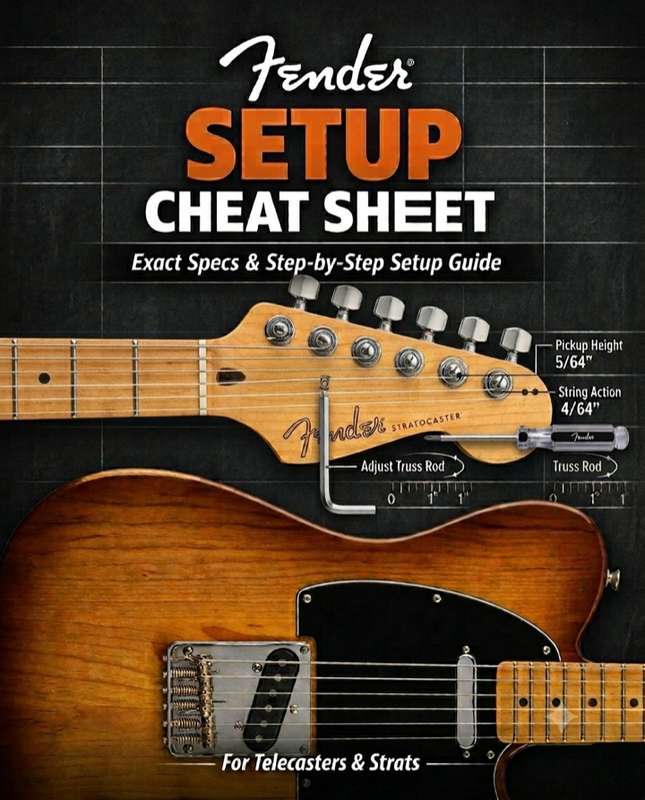
Telecaster three-saddle bridges need the saddles angled so the bass-side saddles sit slightly farther back than the treble-side saddles. On a six-saddle Tele, each saddle is adjusted individually like a Strat. For exact factory measurements, use the Setup Specs Lookup or the Fender Setup Guide.
Internal Links and Next Steps
- Fender Serial Number Lookup — Decode any Fender or Squier serial instantly
- Fender Authenticity Check — Free red-flag checklist for suspicious guitars
- Pre-CBS Fender Serial Numbers — 1954–1964 dating and value guide
- CBS-Era Fender Serial Numbers — 1965–1985 dating and value guide
- Vintage Stratocaster Identification — Visual markers by era
- Vintage Telecaster Identification — Visual markers by era
- Fender Stratocaster Value Guide — Market values by year and condition
- Fender Telecaster Value Guide — Market values by year and condition
- Fender Neck Date vs Serial Number — How to read and reconcile body dates
- Fender Setup Guide — Printable factory specs by model and era
FAQ
What is a Fender synchronized tremolo?
A Fender synchronized tremolo is the vibrato system introduced on the Stratocaster in 1954. It uses a pivoted bridge plate, six saddles, a steel inertia block, and a spring claw to return the strings to pitch after the vibrato arm is moved.
How do I tell a vintage Strat tremolo from a modern one?
A vintage Strat tremolo has six wood screws through the front of the bridge plate and string spacing of 2-7/32 inches. A modern two-point tremolo uses two pivot studs and string spacing of 2-1/16 inches.
What is the difference between a three-saddle and six-saddle Tele bridge?
A three-saddle Tele bridge has one saddle per pair of strings and is the original vintage design. A six-saddle Tele bridge gives each string its own saddle for more accurate intonation and is common on modern Teles.
What is the string spacing on a vintage Fender bridge?
Vintage Stratocaster and Telecaster bridges usually have a string spacing of 2-7/32 inches, or about 56.4 mm. Jazzmaster and Jaguar rocking bridges are close at 2-3/16 inches. Mustang, Duo-Sonic, and Musicmaster bridges are narrower, around 2 inches.
How do I identify a Jazzmaster tremolo?
A Jazzmaster tremolo has a floating tailpiece near the strap button, a lock button, and a single vibrato arm. The bridge is a rocking bridge with threaded saddles on two height-adjustable posts.
What is a hardtail Stratocaster bridge?
A hardtail Stratocaster bridge is a fixed bridge plate with six individual saddles and no vibrato mechanism. The body lacks the large tremolo rout found behind a standard Strat bridge.
Does a replaced bridge lower the value of a vintage Fender?
Yes, a replaced bridge usually lowers the value of a vintage collectible Fender because originality is a major value driver. The impact is smaller on player-grade instruments or guitars with other modifications.
What tools do I need to measure a Fender bridge?
A small metal ruler or digital caliper is enough. Measure string spacing from the center of the low-E saddle to the center of the high-E saddle. For tremolo bridges, also measure the distance between mounting screws or pivot studs.
What is the screw spacing on a vintage Strat tremolo?
The outer mounting screws on a vintage six-screw Strat tremolo span roughly 2-7/32 inches. The modern two-point pivot stud spacing is 2-1/16 inches.
Can I put a modern two-point tremolo on a vintage Strat?
You can, but it requires drilling new mounting holes because the spacing differs. It also changes tone and collector value. Many players prefer to keep a vintage Strat original.
Conclusion
Fender bridge and tremolo identification is a practical skill that pays off every time you evaluate, buy, sell, or set up a Fender guitar. The bridge tells you about the model, the era, and often the originality of the instrument. A six-screw vintage synchronized tremolo, a three-saddle Tele ashtray, a floating Jazzmaster tailpiece, and a Mustang two-post bridge are all instantly recognizable once you know the measurements.
Start by counting saddles and mounting points. Measure string spacing and post spacing. Compare what you see to the era claimed by the serial number and neck date. If the hardware does not line up, dig deeper before paying a premium. Once the bridge is identified, the next step is setting the guitar up correctly. The Fender Setup Guide puts factory-correct bridge height, action, relief, intonation, and pickup height specs for your exact model on one printable card.