Fender Logo Era Guide: Spaghetti, Transition, and CBS Decals Explained
Decode Fender headstock logos by era. Learn the spaghetti logo, transition logo, CBS-era silver logo, and how decals help date and authenticate a vintage Fender.
Fender Logo Era Guide: Spaghetti, Transition, and CBS Decals Explained
The Fender logo on a headstock is more than decoration. It is a quick-read calendar that can place a guitar within a few years, confirm a serial number, and expose a fake before you finish tuning the low E. Learning to read Fender headstock decals is one of the fastest skills a buyer, seller, or owner can develop.
This guide walks through the three major logo eras used on mass-production Fender electrics from the early 1950s through the mid-1980s: the flowing spaghetti logo of the pre-CBS years, the brief transition logo of the mid-1960s, and the blocky CBS-era silver logo that dominated the 1970s and early 1980s. You will learn what each decal looks like, when it was used, which models carried it, and how to combine decal evidence with serial numbers and hardware for a confident date.
If you are trying to authenticate or value a guitar, start with the free Fender serial number decoder and the Fender authenticity check. Then use this guide to make sure the decal matches the claimed year.
Why the Logo Matters More Than You Think
Fender did not change headstock decals on a predictable annual schedule, but each major logo style maps to a clear chapter in company history. The spaghetti logo covers the Leo Fender years and early CBS transition. The transition logo marks the last months of pre-CBS construction. The CBS logo arrives after 1968 and stays in various forms through the 1980s.
Because decals are waterslide-applied and relatively easy to reproduce, a logo alone cannot prove authenticity. But a logo that conflicts with a serial number or hardware set is a serious red flag. A 1962 serial number with a CBS block logo, for example, is almost certainly wrong. A 1975 serial with a spaghetti logo is equally suspicious. The decal is one line of evidence in a larger story.
Collectors pay close attention to logo era because it tracks the most collectible periods of Fender history. Pre-CBS spaghetti-logo guitars command the highest prices. Transition-logo instruments are desirable because they often combine pre-CBS construction with late-1965 details. CBS-era guitars are more affordable and more common, but clean examples still bring strong money.
The Spaghetti Logo Era (1950 to Mid-1965)
The original Fender logo is nicknamed the spaghetti logo because of its long, flowing, cursive letterforms. It first appeared on Broadcaster, Telecaster, and Esquire models in the early 1950s and remained the standard logo on most Fender electrics through mid-1965.
What the Spaghetti Logo Looks Like
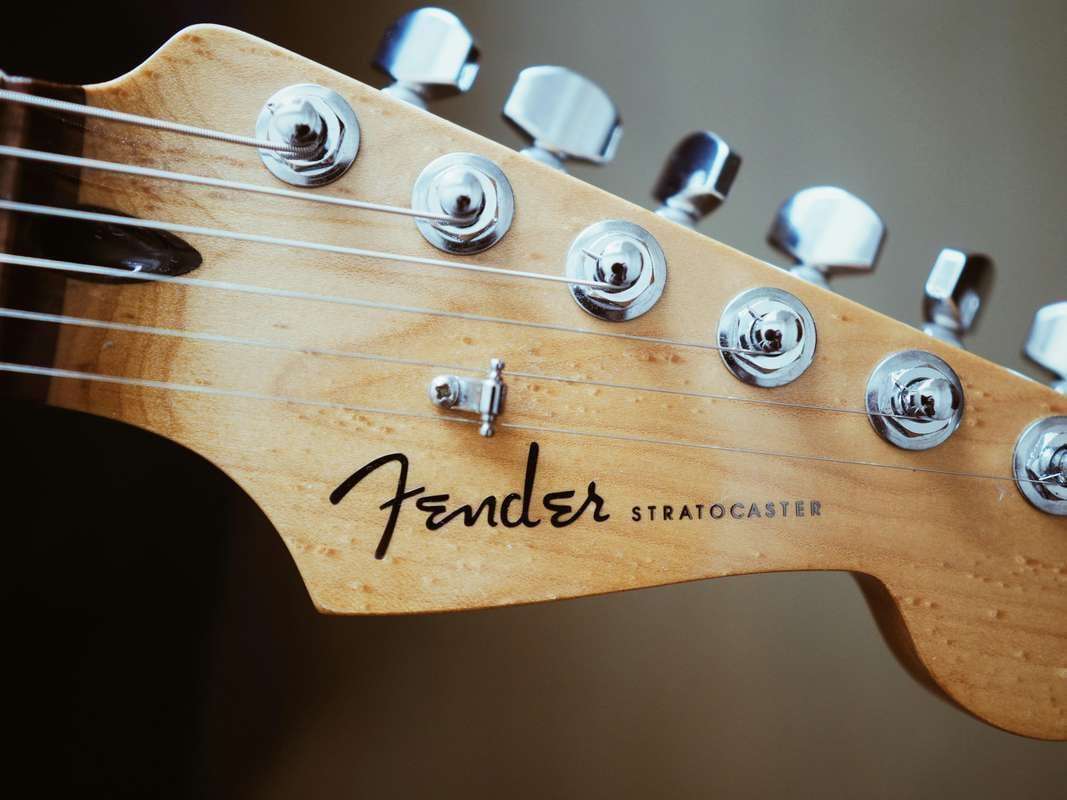
The spaghetti logo spells out "Fender" in a thin, connected script with exaggerated horizontal strokes. The tail on the capital F sweeps under most of the word. The letters are gold or yellow when new, though age and lacquer yellowing can shift the color toward amber or brown. The decal sits on the headstock face, usually centered below the tuners.
On most USA guitars, the spaghetti logo carried a small "®" registered-trademark symbol near the tail of the final "r." Some very early 1950s examples did not have the registered mark, but by the mid-1950s it was standard. The absence of the ® on a guitar that should have it can indicate a reproduction decal.
Country-of-Manufacture Stamps
Spaghetti-logo Fenders were built in Fullerton, California, and the headstock usually advertised that fact. The most common stamp under the spaghetti logo reads "WITH SYNCHRONIZED TREMOLO" on Stratocasters or "ORIGINAL Contour Body" on early Stratocasters. On Telecasters, Esquires, and other models, a "MADE IN U.S.A." stamp often appeared in small block letters near the bottom edge of the headstock face.
The exact placement and wording of these secondary stamps changed over time. Pre-CBS Stratocasters from the late 1950s and early 1960s often carried two or three lines of small text below the logo. These stamps are part of the era signature, not afterthoughts.
Models That Used the Spaghetti Logo
Nearly every classic Fender electric carried the spaghetti logo during this era:
- Telecaster, Esquire, Broadcaster — from the early 1950s onward
- Stratocaster — from 1954 introduction through mid-1965
- Jazzmaster — from 1958 introduction through mid-1965
- Jaguar — from 1962 introduction through mid-1965
- Mustang, Duo-Sonic, Musicmaster — student models through mid-1965
- Precision Bass and Jazz Bass — through mid-1965
If a guitar is supposed to be from 1963 or earlier and it does not have a spaghetti logo, investigate carefully. Reissues, parts guitars, and refins with reproduction decals are the most common explanations.
Spaghetti Logo Subtle Changes
The spaghetti logo was not frozen. Early 1950s examples have a slightly different letter spacing than late-1950s and early-1960s examples. The gold color shifted over time as Fender changed decal suppliers. These differences are subtle, but experienced collectors use them to spot reproductions and place a guitar more precisely within the era.
For a deeper dive into pre-CBS specs and serial numbers, see our pre-CBS Fender serial number guide.
The Transition Logo Era (Mid-1965 to 1968)
The transition logo is exactly what its name suggests: a bridge between the flowing spaghetti script and the bold CBS block logo. It first appeared in mid-1965 and remained in use through roughly 1968, with overlap on either side.
What the Transition Logo Looks Like
The transition logo keeps the cursive "Fender" wordmark from the spaghetti era but adds a thick black outline around the letters. The letterforms are still script-like, but the black border makes the logo look heavier and more graphic than the thin pre-CBS decal. The ® symbol remains, usually in the same position near the tail of the "r."
Some collectors call this the black-outline spaghetti logo or transition decal. The key visual cue is the combination of cursive script with a bold outline. If the letters are outlined in black and still flowing, you are looking at a transition logo.
Secondary Stamps in the Transition Era
Transition-logo guitars often carried the same secondary stamps as late spaghetti-logo guitars, but with subtle changes. Stratocasters commonly show "ORIGINAL Contour Body" and "WITH SYNCHRONIZED TREMOLO" in small block letters. "MADE IN U.S.A." stamps appear near the bottom of the headstock. Because 1965 was a transition year, you will see some guitars with mixed features: a transition logo paired with pre-CBS clay dot inlays, for example, or a transition logo with a three-ply pickguard.
Why Transition Guitars Are Interesting
The transition era captures Fender at a moment of change. CBS purchased Fender in January 1965, but the factory did not switch every spec overnight. Guitars from late 1965 and 1966 often have pre-CBS construction details with CBS-era cosmetics. That combination makes them collectible in their own right.
A 1965 transition-logo Stratocaster with a clay-dot neck, three-ply pickguard, and spaghetti-era hardware is a textbook example. It is not a pre-CBS guitar, but it carries many of the features collectors associate with the golden era. Values for clean transition guitars usually fall between pre-CBS and CBS prices.
For more on dating this boundary period, see our CBS-era Fender serial number guide.
The CBS Logo Era (1968 to Mid-1980s)
The CBS-era logo is the easiest to recognize. It is a bold, blocky "FENDER" in large silver or chrome letters with a black outline. Collectors often call it the silver logo or CBS block logo. It first appeared around 1968 and remained the standard decal on USA Fenders through the mid-1980s.
What the CBS Logo Looks Like
The CBS logo drops the cursive script entirely. The letters are thick, sans-serif, and spaced wide across the headstock. The face of the letters is silver or metallic, and a black outline separates the logo from the headstock finish. The ® symbol appears near the top right of the logo.
On some early CBS-logo guitars, the letters have a slightly thinner weight than later examples. By the 1970s, the logo had settled into its familiar bold form. The logo remained essentially unchanged on most USA models until Fender introduced the modern Stratocaster logo variations in the mid-1980s.
Secondary Stamps and Placement
CBS-era headstocks usually carried a "MADE IN U.S.A." stamp near the bottom edge of the face. Stratocasters kept the "ORIGINAL Contour Body" and "WITH SYNCHRONIZED TREMOLO" text. Telecasters and basses had simpler stamp layouts.
Headstock shape also changed during the CBS era. The large headstock, often called the big headstock or CBS headstock, appeared on Strats and Teles in the late 1960s and grew even larger in the 1970s. If you see a CBS block logo on a small headstock, the guitar is likely from the very beginning of the CBS-logo period or is a reissue.
Models and Years
The CBS logo appeared on nearly every USA Fender electric from 1968 through the early 1980s:
- Stratocaster, Telecaster — 1968 through mid-1980s
- Jazzmaster, Jaguar — late 1960s through discontinuation in the 1970s
- Mustang, Musicmaster, Bronco — student models through the 1970s
- Precision Bass, Jazz Bass — 1968 through mid-1980s
By 1985, when Fender was sold by CBS to a group led by Bill Schultz, the block logo was still in use. The transition to the modern era happened gradually through the late 1980s, not overnight.
Japanese, Mexican, and Modern Logos
Not every Fender headstock follows the USA timeline. Imports and modern guitars use their own decal conventions.
Fender Japan Logos
Japanese Fenders from the 1980s often carried a spaghetti-style logo even when USA guitars had moved to the block logo. Fuji-Gen-built guitars from the early 1980s used JV and SQ serial prefixes with a gold spaghetti-style decal. Later Japanese production used a mix of spaghetti and block logos depending on the model line and export market.
The key identifier on a Japanese Fender is not the logo style but the country stamp. Look for "MADE IN JAPAN," "CRAFTED IN JAPAN," or "MADE IN JAPAN" on the back of the headstock or on the front decal. A spaghetti logo with a "Made in Japan" stamp is almost certainly a 1980s or 1990s Japanese Fender, not a 1960s USA guitar.
Fender Mexico Logos
Mexican-made Fenders from the 1990s onward usually carry a modern block-style logo with a "MADE IN MEXICO" stamp on the back of the headstock. The decal material and finish differ from vintage USA decals. Modern Mexican Standard and Player series logos are crisp and uniform in a way vintage decals rarely are.
Modern USA and Custom Shop Logos
Modern American Standard, American Professional, and Ultra models use a refined version of the CBS block logo. The letters are cleaner, the spacing is consistent, and the finish is polyurethane or polyester rather than nitrocellulose lacquer. Custom Shop guitars can have custom decals, but they are clearly marked as Custom Shop instruments.
How to Use the Logo to Date a Fender
The logo gives you a window. To pin down a year, combine the decal with other evidence.
Step 1: Read the Serial Number
Start with the serial number. It is the factory's primary dating tool. Run it through the Fender serial number decoder to get the most likely year and country. If the serial decodes to 1972 and the guitar has a CBS block logo, everything lines up. If the serial decodes to 1961 and the guitar has a CBS block logo, something is wrong.
Step 2: Check the Logo Against the Serial Year
Use the eras in this guide as a sanity check. Spaghetti logos belong on guitars from 1950 through mid-1965. Transition logos fit mid-1965 through 1968. CBS block logos fit 1968 through the mid-1980s. There is overlap at every boundary, but a mismatch of several years is a red flag.
Step 3: Inspect the Headstock Shape and Stamps
Headstock shape and secondary stamps help narrow the era. Pre-CBS small headstocks with spaghetti logos differ from late-1960s small-transition headstocks and 1970s large CBS headstocks. The "MADE IN U.S.A." stamp location, the Stratocaster tremolo and contour body text, and the finish type all add evidence.
Step 4: Cross-Check Hardware and Features
Pickguard material, fretboard dots, neck profile, bridge type, and tuner brand all changed over the same decades. A 1965 transition logo on a guitar with a thick poly finish, large headstock, and five-screw pickguard is contradictory. For visual checklists by model, see our vintage Stratocaster identification guide and vintage Telecaster identification guide.
Common Decal Scams and Red Flags
Reproduction decals are widely available. A wrong or suspicious decal is one of the fastest ways to spot a problem guitar.
Reproduction Spaghetti Logos on CBS-Era Bodies
The most common decal swap is a reproduction spaghetti logo applied to a 1970s or 1980s body. The seller hopes the buyer sees the classic logo and assumes pre-CBS value. Check the serial number, headstock shape, neck pocket stamps, and hardware. A 1970s three-bolt neck with a spaghetti logo is not a pre-CBS guitar.
Wrong Country Stamp
A "Made in U.S.A." stamp on a guitar with Japanese hardware and serial format is a contradiction. Similarly, a "Made in Japan" stamp on a guitar with USA-style serial numbering and CBS hardware needs explanation. Trust the total picture, not one stamp.
Missing or Misplaced ® Symbol
The registered-trademark symbol is a small detail that reproductions often get wrong. Its position changed over time, but it was present on most USA decals from the mid-1950s onward. A missing ® on a guitar that should have it, or a ® placed in the wrong spot, is a yellow flag.
Decal Under Finish vs Over Finish
On vintage Fenders, the decal sits under the clear finish. The lacquer protects and slightly yellows the decal over time. A decal that sits on top of the finish, or that looks too crisp and new under old lacquer, may be a replacement. Reproduction decals applied over a refinish are especially common on partscasters.
For a structured authenticity checklist, use the Fender fake checker.
Logo Era and Value
The logo era has a direct impact on market value. Pre-CBS spaghetti-logo guitars are the most collectible. Transition-logo guitars occupy the middle ground. CBS-era block-logo guitars are more affordable but still desirable when clean and original.
Pre-CBS Spaghetti Logo Value
Clean pre-CBS Stratocasters, Telecasters, Jazzmasters, and Jaguars with original spaghetti logos command top dollar. A 1962 Stratocaster in excellent condition can sell for tens of thousands of dollars. Even player-grade pre-CBS guitars bring strong prices because the supply is fixed and demand is global.
Transition Logo Value
Transition-logo guitars from 1965 and 1966 are collectible because they bridge two eras. Values are usually lower than equivalent pre-CBS guitars but higher than 1970s CBS examples. A clean 1965 transition-logo Stratocaster with pre-CBS-style features is often a smart buy for collectors who want vintage character without peak pre-CBS pricing.
CBS Logo Value
CBS-era guitars are the most affordable entry point into vintage Fender ownership. A clean 1970s Stratocaster or Telecaster with a CBS block logo can deliver classic Fender tone and feel at a fraction of pre-CBS prices. Values vary widely by year, model, and originality. For current ranges, see the Fender Stratocaster value guide and Fender Telecaster value guide.
The Neck Date Check
Logo evidence is powerful, but it should always be paired with the neck date when possible. The neck heel date records when the neck was produced, and it can confirm or contradict the logo era.
A 1965 transition logo on a neck dated 1964 is normal. Parts crossed calendar boundaries. A 1962 spaghetti logo on a neck dated 1972 is not normal. The neck has been swapped. For full instructions on removing the neck and reading the date, see our Fender neck date vs serial number guide.
Internal Links and Next Steps
- Fender Serial Number Lookup — Decode any Fender or Squier serial instantly
- Fender Authenticity Check — Free red-flag checklist for suspicious guitars
- Pre-CBS Fender Serial Numbers — 1954–1964 dating and value guide
- CBS-Era Fender Serial Numbers — 1965–1985 dating and value guide
- Vintage Stratocaster Identification — Visual markers by era
- Vintage Telecaster Identification — Visual markers by era
- Fender Neck Date vs Serial Number — How to read and reconcile both dates
- Fender Stratocaster Value Guide — Market values by year and condition
- Fender Telecaster Value Guide — Market values by year and condition
- Fender Setup Guide — Printable factory specs by model and era
FAQ
What is the Fender spaghetti logo?
The spaghetti logo is the original flowing cursive Fender script used from 1950 through mid-1965. It gets its nickname from the long, thin, connected letterforms. Pre-CBS Fenders with original spaghetti logos are the most collectible.
When did Fender change from the spaghetti logo to the transition logo?
Fender began using the transition logo around mid-1965. The transition logo keeps the cursive script but adds a bold black outline. It remained in use through roughly 1968, overlapping with the final spaghetti-logo guitars and the first CBS block-logo guitars.
What does the Fender CBS logo look like?
The CBS-era logo is a bold, blocky "FENDER" in silver or chrome letters with a black outline. It appeared around 1968 and remained standard on USA Fenders through the mid-1980s. Collectors often call it the silver logo or CBS block logo.
Can a 1970s Fender have a spaghetti logo?
No. A genuine 1970s USA Fender should have the CBS block logo. A 1970s guitar with a spaghetti logo likely has a reproduction decal, a replacement neck from an earlier era, or is a partscaster. Always verify with the serial number and hardware.
Are Japanese Fenders from the 1980s stamped "Made in Japan"?
Yes. Japanese Fenders from the 1980s usually carry a "MADE IN JAPAN" or "CRAFTED IN JAPAN" stamp, often on the back of the headstock. Some Japanese models used a spaghetti-style logo, so the country stamp is the key identifier.
How do I spot a fake Fender decal?
Look for mismatches: wrong logo era for the serial year, missing or misplaced ® symbol, decal sitting on top of the finish instead of under it, colors that are too crisp or too modern, and secondary stamps that do not match the claimed era. When in doubt, use the Fender authenticity check.
Which Fender logo era is most valuable?
The pre-CBS spaghetti-logo era is the most valuable. Clean 1950s and early-1960s Fenders with original decals command the highest prices. Transition-logo guitars from 1965–1966 are the next tier, followed by CBS-era block-logo guitars from 1968 onward.
Do all Stratocasters have the same headstock logo?
No. Stratocasters have carried the spaghetti logo, transition logo, and CBS block logo at different times. Modern Strats use a refined block logo. Reissues and signature models can use era-correct decals regardless of production year.
What secondary stamps should appear under a Fender logo?
Common secondary stamps include "WITH SYNCHRONIZED TREMOLO," "ORIGINAL Contour Body," and "MADE IN U.S.A." The exact wording and placement changed by era and model. Stratocasters usually carried tremolo and contour body text; Telecasters and basses had simpler layouts.
How do I date a Fender using the logo?
Match the logo style to its era, then cross-check with the serial number, headstock shape, secondary stamps, neck date, and hardware. Start with the Fender serial number decoder and use this guide to confirm the decal fits the decoded year.
Conclusion
Reading a Fender headstock logo is one of the fastest ways to place a guitar in time. The spaghetti logo points to the pre-CBS golden era, the transition logo marks the 1965–1968 handoff, and the CBS block logo covers the 1970s and early 1980s. Each decal carries its own value profile, its own authentication cues, and its own set of reproduction red flags.
Start by identifying the logo style. Then run the serial number through the Fender serial number decoder, inspect the headstock stamps and shape, and remove the neck to check the date if necessary. Cross-check everything against the hardware and finish. If anything conflicts, pause and investigate before assigning a value.
Once the guitar is dated and authenticated, the next step is making it play its best. The Fender Setup Guide collects factory-correct action, relief, intonation, and pickup height specs for your exact year and model on one printable page.